

Shibuya Sky (渋谷スカイ) puts each day’s tickets on sale at 00:00 Japan time exactly two weeks ahead, and the slot that goes first is the one that gets you onto the roof about 50 minutes before sunset. That ticket costs an adult ¥3,400 online in late 2026, because every sunset in Tokyo falls after 15:00, which is when the price steps up from ¥2,700. In December the slot to book is the 15:40 entry; in June it is 18:00.
Set the alarm for the moment your date opens, in your own time zone, and book on the operator’s official ticket page. The window on the 14th floor sells the same slots for ¥300 more, but once adult tickets sell out online the window is sold out too. If the sunset slot has gone, I’d take a slot after 19:00, when the searchlights on the roof run every half hour, or an entry before 15:00 on a clear winter day, which is ¥700 cheaper and the likeliest time to see Mount Fuji.

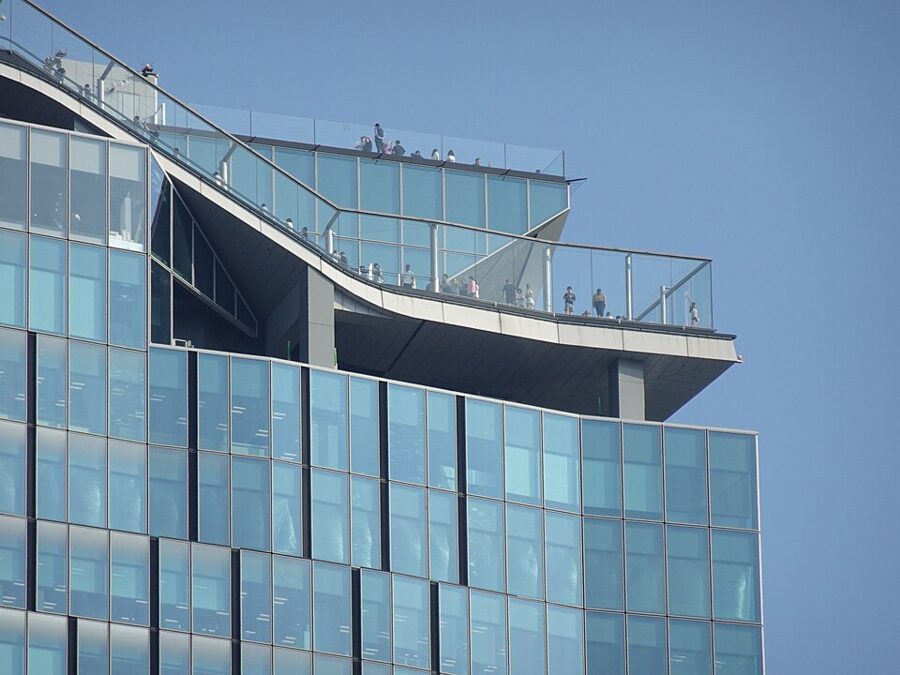
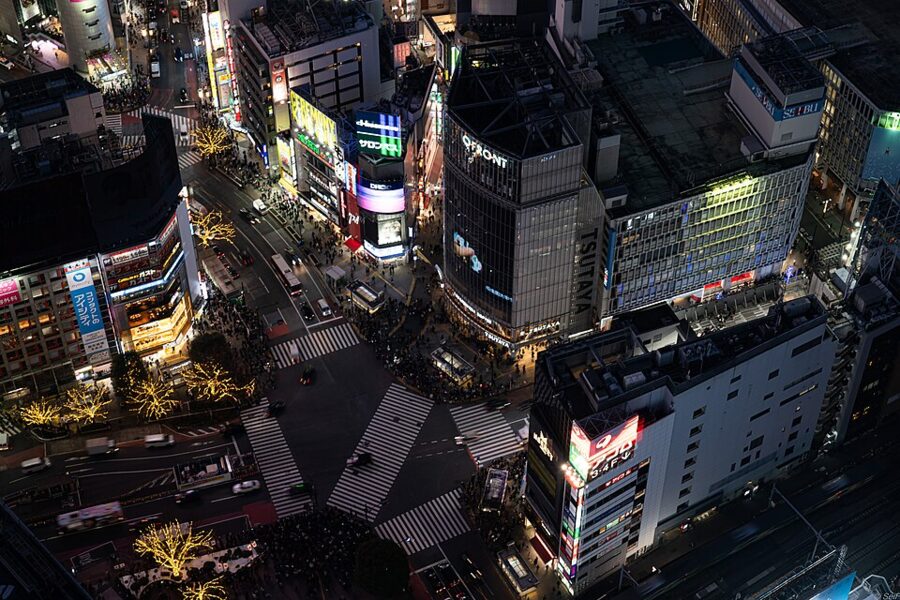
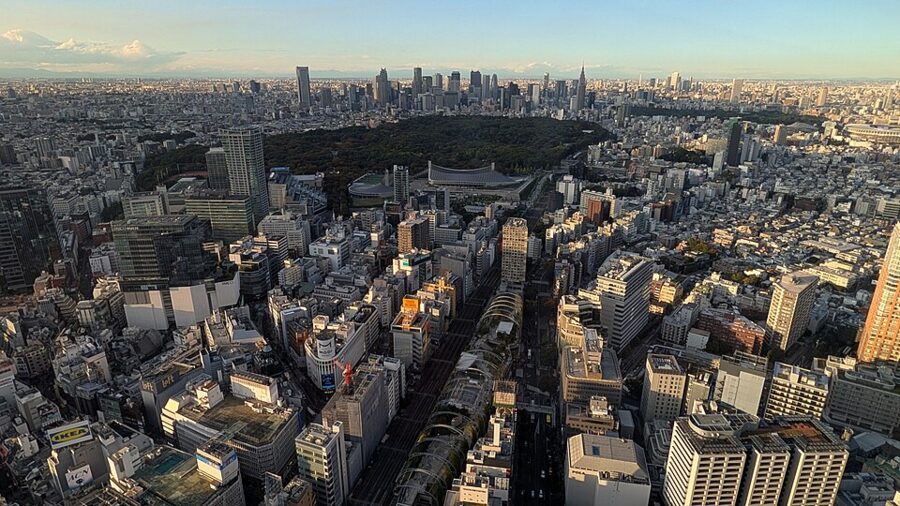
The deck is the open-air roof of Shibuya Scramble Square, the 47-floor tower that rose over Shibuya Station and opened on November 1, 2019. It stands 229 m above the streets of Shibuya, directly over the platforms, so you look down on the Scramble Crossing rather than across at it. The tower was built by the three railways that meet underneath it, Tokyu, JR East and Tokyo Metro.

Nobody hurries you down. The ticket fixes only the 20 minutes in which you walk through the gate, and you can stay until closing at 22:30, so a sunset slot is also a dusk slot and a night slot. Most of what goes wrong on the day comes from three things that have nothing to do with the view: the wind, the locker rules and, from November 19, 2026, the passport check at the gate.

What it costs in late 2026
Since April 2025 the price has depended on the hour you walk in. These are the operator’s figures on its ticket page in November 2026, tax included. “Adult” covers everyone aged 12 and over, junior and senior high school students included.
| Ticket | Online | 14th-floor window |
|---|---|---|
| Adult, entry until 14:59 | ¥2,700 | ¥3,000 |
| Adult, entry from 15:00 (every sunset slot) | ¥3,400 | ¥3,700 |
| Child, ages 6–11 (and 12-year-olds still in elementary school) | Not sold online | ¥1,200, on the day |
| Age 5 and under (and 6-year-olds not yet at school) | Free | Free |
Opening hours are 10:00–22:30, with last entry at 21:20; the window on the 14th floor sells from 10:00 to 21:20. The deck closes for normal business on New Year’s Day and can close early or shut for the day at short notice, which the operator posts on its own site. There is no time limit inside and no re-entry once you leave.
The two-band price changes the arithmetic of a visit. A sunset ticket at ¥3,400 costs more than the ¥3,300 online Top Deck Tour at Tokyo Tower, which takes you 250 m up, and twice as much as the tower’s ¥1,500 Main Deck. What the extra buys is the open air and the crossing under your feet.
How the tickets work
Two weeks ahead, in 20-minute slots
Every ticket is for a date and a 20-minute entry window: 14:00–14:19, 14:20–14:39, and so on through the day. According to the operator’s FAQ, each date goes on sale at 00:00 Japan time two weeks before it, online and at the window alike. That is 15:00 the previous afternoon in London and 10:00 the previous morning in New York in winter.
Sunset sells first, and on a busy date it can go soon after release. A sold-out slot is not always final: the FAQ notes that other buyers’ cancellations put tickets back on sale, marked as available again, so checking back over the following days is worth it. If you add people to a booking later, you can buy more tickets for the same slot only while it still has some left.
Two shops, and the passport rule
For entries from November 19, 2026, the official site sells through two separate shops: one for residents of Japan, in Japanese only, and one marked for international customers. The difference matters at the gate. Japan-resident tickets arrive as QR codes, one per person, emailed to the buyer; the group either prints them or walks through together while the buyer scans each code in turn.
Tickets from the international shop, and from the operator’s authorized overseas resellers, are checked against passports instead. Everyone in the group must bring their own original passport, the details must match what was entered at booking, and the QR code alone will not get you in. Forget a passport and you may be turned away.
The operator lists its authorized sellers on the FAQ, dated September 1, 2026, and says tickets from anyone else are void. It names two Chinese resale marketplaces whose tickets it refuses, and warns that persistent touts may be reported to the police. Tickets from its other authorized agents, which include rail and tour packages, are exchanged for a paper ticket at the 14th-floor window.
Children, the window and sold-out days
Children’s tickets are sold only at the 14th-floor window, on the day, with the child present, and they are sold even when the slot is sold out. Every child of 11 and under has to come in with a guardian holding a ticket. In practice a family books the adult tickets online for the slot it wants and pays for the children at the window just before going in.
Adults cannot do the same. The FAQ is blunt that once adult tickets are sold out online, the window has none for that slot either, and turning up on the day does not change it. The window is a fallback for a quiet weekday, not a plan for a sunset in November.
Cancelling, changing and arriving late
Web tickets covered by the cancellation service can be cancelled free until the day before your visit, from the booking page of the ticket site. Cancellation works on the whole payment: five tickets bought together can be cancelled as five, never as three. Window tickets cannot be cancelled at all, and no ticket can be moved to another date or time, so a change means cancelling and buying again.
On the day itself the only free cancellation is when the roof is closed at your entry time, covered below. Arriving early does not help; you enter within your 20 minutes. Arrive late and staff may hold you until a slot they choose or refuse entry, and if that slot falls in the dearer band you pay the difference. Nobody gets in after 21:20.
Discounts, such as they are
There is no group rate. Holders of a Japanese disability certificate buy a normal ticket and get half the price refunded at the 14th-floor window on the day, for themselves and one companion. The annual pass, the SHIBUYA SKY PASSPORT, has its new sales suspended as of November 2026; renewals continue.
The floors, from the 14th to the roof
The operator’s floor guide divides the deck into three zones: Sky Gate, the ride from the 14th floor to the 45th; Sky Gallery, the indoor corridor on the 46th; and Sky Stage, the roof. You see them in that order, the roof last.
14th floor: the gate
The ticket window and the entrance gate are on the 14th floor of Shibuya Scramble Square, above the shops and restaurants that fill the floors below it. Staff and guards check bags at the gate. Free Wi-Fi (SHIBUYA-Wi-Wi-Fi) works on the 14th floor and from the 45th floor up, in two-hour sessions you can restart as often as you like, and the window rents phone batteries through the ChargeSPOT app.
Sky Gate: the ride up
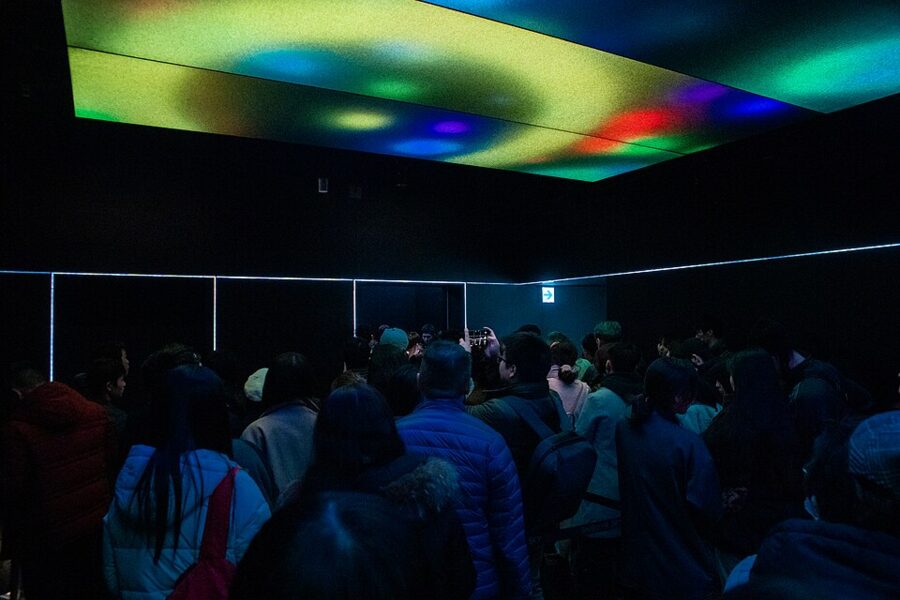
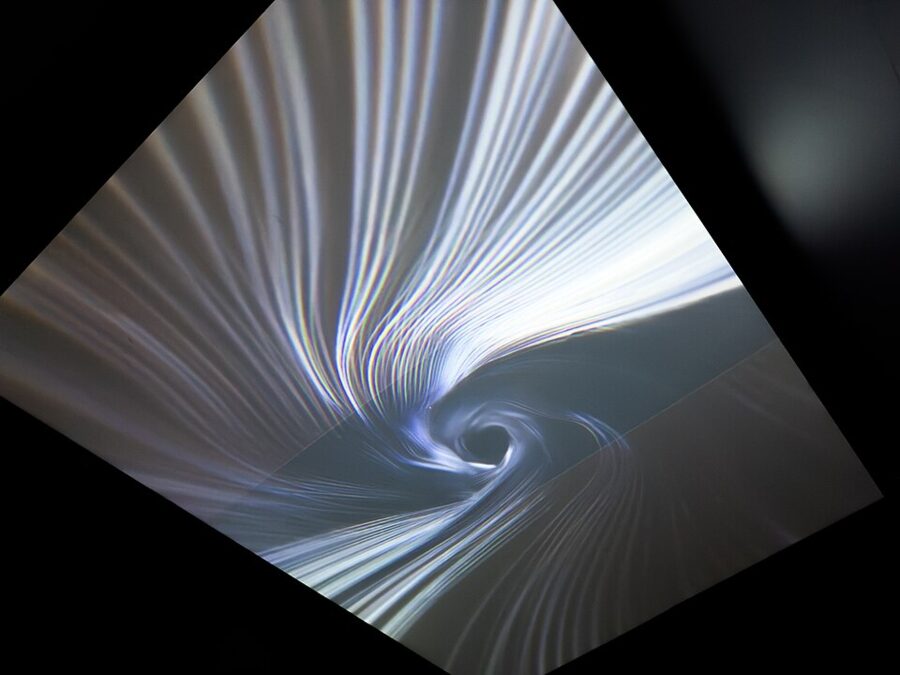
Sky Gate starts with a darkened room where lines of light and a ceiling projection open the climb. The elevator itself, which the operator calls the Transition Pod, plays a projection on its ceiling and directional sound for the climb from the 14th floor to the 45th. A line of light, the Leading Line, then guides you on toward the open air.



Sky Stage: the roof
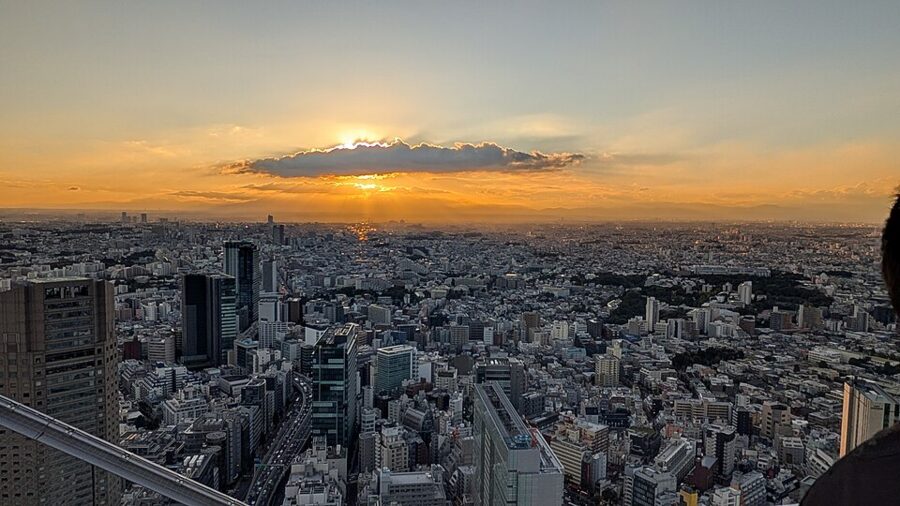
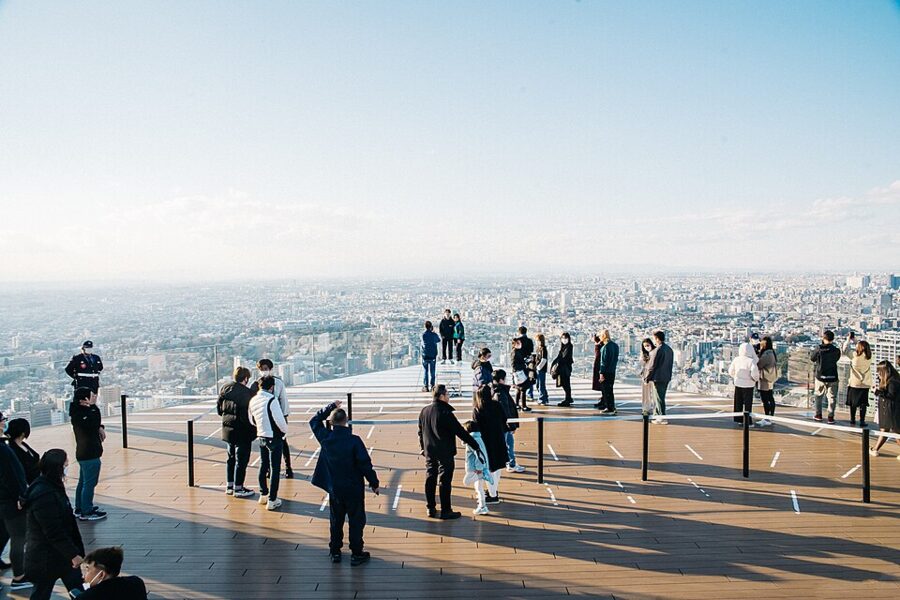
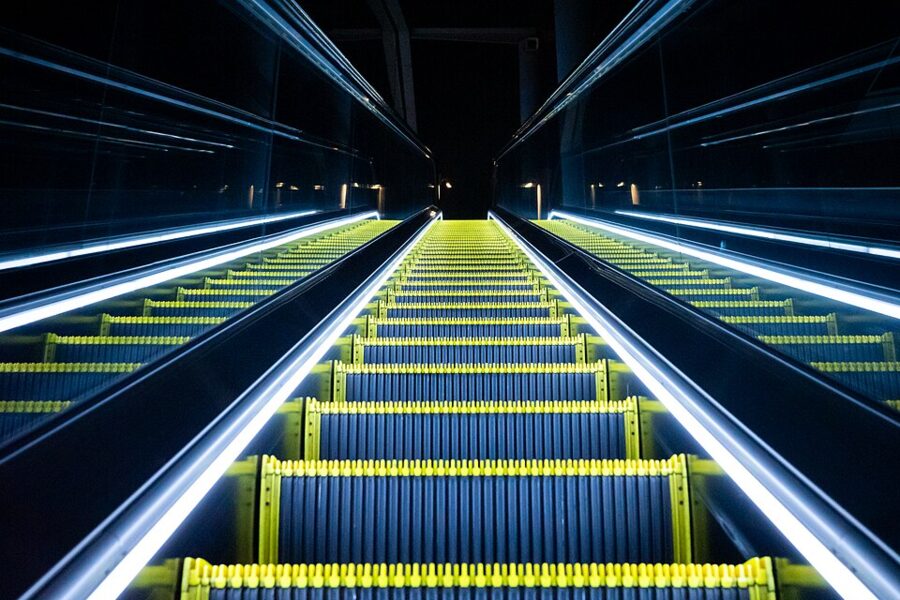
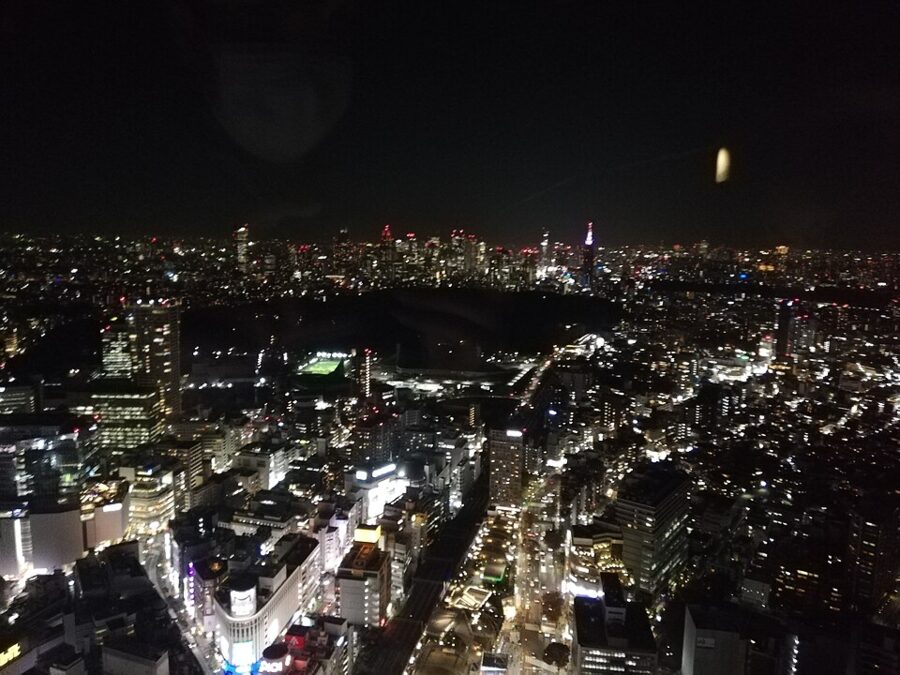
Escalators climb from the 46th floor to Sky Stage, an open deck around the top of the tower. The edge is a glass wall with nothing above it. Shibuya ward spreads out below, the towers of Shinjuku stand 3.6 km to the north, Tokyo Tower is 3.9 km due east and Skytree is 11.4 km to the northeast.
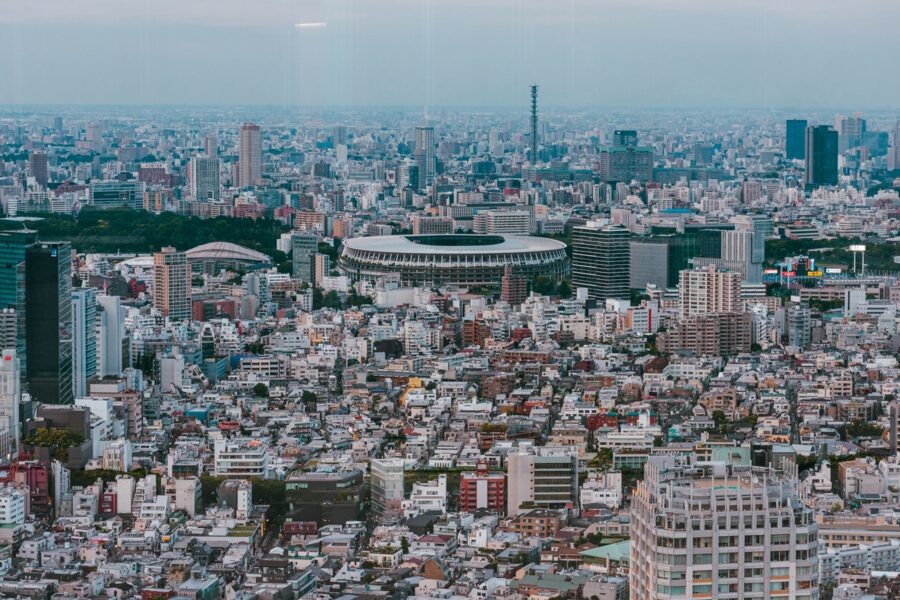
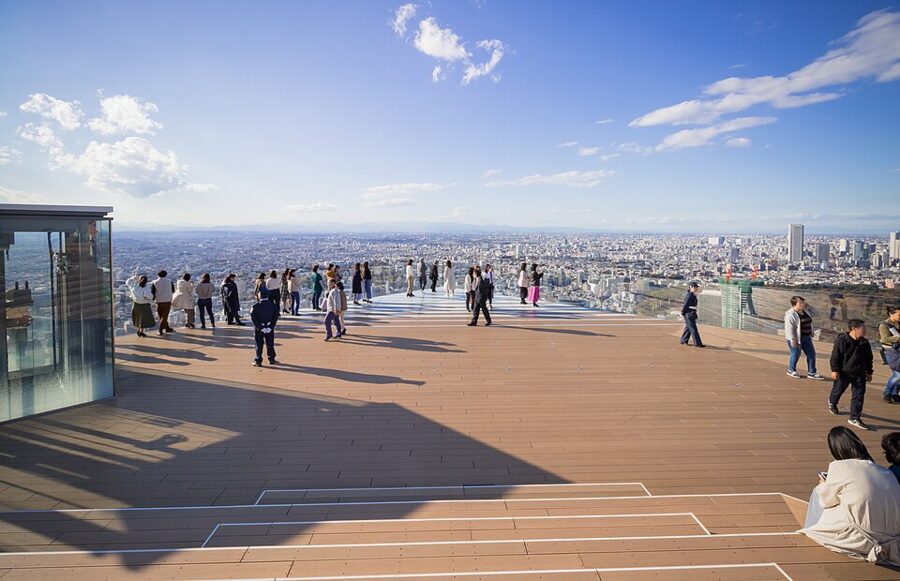

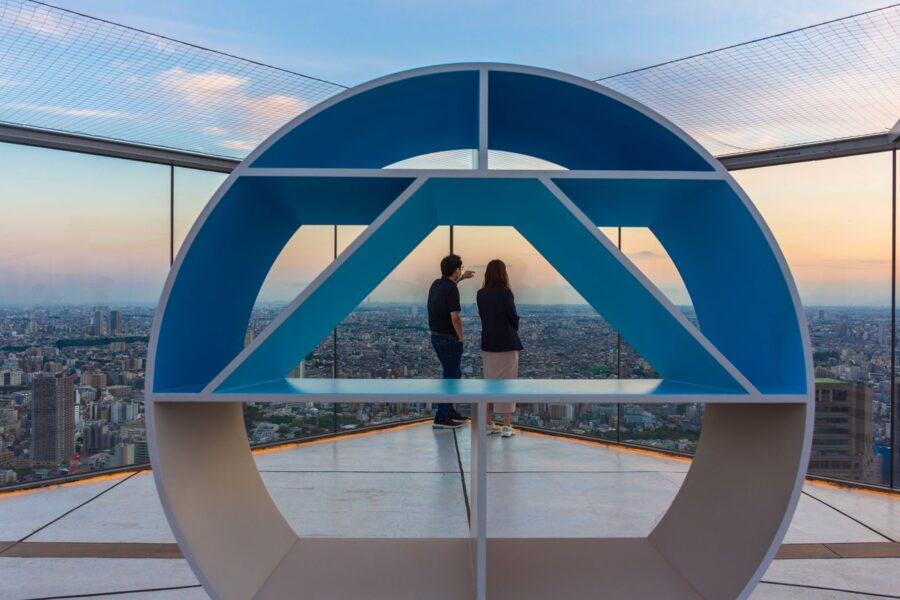
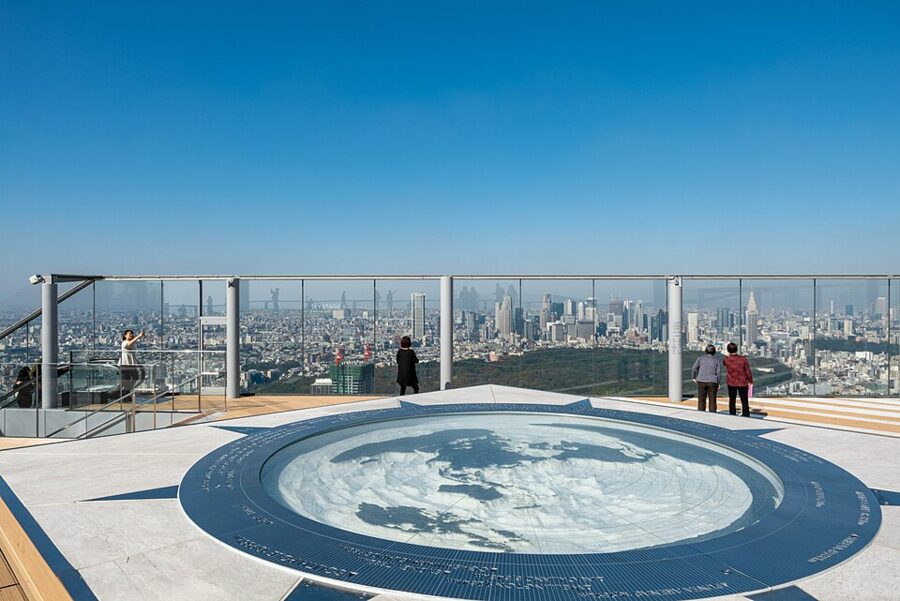
Sky Edge, the glass corner over the crossing, is the shot everyone lines up for, and the official photo service works there: ¥2,000 for one print in a card mount, ¥2,300 with the data, ¥1,500 for the data alone and ¥5,000 for a framed print, prices that apply from November 1, 2026. You collect prints at the photo counter on the 45th floor. The roof also has Cloud Hammock, a set of nets to lie back in, and at its center the Geo Compass, a round map marking the highest point of the deck.

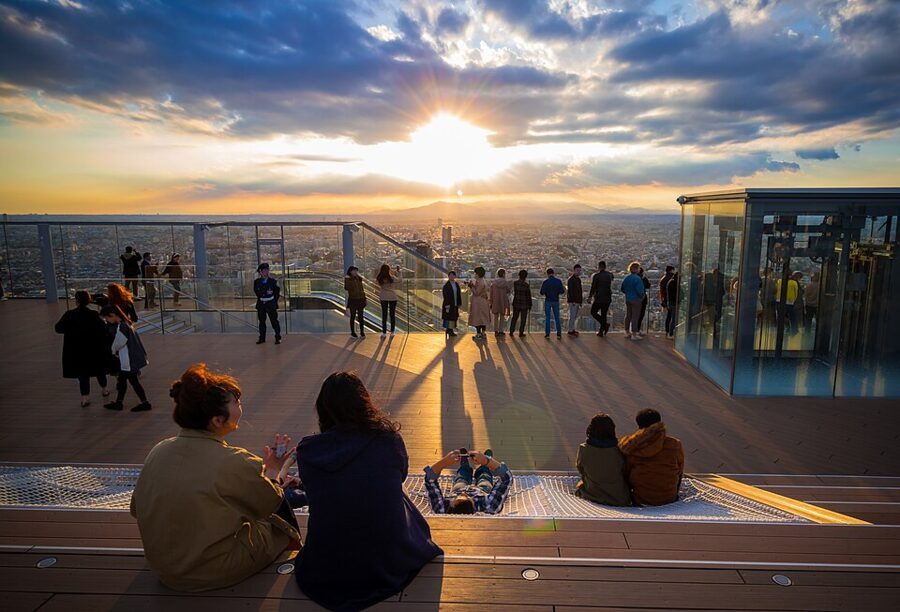

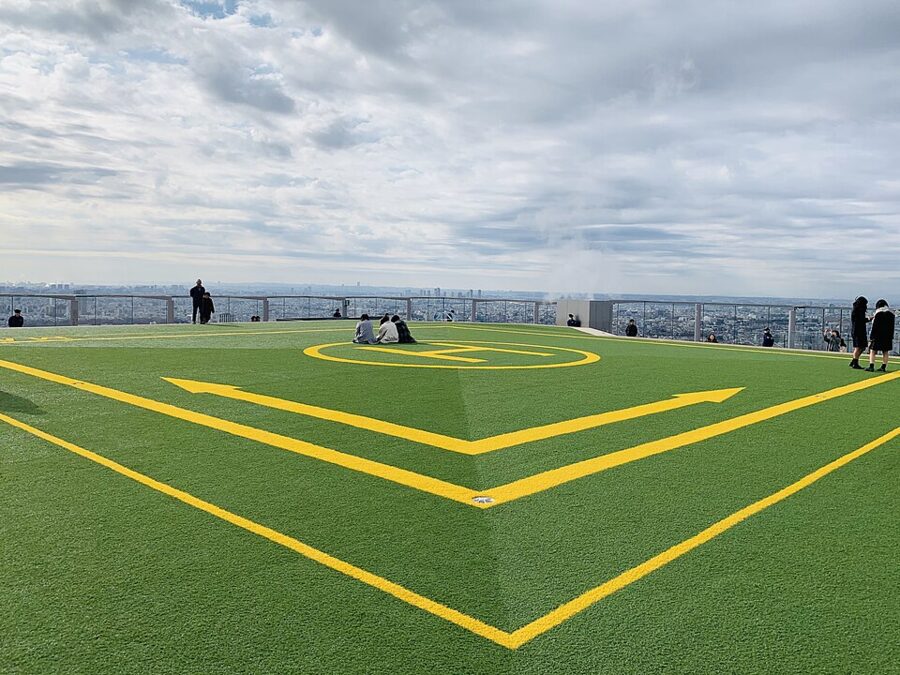
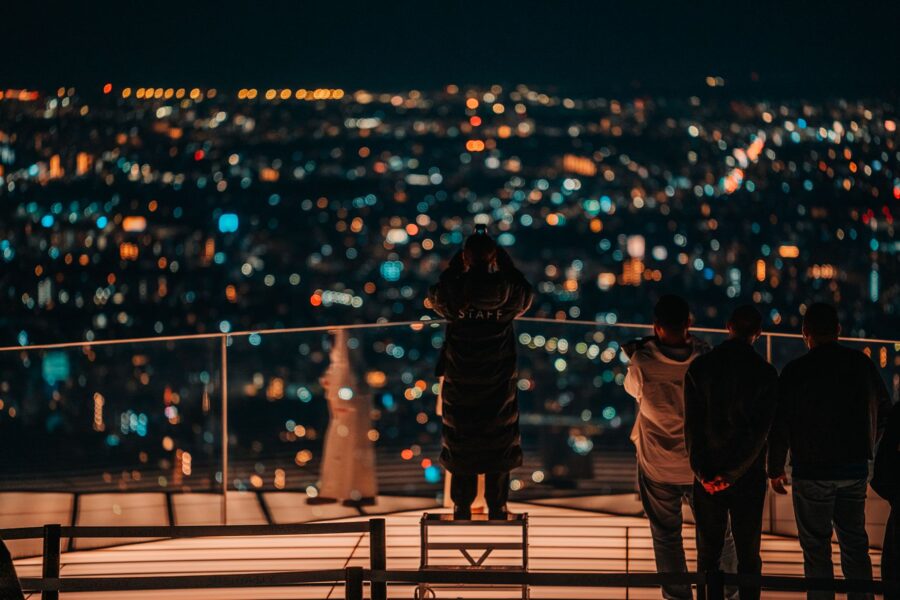
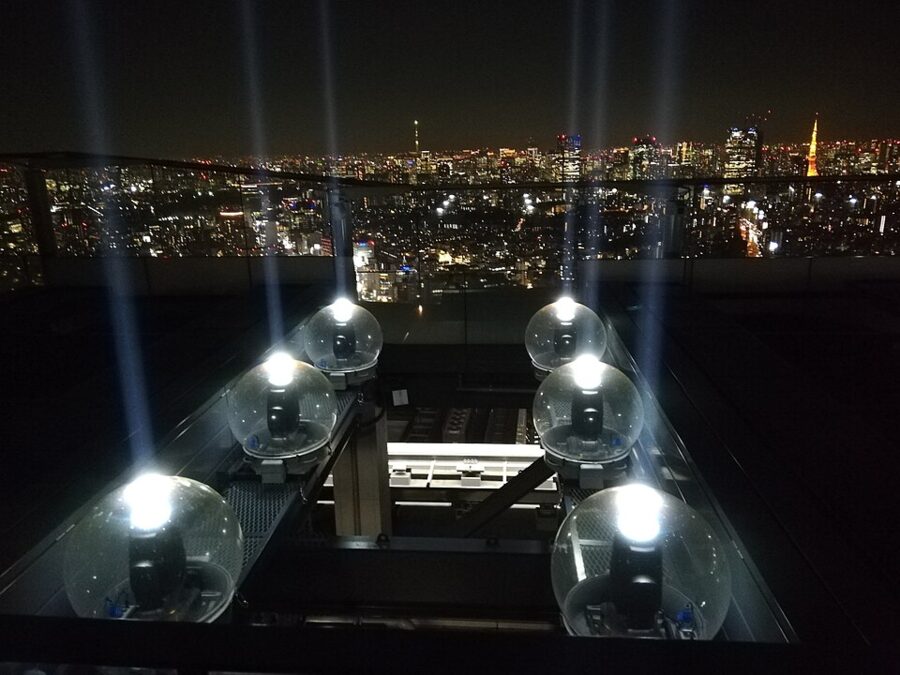
The middle of the roof is the helipad, laid with green turf and open to walk on. From 19:00 every evening the Crossing Light, a set of searchlights, shoots beams into the sky on the hour and the half hour, with a show the operator changes with the seasons. It is the reason a late slot is not a consolation prize.

Sky Gallery: the 46th floor
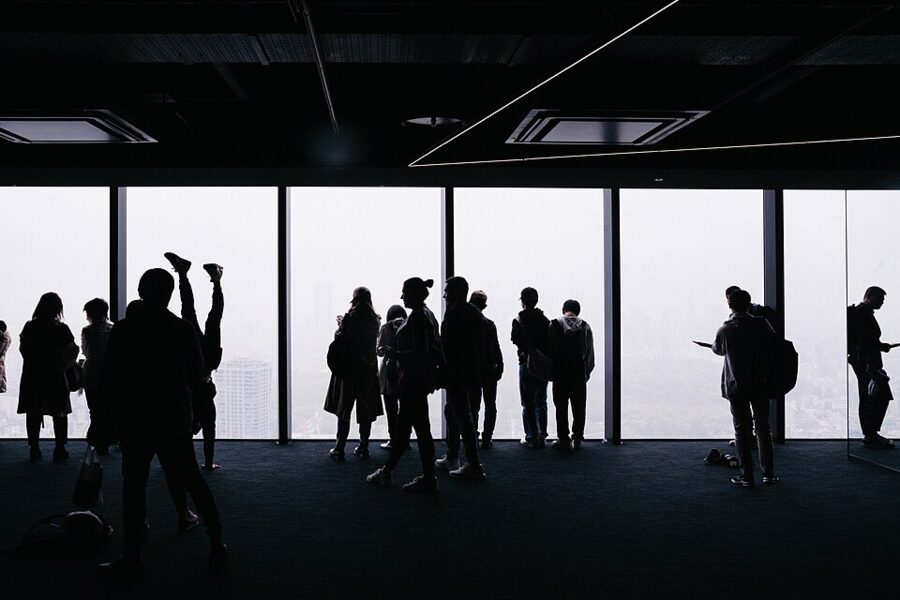
The 46th floor is an indoor observation corridor behind floor-to-ceiling glass, with the same 360-degree view a floor lower. It has lighting installations, a projection about the passing of time and a wall of Shibuya data laid over the view. The multipurpose toilets, the baby room and the information counter are all on this floor.
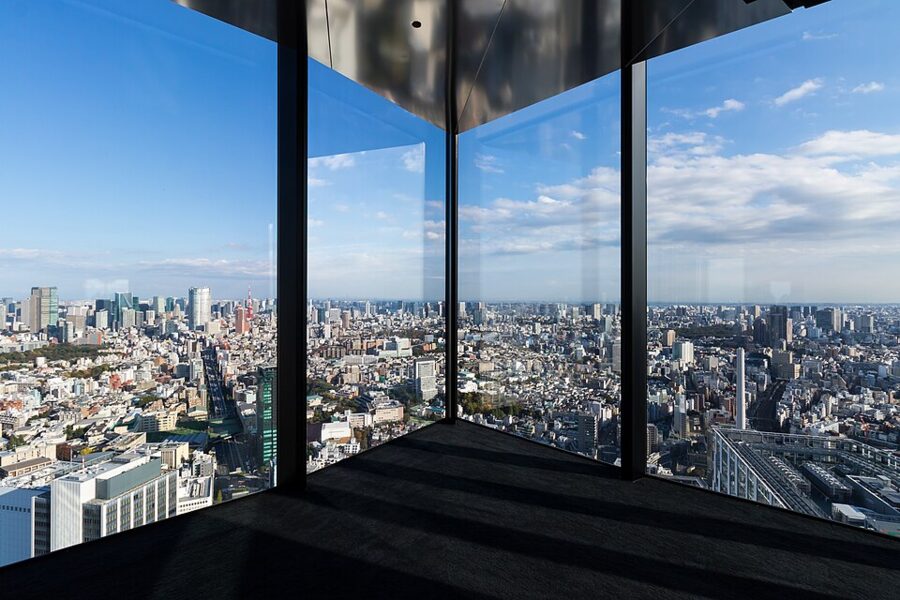

Indoors you may use a tripod or selfie stick, though staff can ask you to stop when it is crowded. It is also the only place to wait out a squall without leaving, because once you are out of the building your ticket is spent.
Paradise Lounge, the shop and the rooftop bar
Paradise Lounge, the cafe and bar on the 46th floor, is the one place indoors where you can eat or drink; everywhere else, food, drink and even chewing gum are banned. The SHIBUYA SKY SOUVENIR SHOP is on the same floor, and commemorative medals are sold in front of it for ¥200 each.
The Roof Shibuya Sky is a seasonal bar on Sky Stage, behind the helipad at the top of the escalators. It runs from late April to late December, from mid-afternoon to 21:00 in the colder months, and the 2026 season opened on April 29. A sofa seat comes as a set with the entry ticket: ¥7,000 a head with two drinks and a snack, or ¥8,000 with a mini bottle of Champagne, sold for two people or more in sittings that run from the top of each hour to ten minutes before the next.
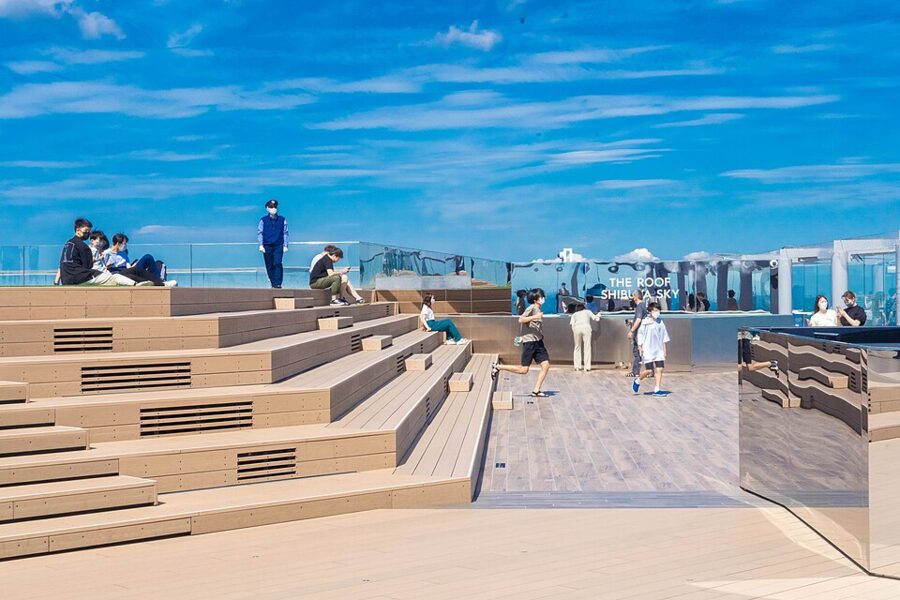

Without a set ticket you can still order from the bar counter, with a normal entry ticket, and drink at a standing table. The bar closes when the roof does, and the operator asks you to keep wallets and phones in a pocket at the counter. I’d skip the set and spend the ¥3,600 difference on dinner back on the ground.
The rules on the roof
The roof has a list of what can go up, and everything else goes in a locker on the 46th floor before you ride the escalators. The reason is wind: anything that blows over the glass falls 229 m onto a station that about 3.3 million people a day pass through. The rules on the ticket page as posted in November 2026:
- Allowed on the roof: a smartphone; a camera or binoculars that hang on a neck strap or fit in a pocket.
- Not allowed: bags, rucksacks and pouches; tripods, monopods and selfie sticks; earphones and headphones; hats, caps and knit hats; food and drink; anything else that could blow away or drop; your own stroller.
The hat rule holds in summer sun and winter cold alike, so bring a hood or a scarf instead. If your clothes have no pockets, the information counter on the 46th floor lends a carry bag for the roof. Phones go up in your hand, with no rule requiring a strap, but on a gusty day I’d keep it on a wrist loop all the same.
Two more rules apply everywhere in the deck. Staff ask you not to carry a child on your shoulders or hold one up while walking or watching. Some floors are kept dark for effect, including the stairs, and the whole deck is non-smoking.
Lockers, big bags and strollers
Lockers on the 46th floor take everything that cannot go up, and they are sized for a daypack, 32 cm high, 37.5 cm wide and 43 cm deep, according to the operator’s information page. Suitcases and other big luggage are not allowed into the deck at all. Leave them in a coin locker in the station, or at the shibuya-san tourist information center on the first floor of Shibuya Fukuras, which stores luggage while it has room and gives half-price drinks to Shibuya Sky ticket holders.
Strollers stop at the 46th floor. For the roof, the information counter lends its own strollers for children up to 18 kg who can sit up unaided, with no reservations and an ID to show; even then, the helipad and some other parts of the roof are off limits. The operator suggests a baby carrier instead, which goes everywhere.
Weather closures and what you get back
The roof can close without notice for strong wind, rain, snow, an approaching thunderstorm, photochemical smog or extreme heat. When it does, the 46th-floor gallery stays open, and the only refund is the one you claim yourself. The operator posts whether the roof is open on its official site and its official X account, so check both on the way.

The rule, from the FAQ: if the roof is closed at your entry time, an eligible web ticket can be cancelled free, by you, on the ticket site, until midnight that day. Once you have walked through the gate, or once the date has changed, there is no refund and no discount, even if the roof shuts five minutes after you arrive. Window tickets are never refundable.
So on a doubtful day, check the roof’s status on your phone before you scan in, not after. If it is shut and you can come back another day, cancel and rebook. If you cannot, the gallery is still a 46th-floor view.
The weather follows the calendar. On the Japan Meteorological Agency’s 1991–2020 averages for central Tokyo, August has the most thunderstorm days (3.2) and an average high of 31.3°C, and September and October bring the heaviest rain, about 225 mm and 235 mm. Winter is the opposite: January averages the clearest skies and the most sunshine of the year, 192.6 hours. The Tokyo weather guide has the rest of the year month by month.
When to go
Sunset, month by month
Book the entry slot that starts 40 to 60 minutes before sunset. That covers the walk through Sky Gate, the locker and finding a place at the rail, and it gives you the last daylight, the sunset and the city lights coming on in a single visit. These are the sunset times for Tokyo from the National Astronomical Observatory of Japan’s tables for 2027; 2026 differs by a minute at most.
| Month | Sunset on the 1st | Sunset on the 15th | Entry slot I’d book mid-month |
|---|---|---|---|
| January | 16:38 | 16:51 | 16:00 |
| February | 17:08 | 17:22 | 16:40 |
| March | 17:36 | 17:48 | 17:00 |
| April | 18:02 | 18:14 | 17:20 |
| May | 18:27 | 18:39 | 17:40 |
| June | 18:51 | 18:58 | 18:00 |
| July | 19:01 | 18:57 | 18:00 |
| August | 18:46 | 18:31 | 17:40 |
| September | 18:09 | 17:49 | 17:00 |
| October | 17:26 | 17:07 | 16:20 |
| November | 16:47 | 16:35 | 15:40 |
| December | 16:28 | 16:29 | 15:40 |
Every slot in that last column is in the ¥3,400 band; there is no cheap sunset. From early November to early January the sun sets before 16:40, so the sunset slot is a mid-afternoon ticket, and the 15:40 entry is the one to fight for.
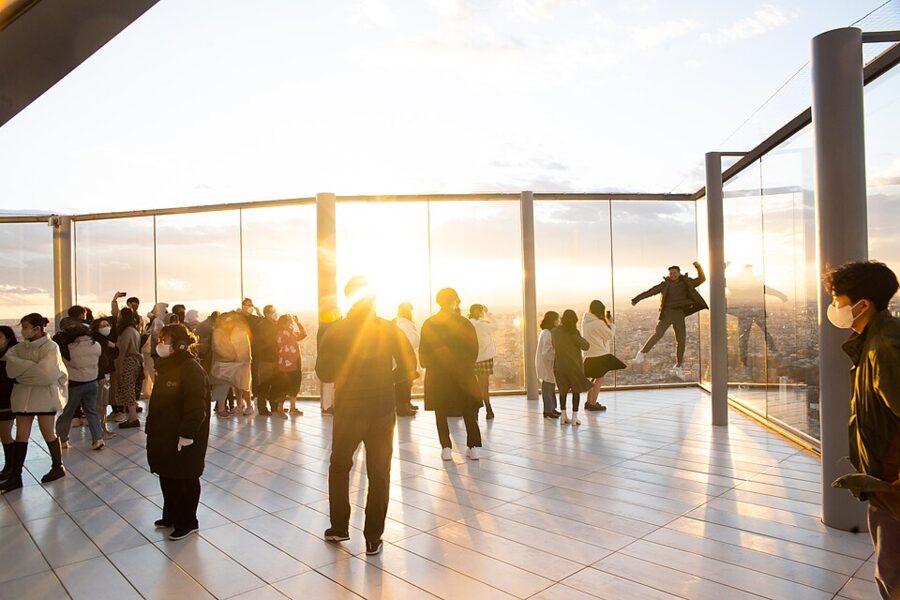

Arriving at the last minute is the mistake. Sky Gate and the lockers take a few minutes each, and the west rail fills well before the sun touches the skyline. The down elevators back up after sunset too, when a whole roof decides to leave at once, so if you have a dinner booking, give yourself half an hour on the way out.
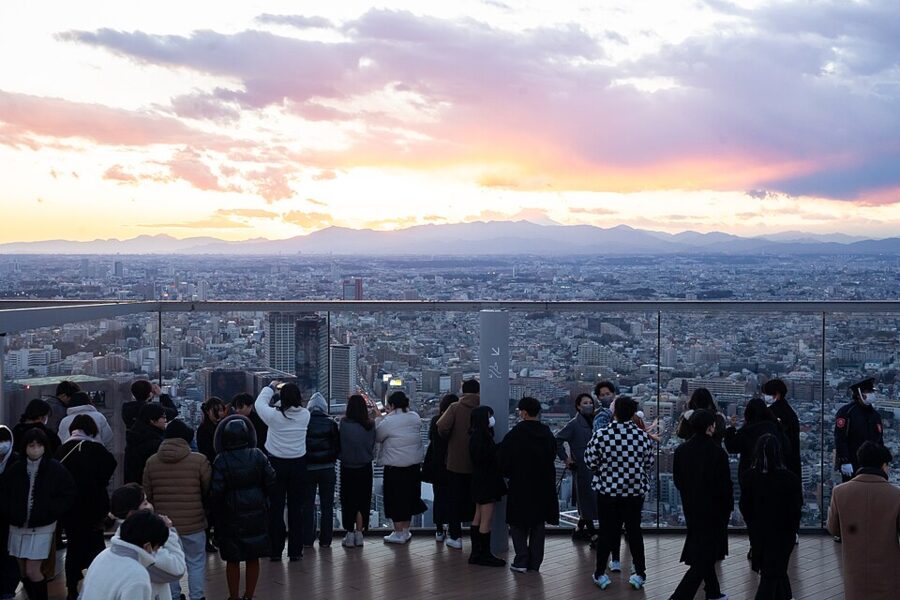

After dark
Night is the fallback that people stop thinking of as one. Slots after 19:00 are usually the last to sell, they cost the same ¥3,400 as sunset, and they come with the Crossing Light every half hour. Last entry is 21:20, which leaves an hour on the roof before closing at 22:30.

Clear winter days and Mount Fuji
For distance, go in winter and go early. January has central Tokyo’s clearest skies on the agency’s averages, and the Tokyo Metropolitan Government says December to February, when the air is cold and dry, gives the most days with Fuji in sight from its own deck in Shinjuku. Fuji is about 94 km from Shibuya, a little south of west, beyond the line of hills.
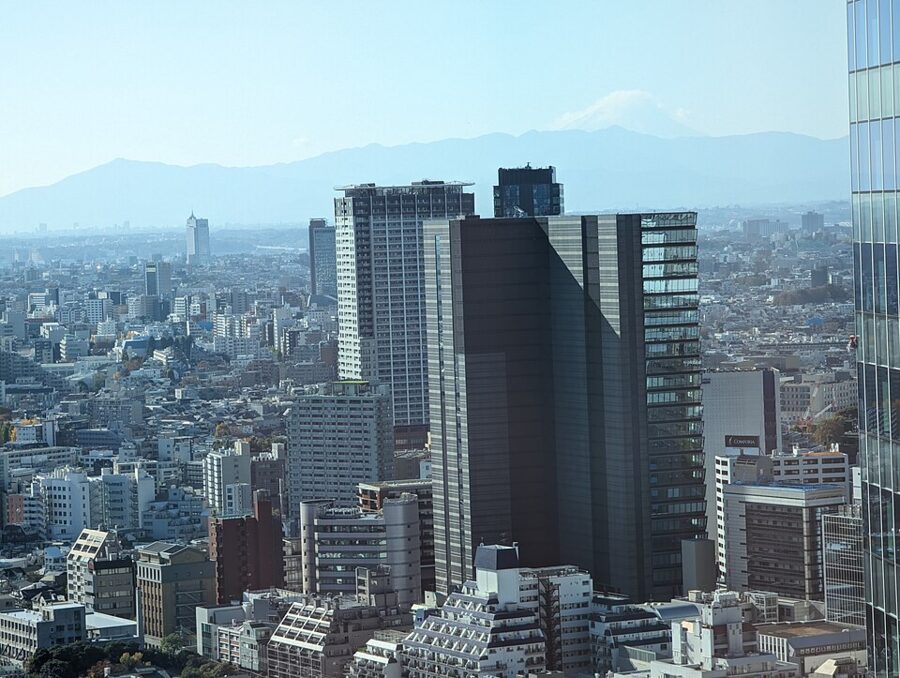
The cheap band suits it. An entry at 10:00, the first slot of the day, costs ¥2,700, is far easier to book than sunset, and catches the air before the afternoon haze builds. In summer the sun sets well to the north of Fuji’s line, but from late autumn to late winter it goes down in the same quarter of the sky, and for a few days in November and again in late January or early February it goes down close to the mountain’s line. The Mount Fuji guide covers seeing it from the city and going to it.

Crowds by the hour
The operator publishes no hourly crowd figures, so this comes from how the slots sell. The roof is busiest in the hour either side of sunset, at weekends and on holidays, and the operator’s own elevator skips the second floor on exactly those days. Mornings and the slots after 20:00 are the calmest, and the slots still unsold a few days out are the best guide there is.
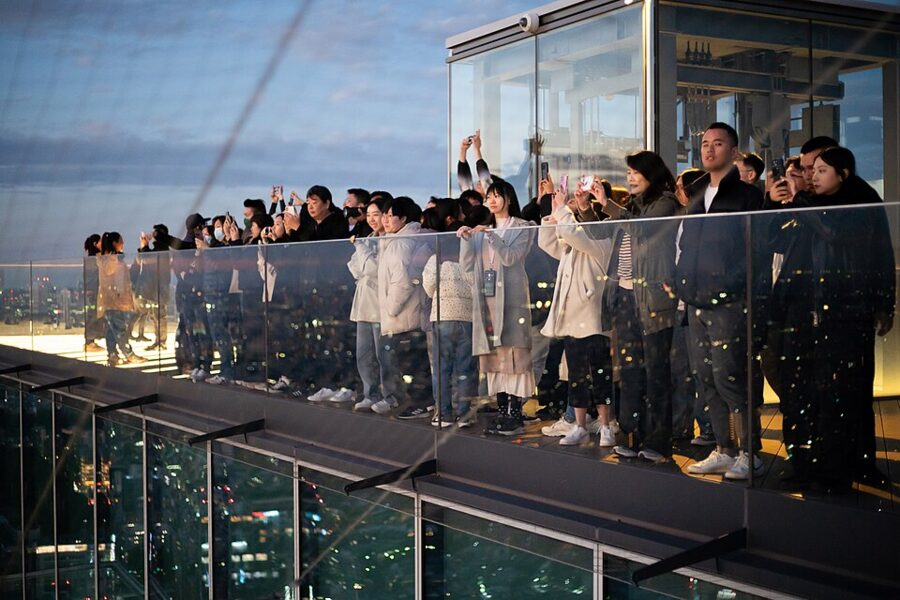

Most visitors come from abroad, which is why the passport rule and the English ticket shop matter as much as they do. Japanese holiday weeks, Golden Week in early May, Obon in mid-August and the New Year, add domestic visitors on top.
Getting in: from Shibuya Station to the 14th floor
Shibuya Scramble Square sits directly over Shibuya Station, on the east side, and its underground entrance is numbered B6. The operator’s access page gives the way from each line:
- JR lines: leave by the Central Gate or the South Gate and follow the signs for the East Exit.
- Tokyo Metro Ginza Line: leave by the gate for Shibuya Scramble Square and turn left.
- Tokyu Toyoko Line and Tokyo Metro Fukutoshin Line: leave by Shibuya Hikarie Gate 1 and turn right, or Hikarie Gate 2 and turn left.
- Tokyu Den-en-toshi Line and Tokyo Metro Hanzomon Line: leave by the Miyamasuzaka Central Gate and turn left.
- Keio Inokashira Line: leave the gates and head toward Shibuya Hikarie.
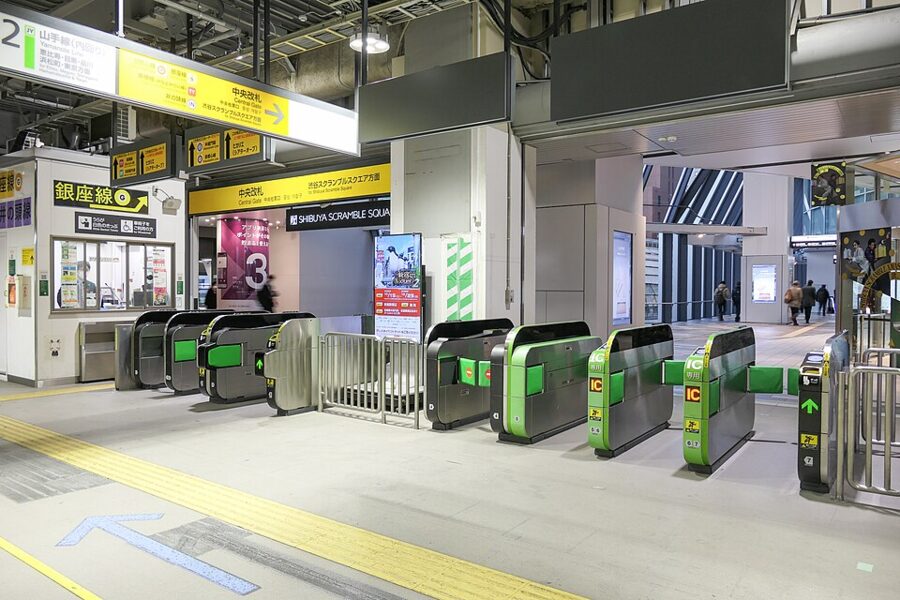

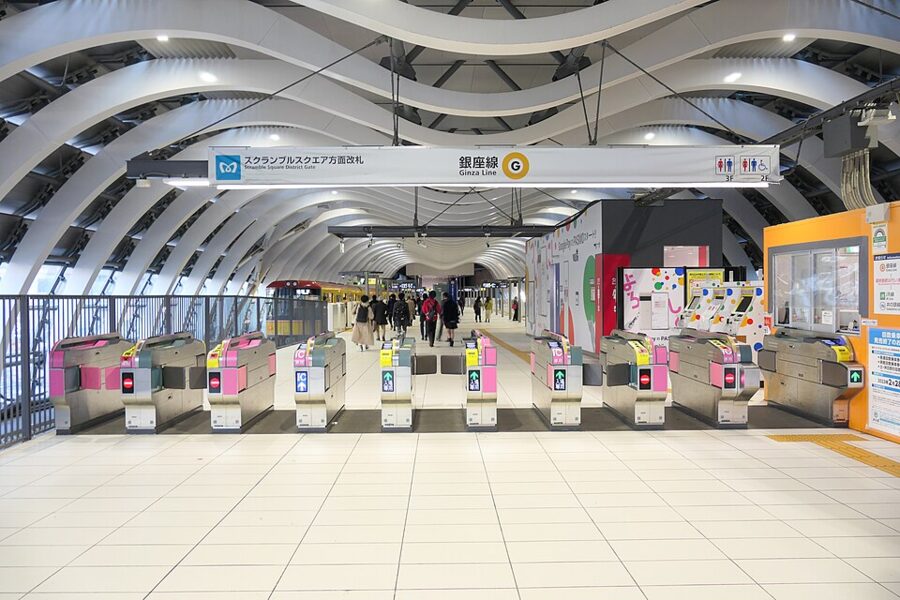

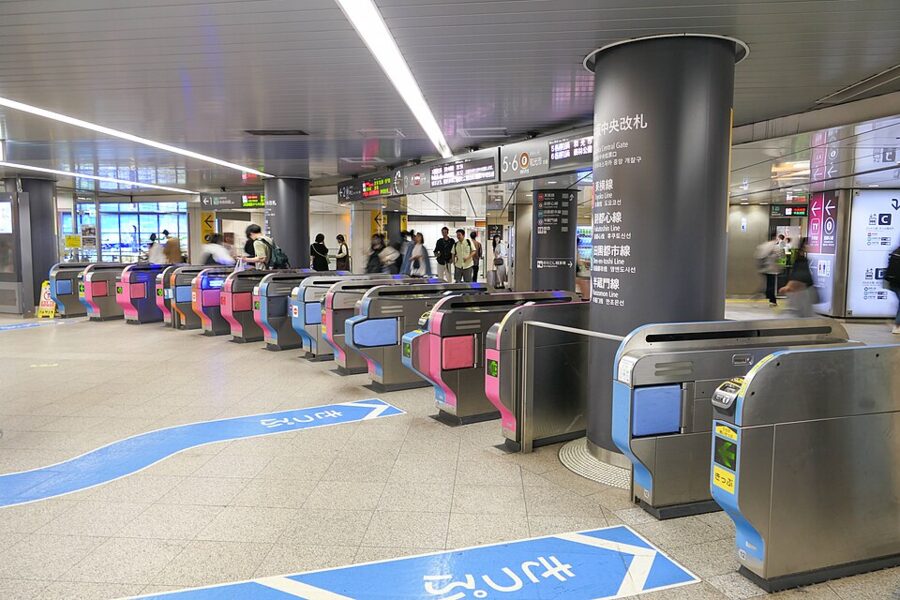

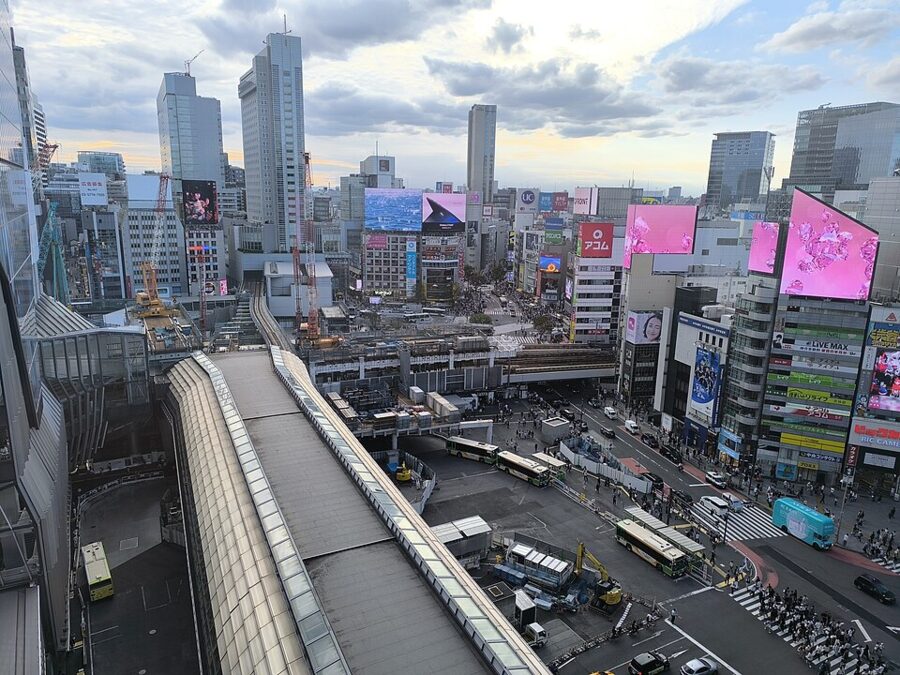

The quickest way up is the dedicated elevator on the ground floor, outside the building’s main doors, which runs to the 14th floor. It does not stop at the second floor at weekends, on holidays or when busy, so on those days go down to the street to board it. The shop escalators get there too, but slowly, through 13 floors of shops.
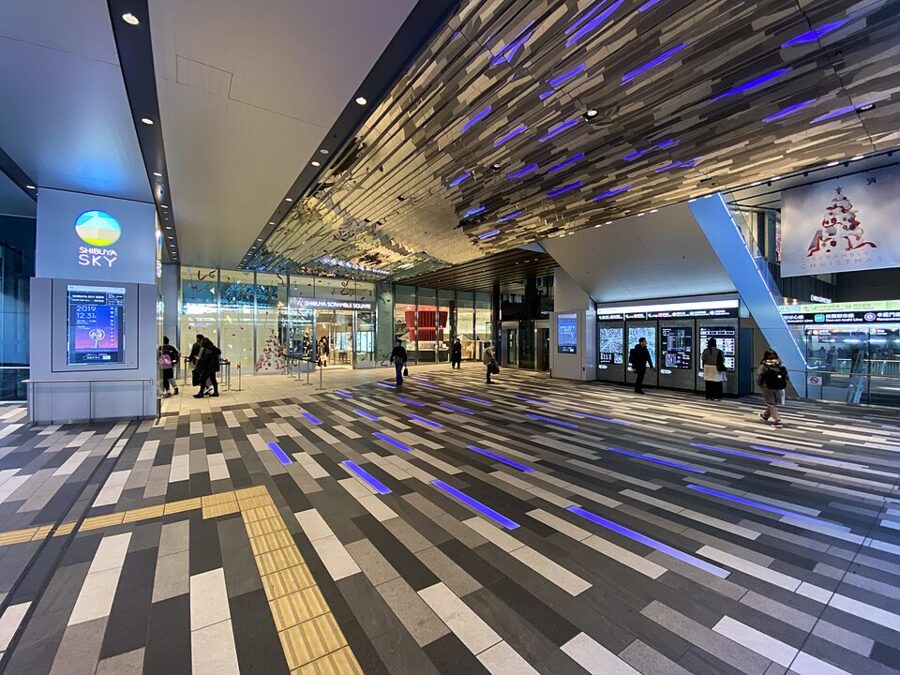

One warning the operator gives on its access page: the “Sky Lobby” on the 11th floor of Shibuya Hikarie, across the road, is a different place, and people go there by mistake often enough that it gets a notice of its own. The Sky Lobby is a free indoor viewpoint; Shibuya Sky is the roof of the tower across Meiji-dori.
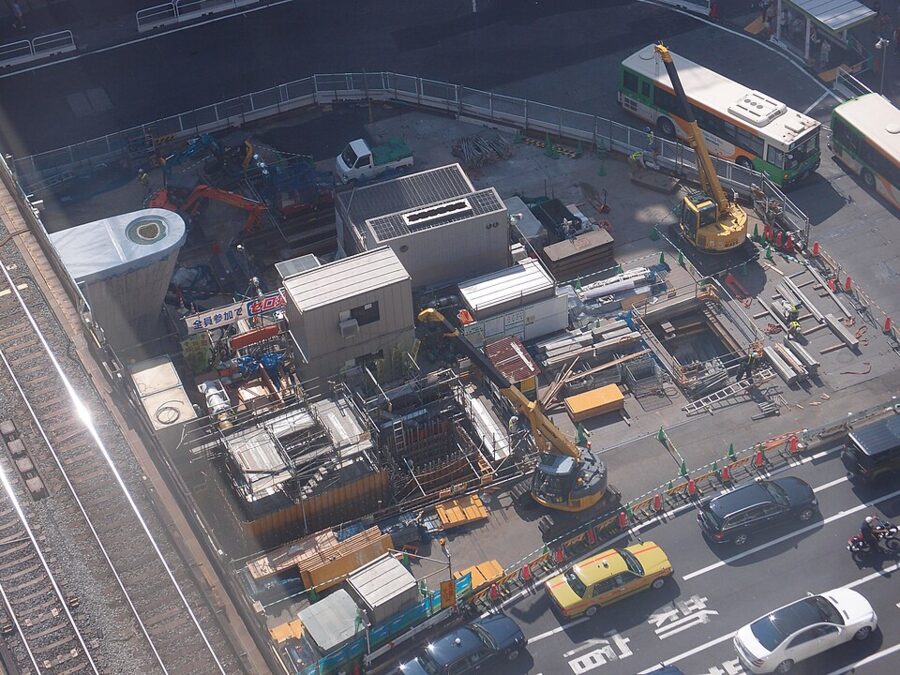

The building has no parking or drop-off point of its own; the operator points drivers to the car parks at Hikarie, Shibuya Stream, Shibuya Fukuras and Shibuya Sakura Stage.
Shibuya Sky against Tokyo Tower, Skytree and the free decks
The things to do in Tokyo guide weighs all the city’s decks. Here they are side by side, with each operator’s figures as posted in late 2026. The free decks are in Shinjuku, at the Tokyo Metropolitan Government Building.
| Deck | Height | Open air | Adult price | Last entry | Booking |
|---|---|---|---|---|---|
| Shibuya Sky | 229 m | Yes, the whole roof | ¥2,700 before 15:00, ¥3,400 from 15:00 online; ¥300 more at the window | 21:20 | 20-minute slots, two weeks ahead |
| Tokyo Skytree | 350 m and 450 m | No | From ¥1,800 (350 m) or ¥3,000 (both decks), varying by date; ¥500 more at the counter | 21:00 | 30-minute slots |
| Tokyo Tower | 150 m and 250 m | No | ¥1,500 Main Deck; ¥3,300 Top Deck Tour online | 22:30 Main Deck; last tour slot 22:00 | Main Deck walk-up; tour in timed slots |
| Tokyo Metropolitan Government Building, South Observatory | 202 m | No | Free | 21:30 | None |
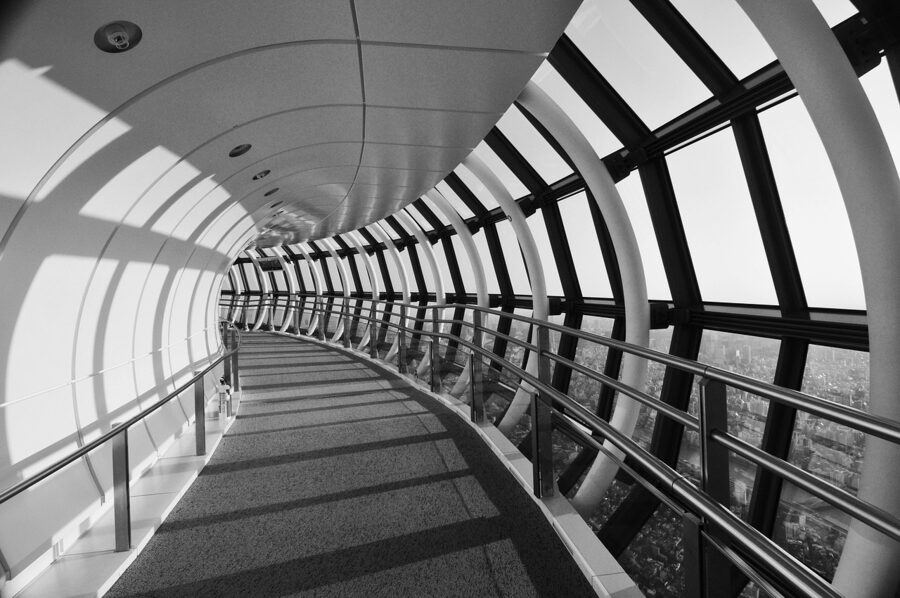
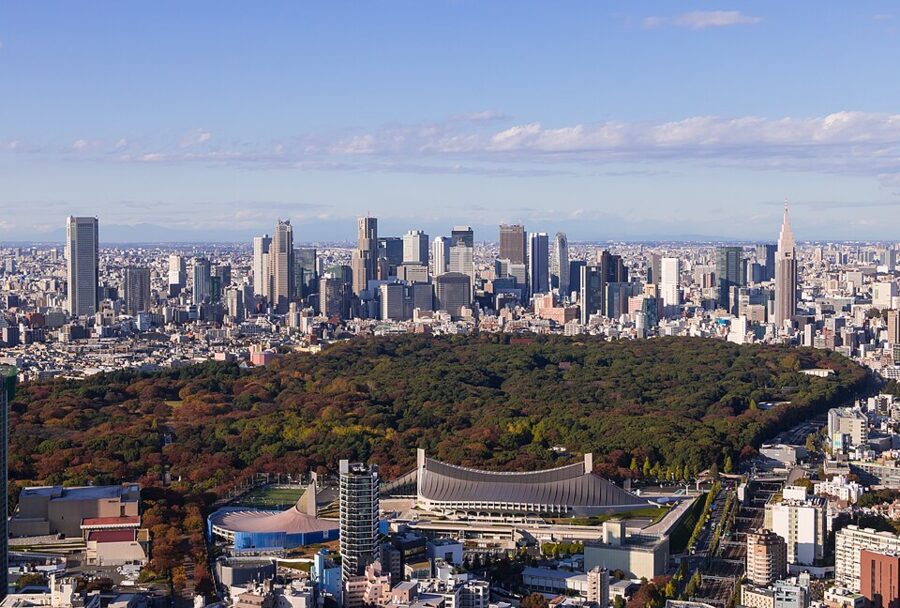

Shibuya Sky is the only one of the four where nothing stands between you and the air, and the only one directly over a famous street. Skytree is more than 120 m higher, and on a clear morning its view east and north reaches further than anything in Shibuya. Tokyo Tower is the cheapest paid view, opens latest and sits in the middle of the city it looks at.
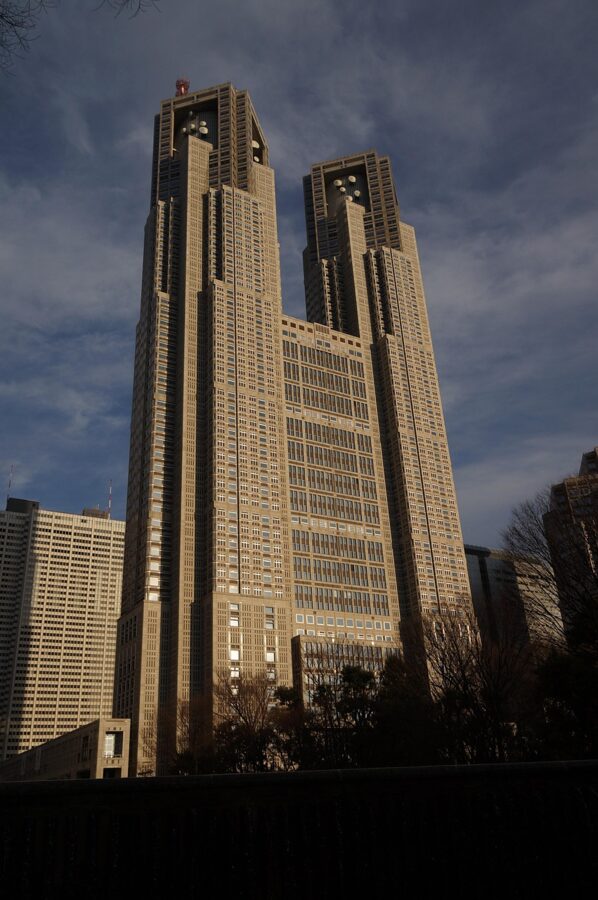
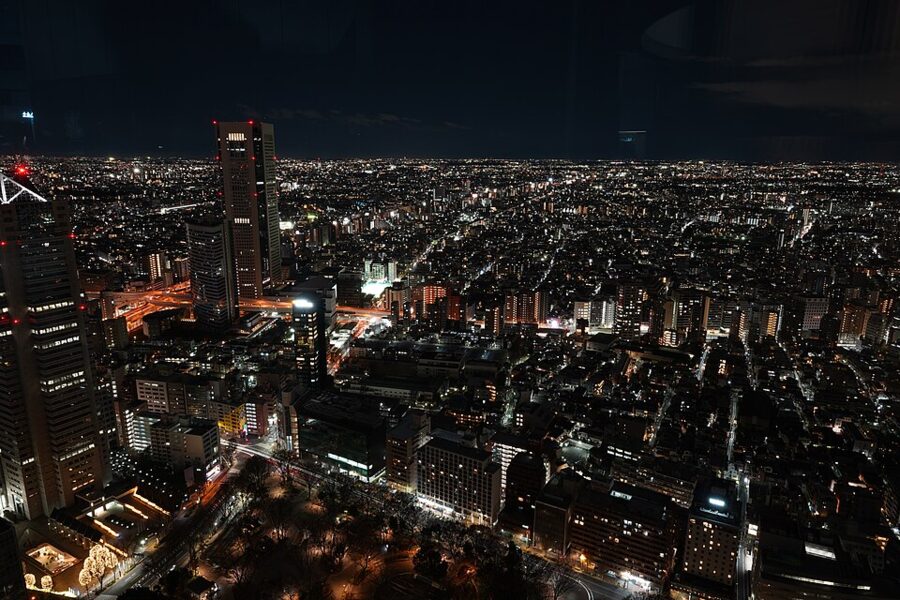

The free South Observatory in Shinjuku is the one that makes the others justify their prices. It is 27 m lower than Shibuya Sky and behind glass, and the view west over the suburbs at dusk is much the same. My verdict: if you pay for one view in Tokyo, pay for Shibuya Sky at sunset; if the sunset slot is gone and you do not want a night slot, go to the Shinjuku deck for free and keep the ¥3,400.
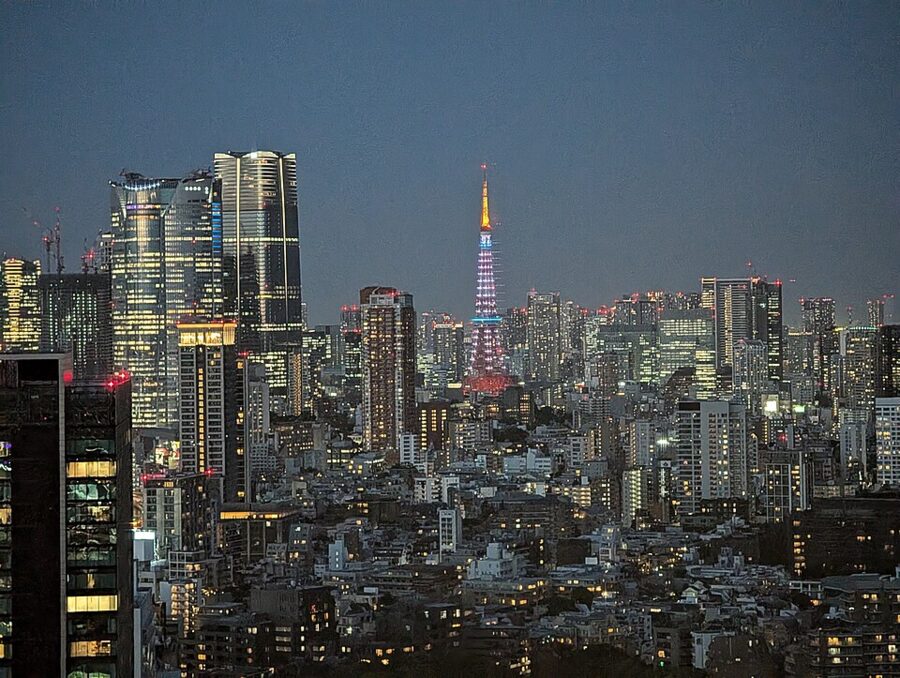
Back to the alarm. The date you want goes on sale at 00:00 Japan time, 14 days before, and the slot to pick is the one 40 to 60 minutes before the sunset time in the table. Book it the minute it appears, pack nothing you would have to carry onto the roof, bring the passport the ticket was booked with, and check the roof’s status before you scan in at the 14th floor.