

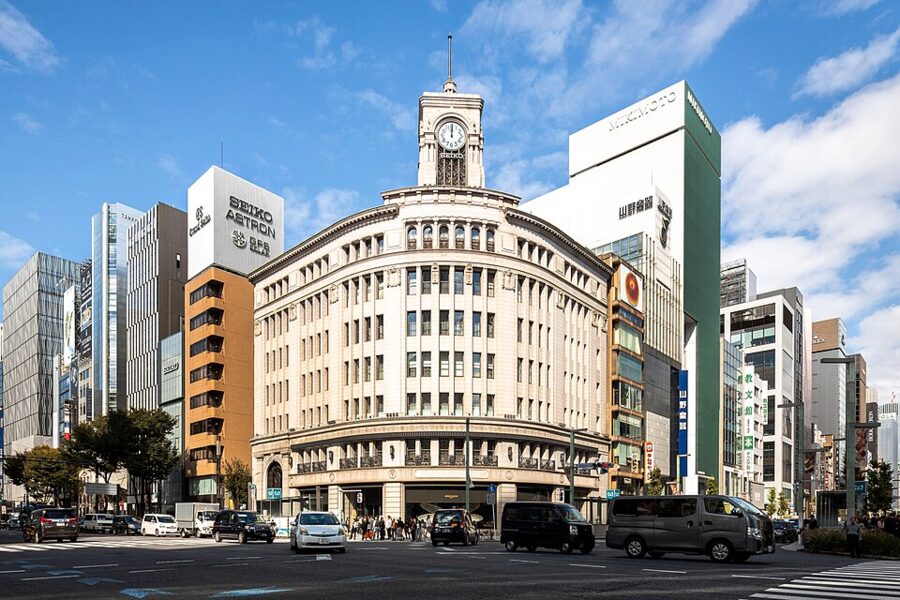
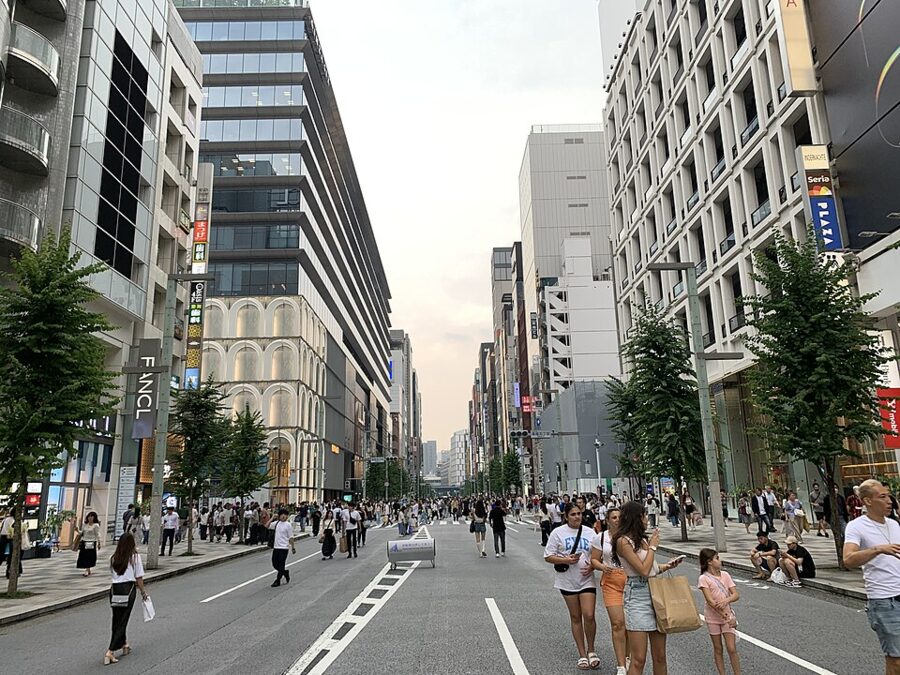
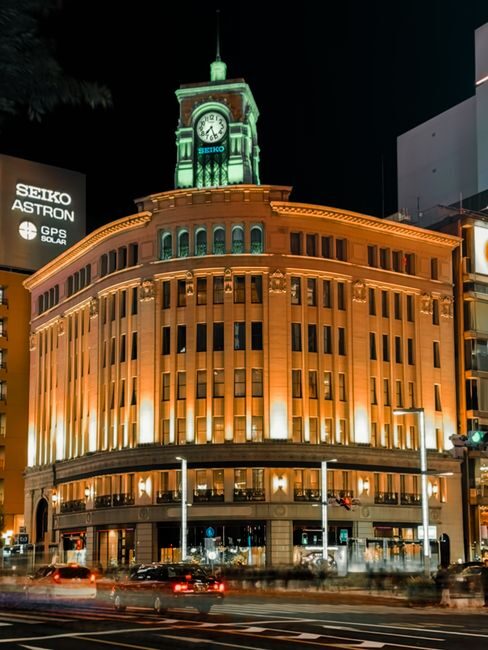
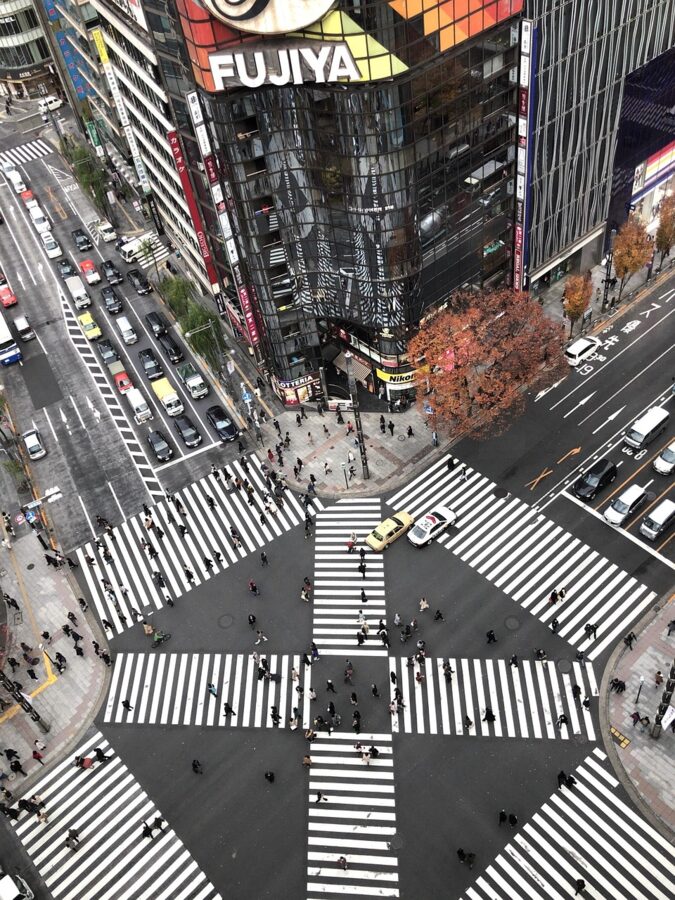
At noon on Saturdays, Sundays and public holidays, police barriers swing across Chuo-dori and about a kilometer of Ginza’s main street, from the Ginza-dori-guchi intersection down to Ginza 8-chome, belongs to people on foot. The cars come back at 17:00 between October and March and at 18:00 between April and September. Take the Tokyo Metro to Ginza Station (G09/M16/H09), follow the signs for the Ginza 4-chome gate, and you surface at the clock tower that every map of Ginza (銀座) is drawn around.
That weekend window is the one I’d plan around. Weekdays, Chuo-dori is six lanes of taxis and delivery trucks between department stores, and the district shows its better side only after you leave the avenue for the side streets, the rooftops and the basements.



Getting in: five stations and the exits that matter
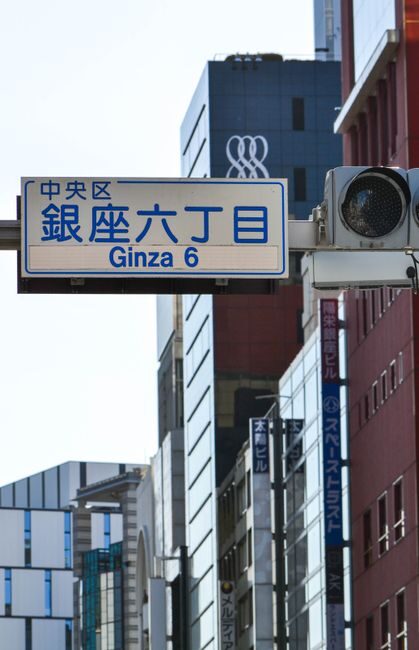
Ginza is a rectangle of eight blocks, numbered 1-chome at the Kyobashi end in the north to 8-chome at the Shimbashi end in the south, with Chuo-dori running down the middle. Harumi-dori crosses it at 4-chome, which is why that crossing is the center of everything. Sotobori-dori and the old overhead expressway mark the west side, Showa-dori the east; past Showa-dori is Higashi-Ginza and the Kabukiza.
The grid is easy. The stations are not, because five of them touch the district and each serves a different end.
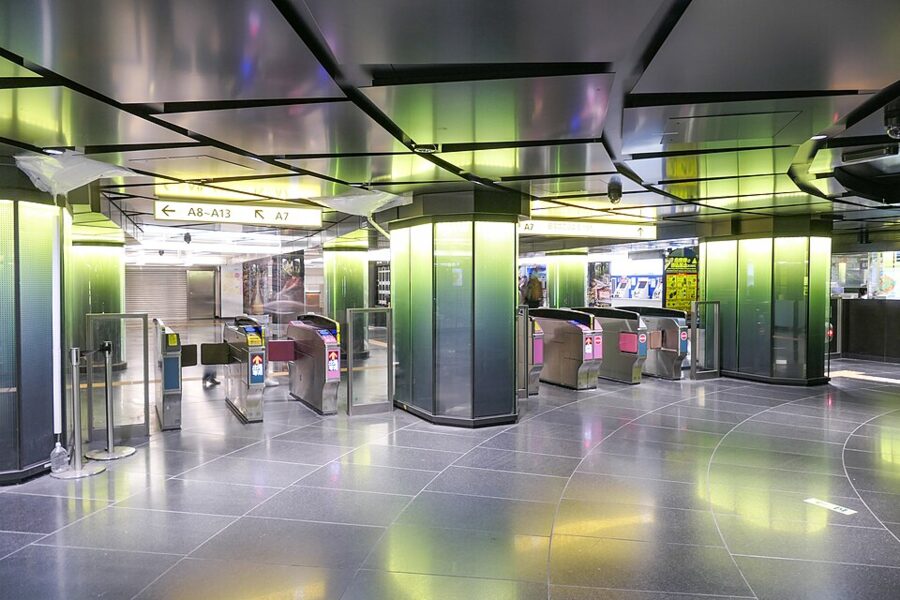
Ginza Station: three lines, one long concourse
Ginza Station is where the Tokyo Metro Ginza Line, Marunouchi Line and Hibiya Line meet under 4-chome. From Tokyo Station it is one stop on the Marunouchi Line, two or three minutes, and the Tokyo Metro fare for 1–6 km is ¥178 on an IC card or ¥180 for a paper ticket. From Shinjuku the Marunouchi Line takes about 16 minutes; the Ginza Line runs straight from Shibuya.
The exits I use:
- Ginza 4-chome gate: Mitsukoshi, Wako and the crossing itself.
- Exit A3: Ginza Six, two minutes on foot. Exit A2, the obvious alternative, was listed as closed on the Ginza Six access page in November 2026; an underground passage also runs from the station straight into Ginza Six’s second basement.
- Exit A4: straight into Ginza Place on the 4-chome crossing.
- Exits C2 and C3: GinzaNovo and Ginza Sony Park at the Sukiyabashi crossing, one minute.
- Exit A13: Matsuya Ginza and the Itoya end of Chuo-dori.
- Exits B6 and B7: the 6-chome lanes behind Chuo-dori, two to five minutes from Tenichi’s tempura counter.
Ginza-itchome, Higashi-Ginza, Yurakucho and Shimbashi
Ginza-itchome Station is on the Tokyo Metro Yurakucho Line and sits under the north end; Exit 9 is five minutes from Mitsukoshi and Exit 8 eight minutes from Ginza Six. It is the quiet way in, and the right one if you are coming from Ikebukuro.
Higashi-Ginza Station, on the Hibiya Line and the Toei Asakusa Line, has an exit (Exit 3) that opens directly at the Kabukiza. It is also the direct line from Haneda Airport: Keikyu trains run through onto the Asakusa Line and reach Higashi-Ginza in about 30 minutes, with Exit A1 three minutes from Ginza Six.
JR Yurakucho Station, on the Yamanote and Keihin-Tohoku lines, sits just west of the district; take the Ginza Exit (銀座口) and you are four minutes from GinzaNovo and ten from Ginza Six. JR Shimbashi does the same job from the south, also through a Ginza Exit, also about ten minutes from Ginza Six. If you hold a JR pass and nothing else, these two are your stations; the getting around Tokyo guide covers which pass pays.
The airport limousine bus to the Courtyard Marriott Ginza Tobu Hotel stop is the luggage option from Haneda. Ginza Six puts the ride at about 25 minutes and the Tokyo Convention & Visitors Bureau says 35; the difference is traffic, and the bureau’s figure is the safer one to plan with.
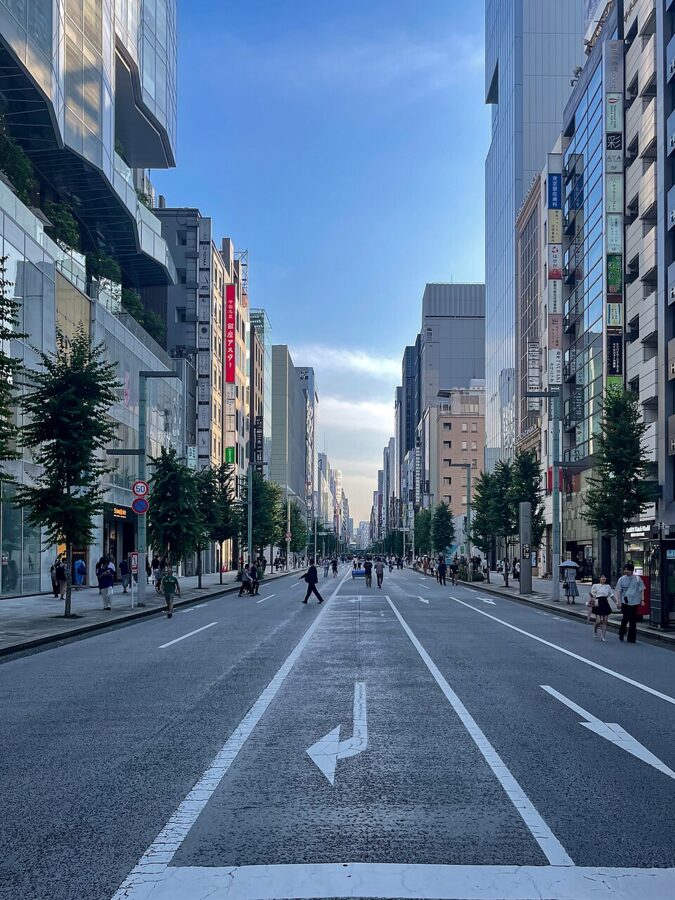

Chuo-dori and the weekend pedestrian street
The pedestrian street (歩行者天国, *hokoten* for short) runs every Saturday, Sunday and public holiday on Chuo-dori from 1-chome to 8-chome. The Ginza street association’s rules give the hours as 12:00–17:00 from October to March and 12:00–18:00 from April to September. Cancellation for bad weather, and the pause over New Year, are decided by the Tsukiji Police Station, not the shops.
That last point matters in late December. In November 2026 the association’s page still showed last winter’s dates (the street ran until December 28, 2025 and restarted on January 3, 2026), and nothing had been posted for 2026–27. If you are in town over New Year, check the barriers before you build an afternoon on them.
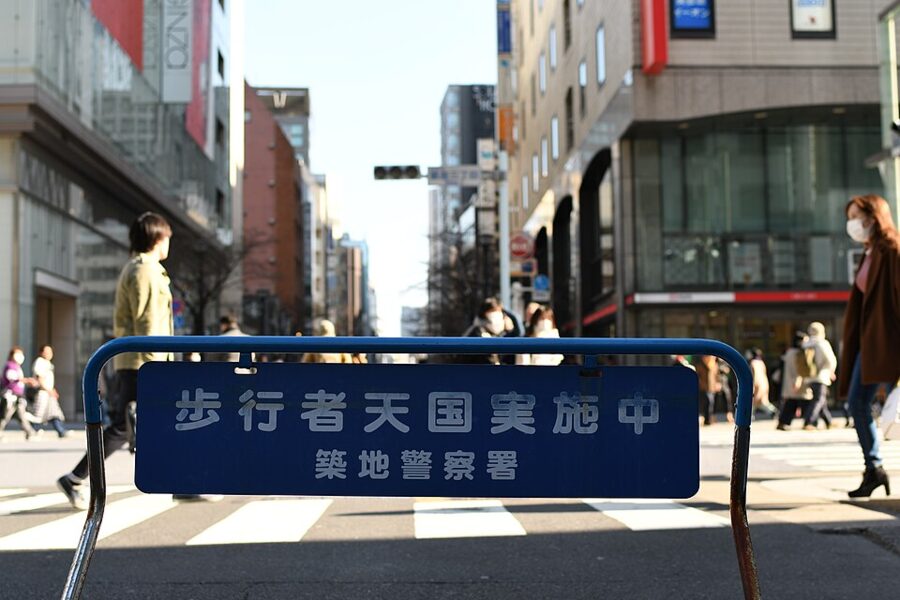

The first car-free day was August 2, 1970, when the Tokyo governor of the day, Minobe Ryokichi, closed streets in Ginza, Shinjuku, Ikebukuro and Asakusa at once. Ginza’s is the one that stuck. Each August the street hosts a summer day called Yukata de Ginbura, a stroll in cotton summer kimono, named after *ginbura*, the old word for idling along this street.
What it looks like is less dramatic than the name. There are no stalls and no buskers: the association bans performances, selling, costumed groups and flag-waving processions, and bicycles have to be pushed. Some weekends parasols and tables go out in the roadway. Mostly it is a wide, quiet avenue where you can stand in the center line and photograph the clock tower without a taxi in the frame.
My verdict: come at noon, walk the whole stretch north to south, and duck into the stores when you need a rest. The avenue is at its emptiest in the first half hour.
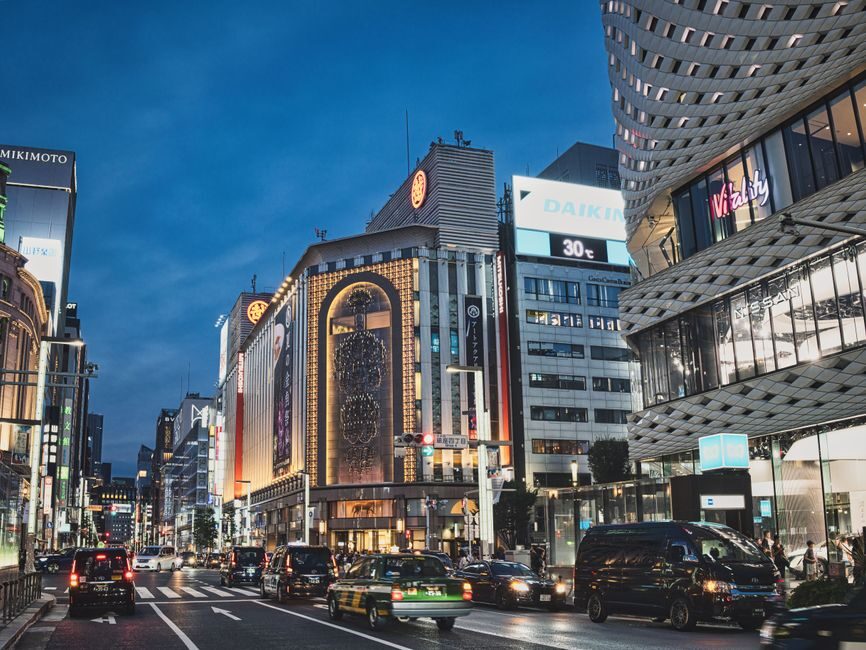
The department stores and the big buildings
Ginza’s buildings are short by Tokyo standards. Most of the center has a height limit of 56 meters, so the stores spread sideways and downward, and the useful parts of them (food floors, rooftops, tax-free counters, places to sit down) are rarely at street level.
Ginza 4-chome crossing: Wako, Mitsukoshi and Ginza Place
The clock tower belongs to Wako, the retailer that grew out of the watchmaker Seiko’s original shop. Since June 10, 2022 the building has been called Seiko House Ginza: Wako still sells watches, jewelry and tableware on the lower floors, and the upper floors became a Seiko showcase with an exhibition hall on the sixth floor. The bells in the tower play the Westminster chime on the hour during store hours.
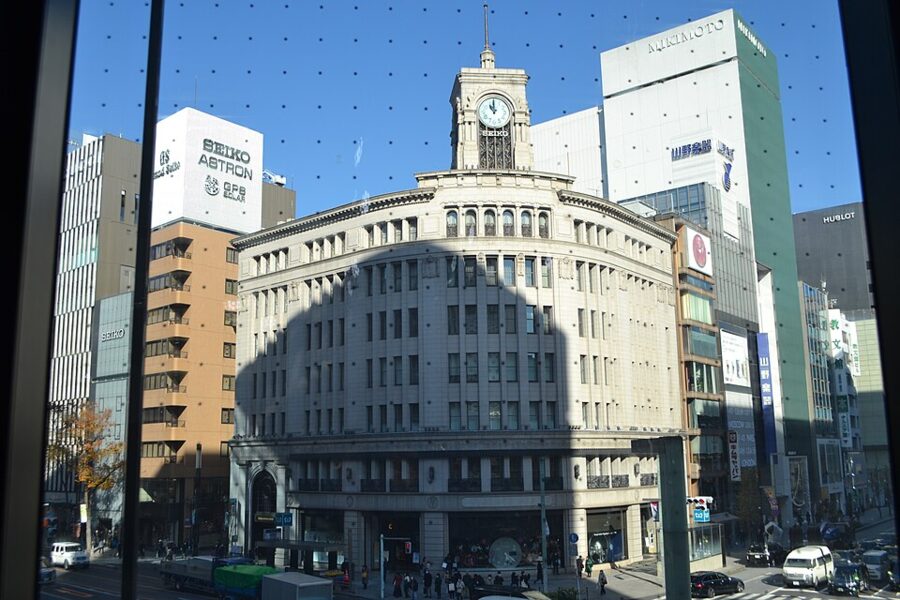
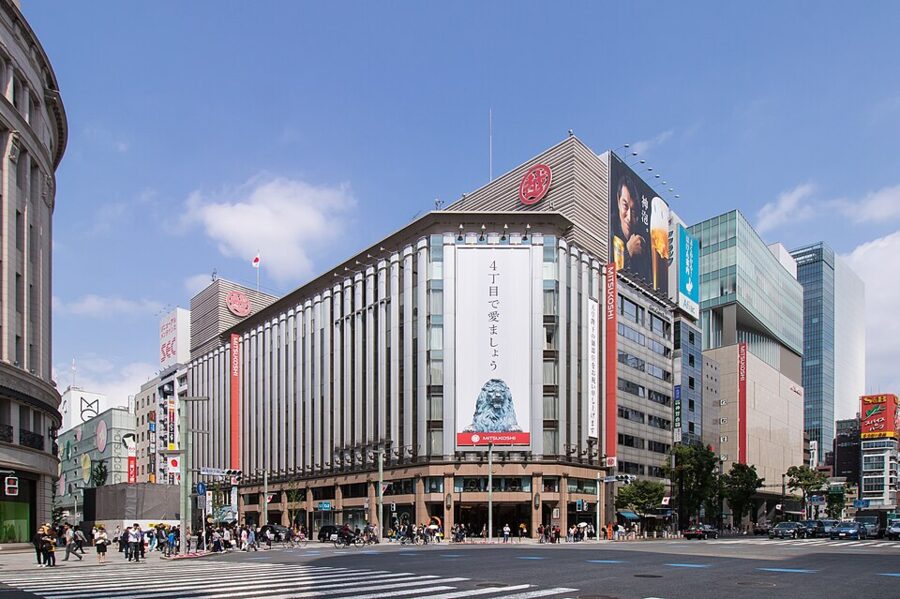
Across the crossing is Ginza Mitsukoshi, open since 1930. The store’s posted hours are 10:00–20:00, with some floors different. Three things make it worth the detour even if you buy nothing: the basement food floors, the ninth-floor Ginza Terrace (a garden with seating, open to anyone), and the small Shusse Jizo statue on that terrace, which office workers visit for luck at work. The store’s own shrine, Mimeguri Inari, is on the roof.

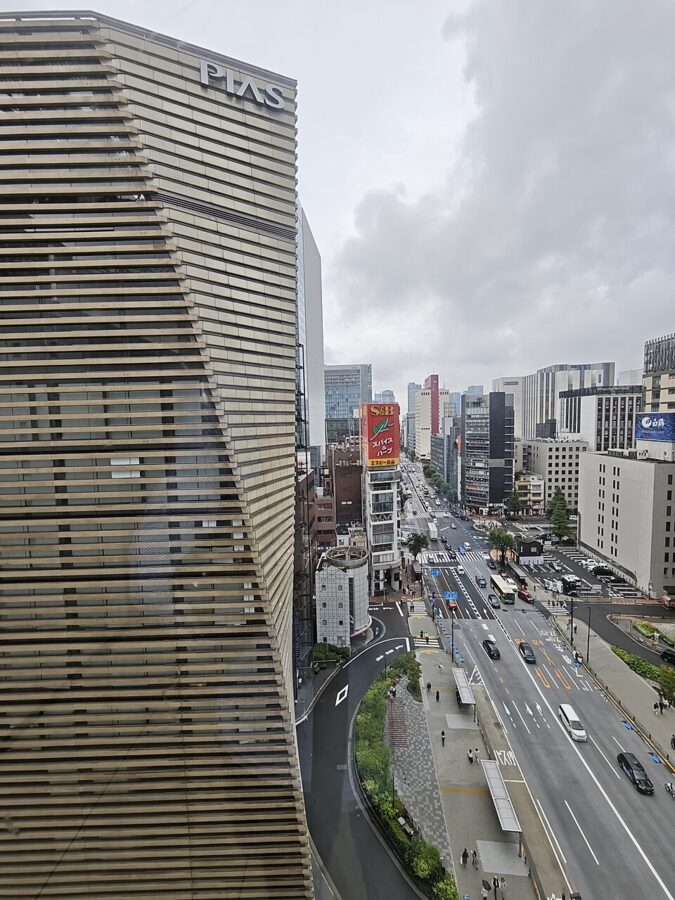

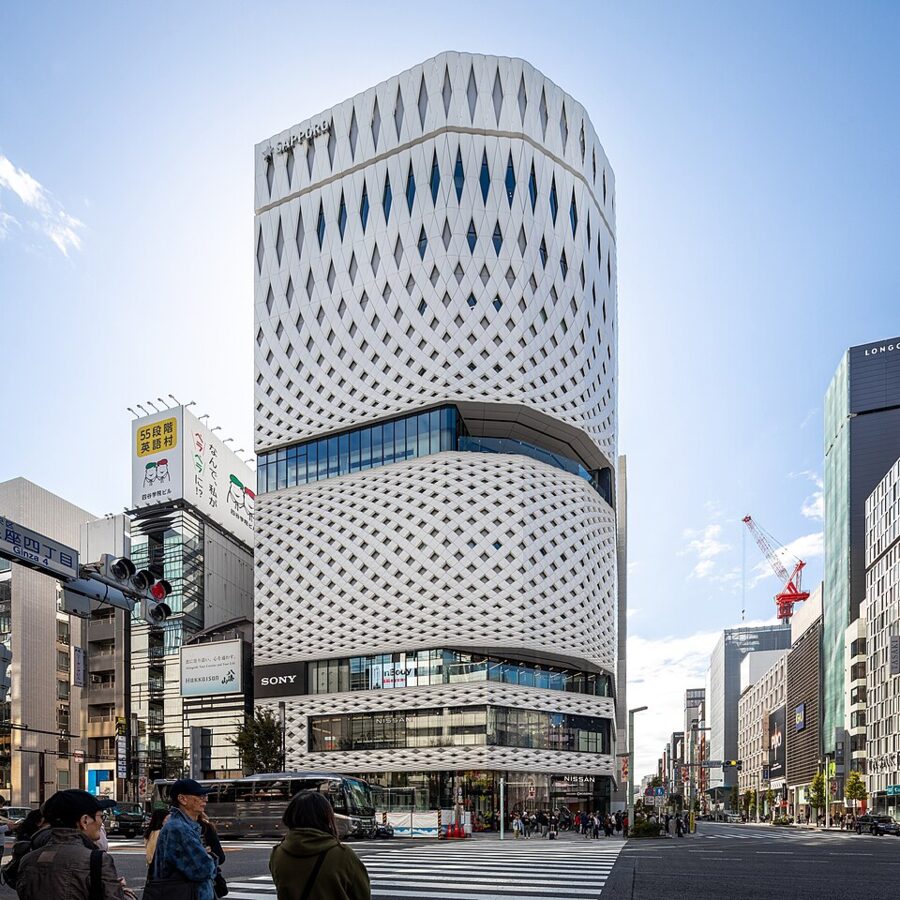
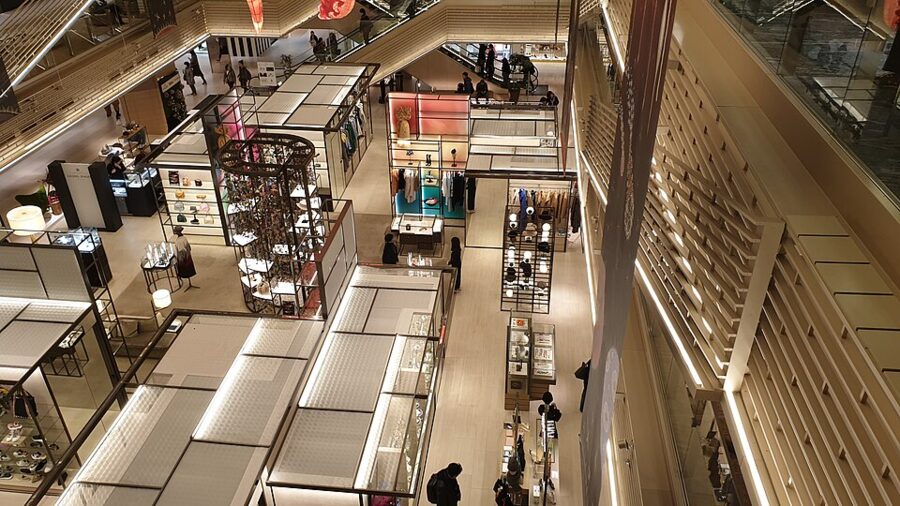
Ginza Place, the white lattice building on the third corner, opened in September 2016 on the plot where the Cafe Lion opened in 1911. Exit A4 opens into it. The first two floors are Nissan Crossing, a car showroom with a cafe; the fourth and fifth are the Sony Store; the basements are where to drink (more on that below).

Matsuya Ginza
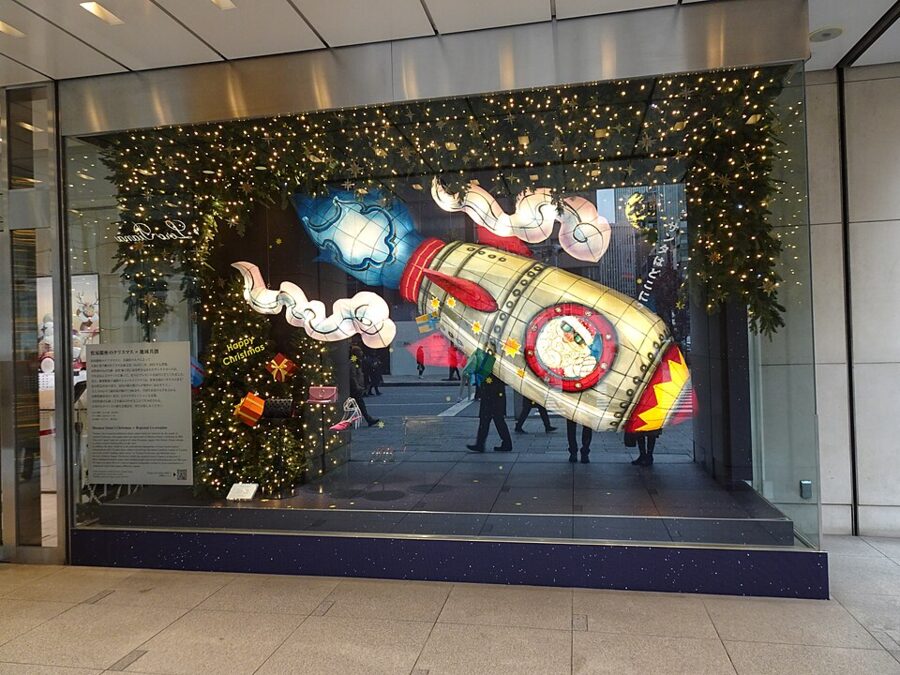
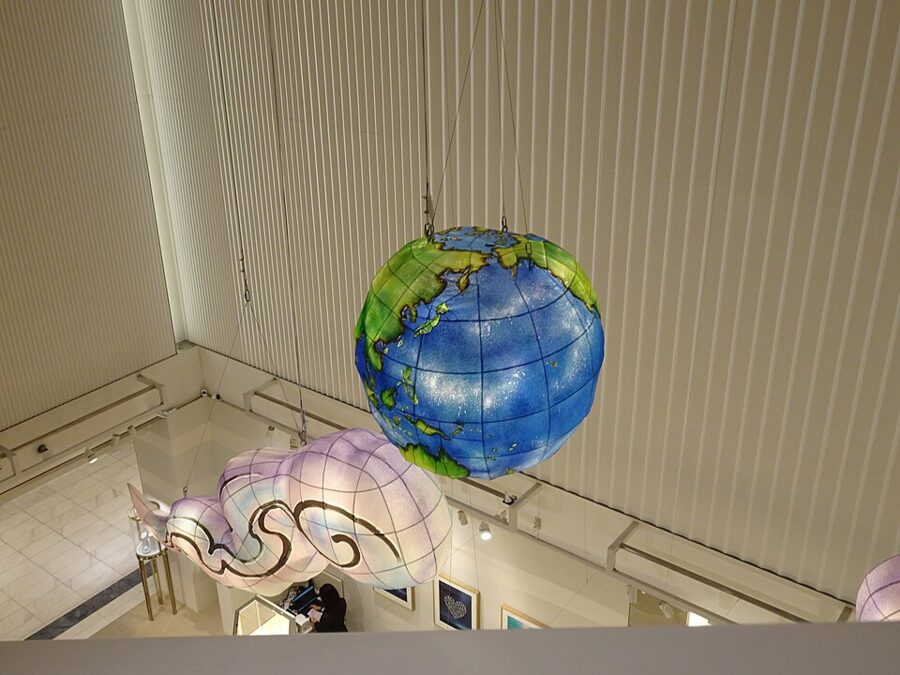
Matsuya, a block north on the east side of Chuo-dori, opened on May 1, 1925 and marked its centenary in 2025. It sells itself as the design department store, with a long-running design collection chosen by the Japan Design Committee, and its show windows change with the season. Exit A13 comes up beside it.
Its roof breaks a Ginza pattern. Mitsukoshi has an Inari shrine on top, and Ginza Six inherited one from the Matsuzakaya store it replaced; Matsuya’s roof has Ryuko Fudoson, a Buddhist guardian rather than the fox god of trade. Matsuya Foods, the unrelated beef-bowl chain that happens to share the name, announced plans to open its first department-store shop inside Matsuya Ginza in 2026.


Ginza Six
Ginza Six opened in April 2017 on the site of the old Matsuzakaya department store in 6-chome, and is the largest building in Ginza: 13 floors above ground, six below, and a frontage of about 115 meters on Chuo-dori. The posted hours are 10:30–20:30 for shops and 11:00–23:00 for restaurants.
What I’d use it for:
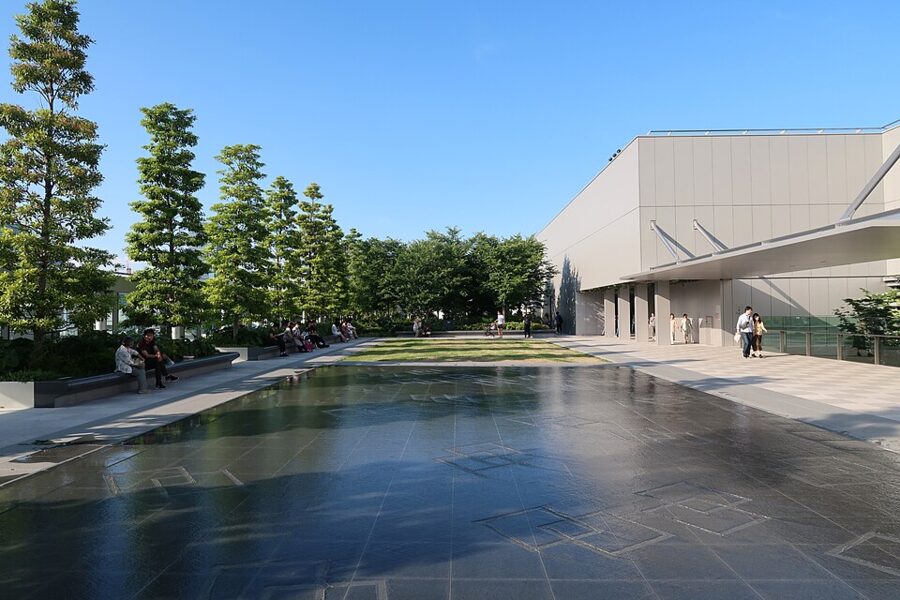
- The rooftop garden: free, open 7:00–23:00, closed without notice in bad weather. It is the largest roof garden in Ginza and hides a small shrine, Kakugo Inari, carried up from the Matsuzakaya roof.
- The tourist center: Terminal Ginza on the ground floor, with tourist information 9:00–21:00, currency exchange and a tax-free counter 10:30–20:30.
- Luggage: the Sagawa counter on the ground floor holds bags for the day at ¥800 per item up to 100 cm (three sides added together), ¥1,000 up to 160 cm and ¥1,500 above that, the rates in force since December 1, 2024. Last drop-off is 20:00.
- The food floor: the second basement, for gift sweets and boxed food.
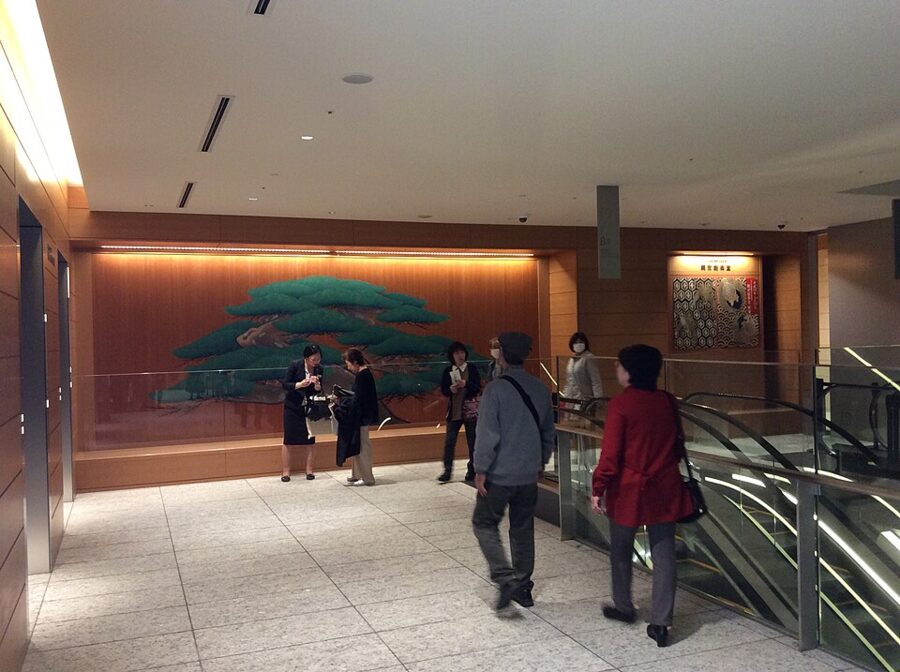
- The Kanze Noh Theater: a full cypress noh stage moved from Shibuya in 2017 and rebuilt on the third basement.



Sukiyabashi: GinzaNovo and Ginza Sony Park
The Sukiyabashi crossing, where Harumi-dori meets Sotobori-dori on the Yurakucho side, has the two newest buildings in the district.
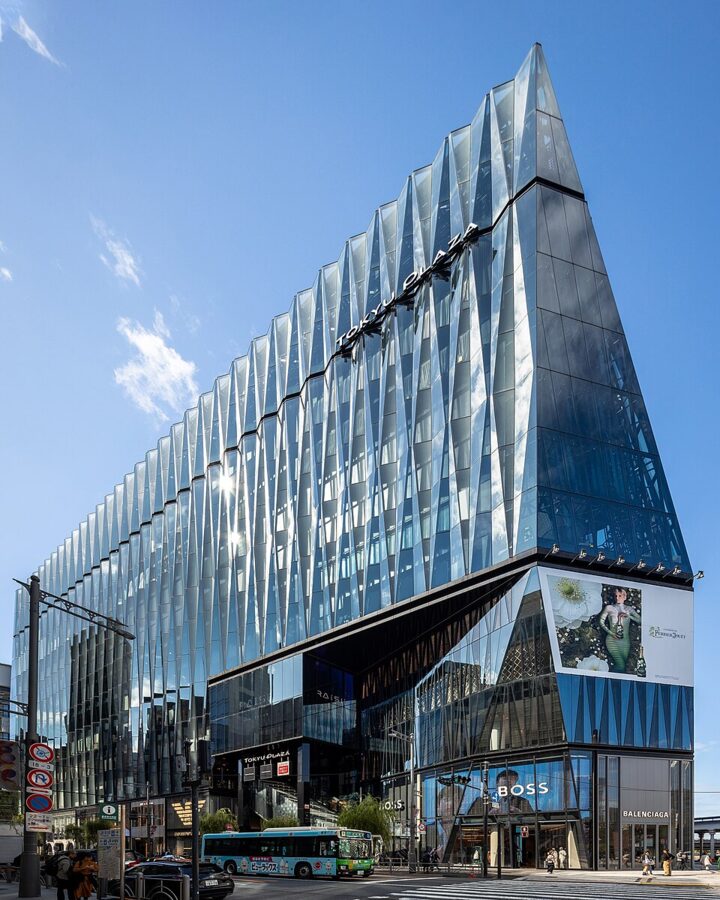
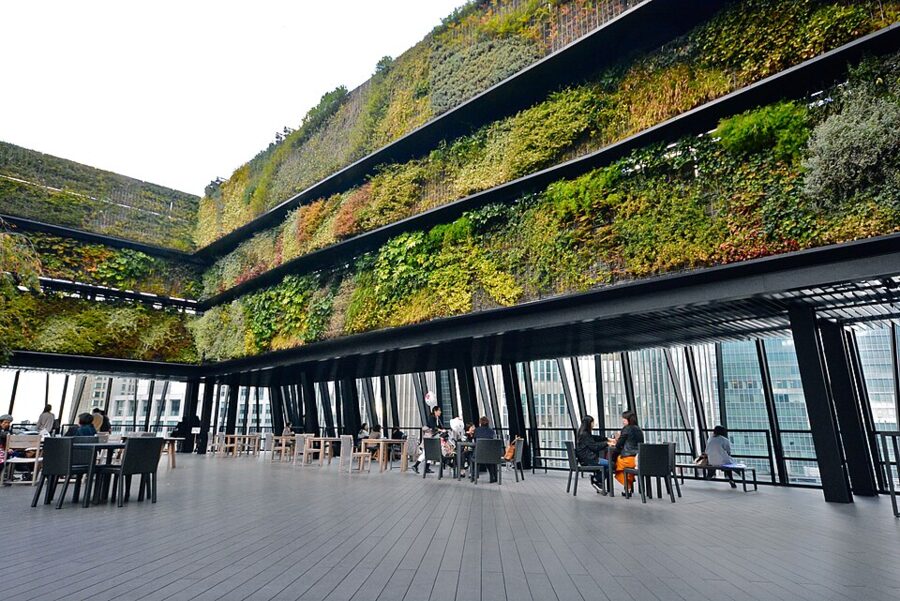
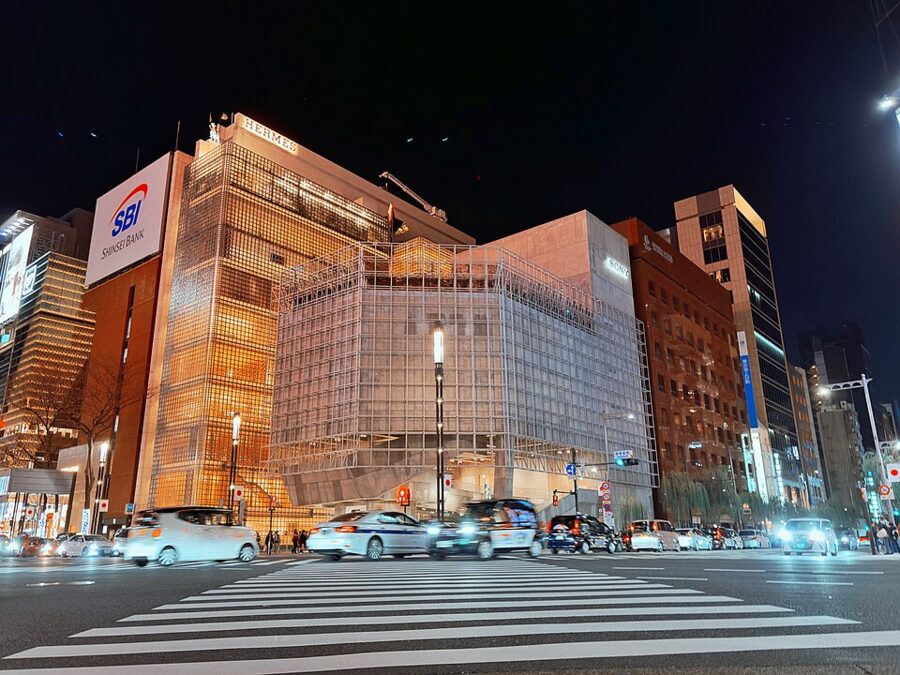
The faceted glass block on the corner opened on March 31, 2016 as Tokyu Plaza Ginza. Its new owner, the Hong Kong investor Gaw Capital, took over the running of the building on December 1, 2025 and renamed it GinzaNovo. Lotte Duty Free fills the eighth and ninth floors, and the roof is the Kiriko Terrace, a public space with planted walls and benches over the crossing.

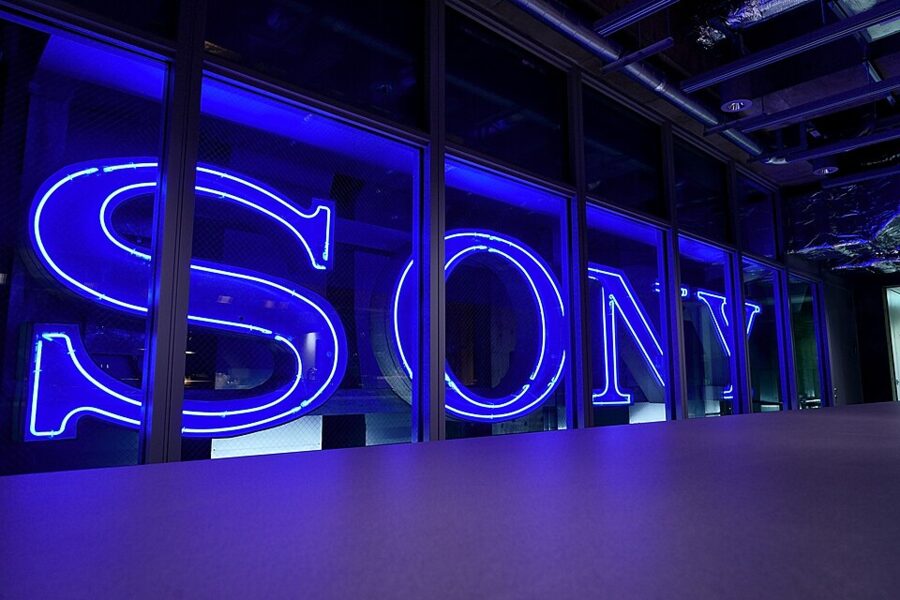
Across the road, Ginza Sony Park opened on January 26, 2025 on the site of the Sony Building, which stood here from 1966. It is deliberately low (three floors below ground, five above counting the roof), wrapped in a steel grid, and works as a venue rather than a store: exhibitions, events and pop-ups, with a spiral stair running from the subway concourse to the roof. Parts of the old Sony Building’s basement were kept where the park joins the station.
Whether it is worth your time depends on the week. In November 2026 it shared a vintage furniture fair with the Muji Hotel next door; earlier in the year it ran a show of old Walkmans and radios. Look at what is on before crossing the road for it.
The flagships
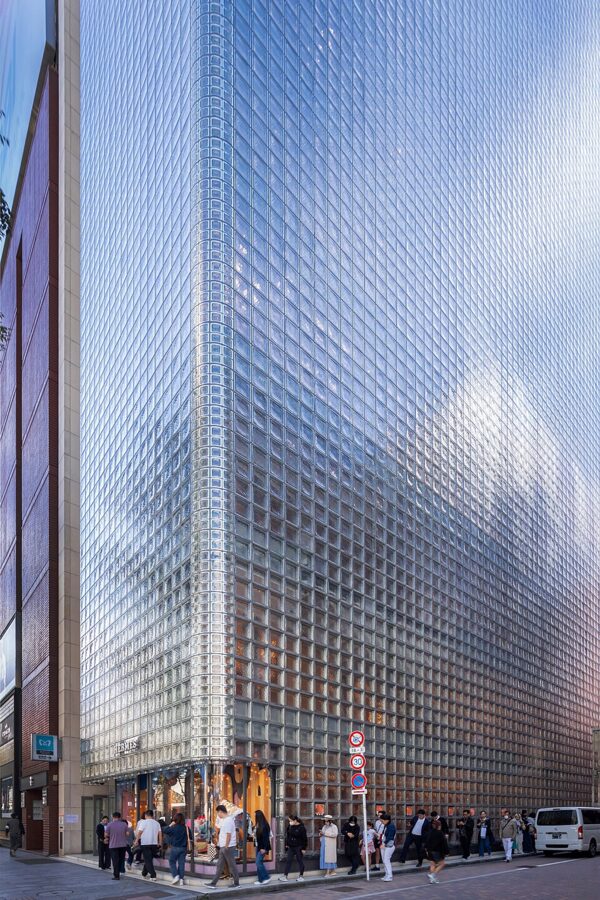
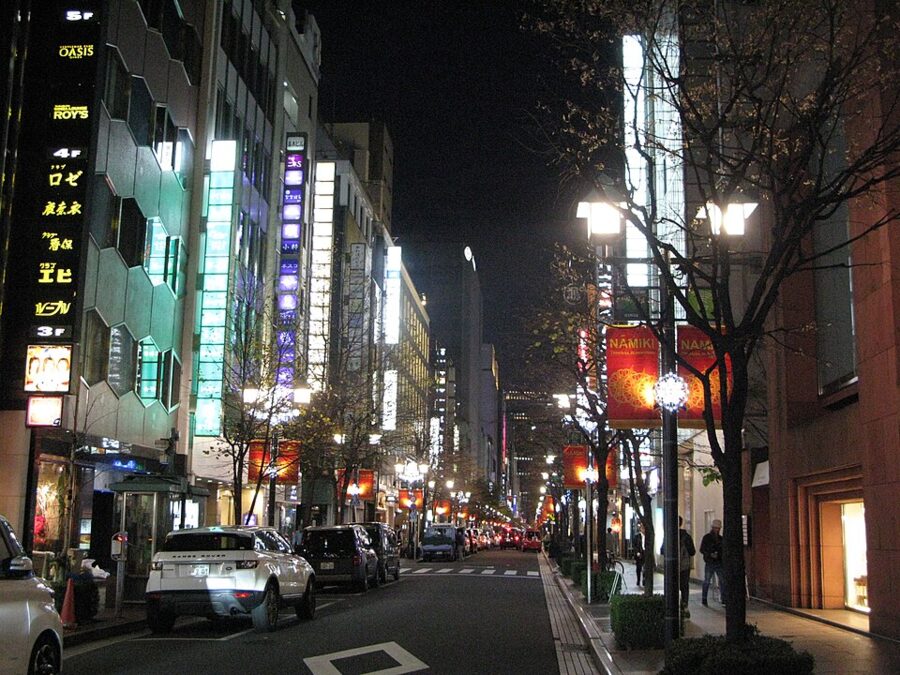
Chuo-dori and Namiki-dori, the narrower street one block west, are lined with fashion and jewelry flagships, and for most visitors they are architecture rather than shopping. The one I would cross the street for is Maison Hermès on Harumi-dori in 5-chome, the glass-block tower designed by Renzo Piano and opened in 2001. Its eighth-floor gallery, Le Forum, is one of Ginza’s better exhibition spaces (see below).

Galleries, theaters and the old brands
Kabukiza and the single-act seats
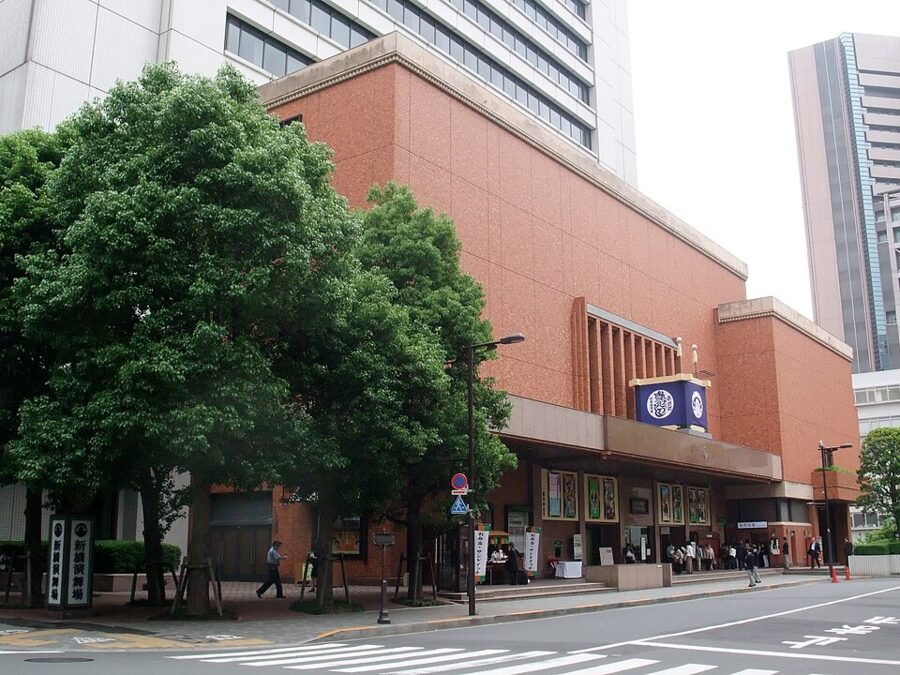
The Kabukiza in Higashi-Ginza is the main stage for kabuki, run by Shochiku. The present theater opened in 2013, a rebuilt copy of the old front with an office tower rising behind it. Programs run most of the month: the theater’s schedule has each program running from the first days of the month to about the 25th, usually in three parts a day, with tickets on sale in the middle of the month before.
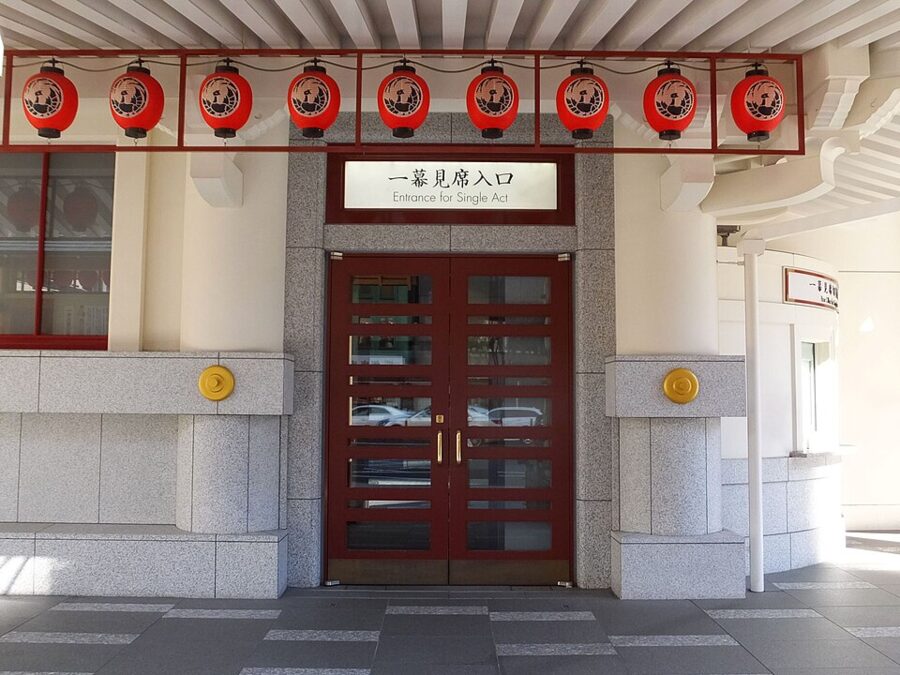
The single-act seats (一幕見席, *hitomakumi-seki*) are how most visitors see kabuki, and the way they are sold has changed. They are reserved seats on the fourth floor, sold through the single-act online ticket system from noon on the day before each performance, for every act at once. For the November 2026 program they cost ¥1,600–3,000 an act depending on length, plus a ¥110 system fee per ticket, credit card only, up to four per person.
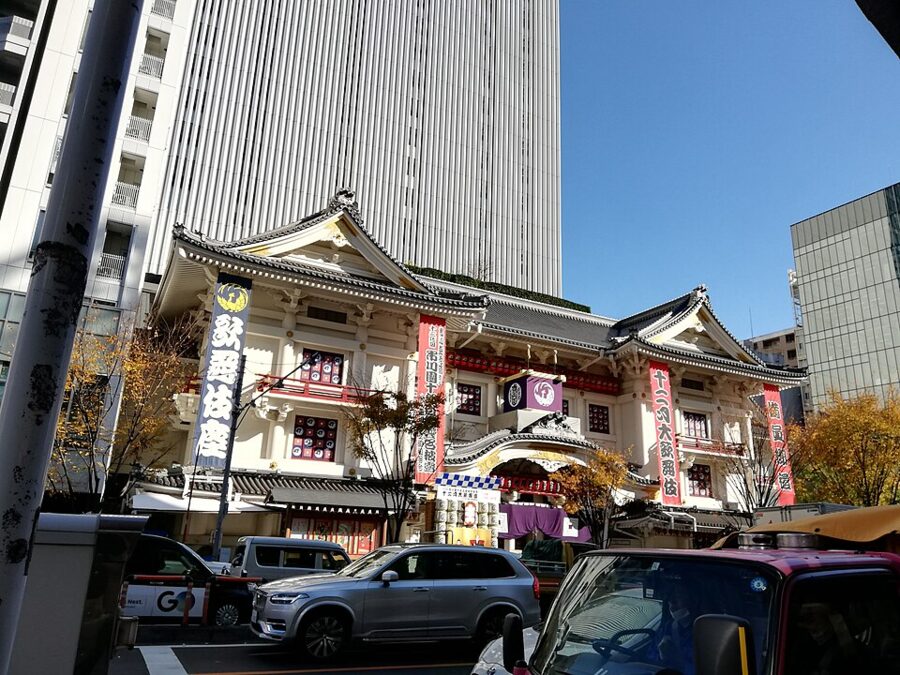
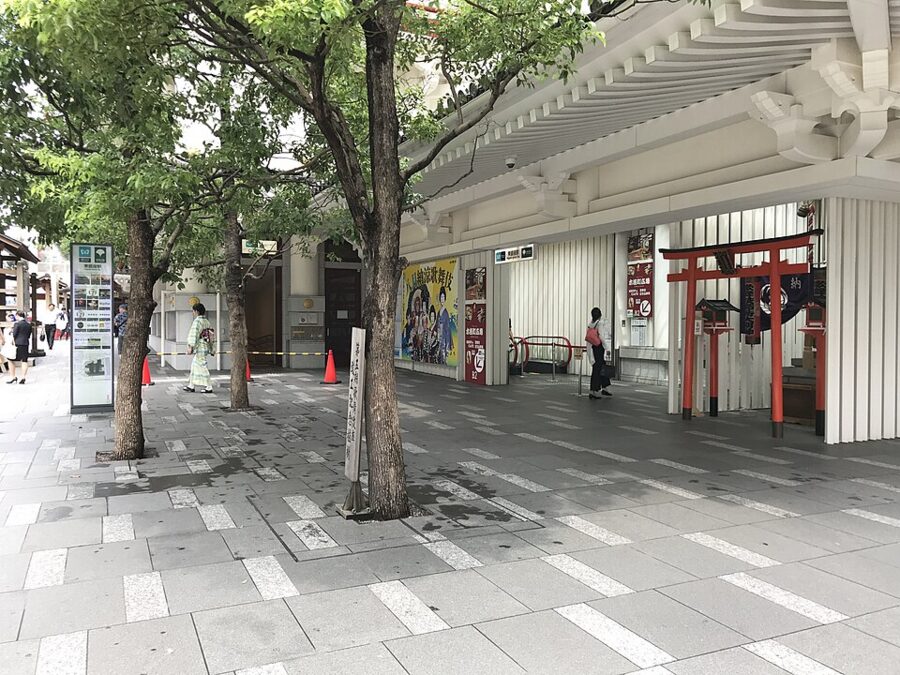

The fine print, all from the same sales page: you show a QR code on your phone or a printout to staff on the fourth floor; the entrance is the separate door on the left as you face the theater; the fourth floor has no food or shop; the seats are tighter than downstairs; and from up there you may not see all of the stage or the *hanamichi*, the walkway through the audience. Each act empties completely before the next. My advice is to set an alarm for 12:00 the day before and buy one act, not a whole half-day program.
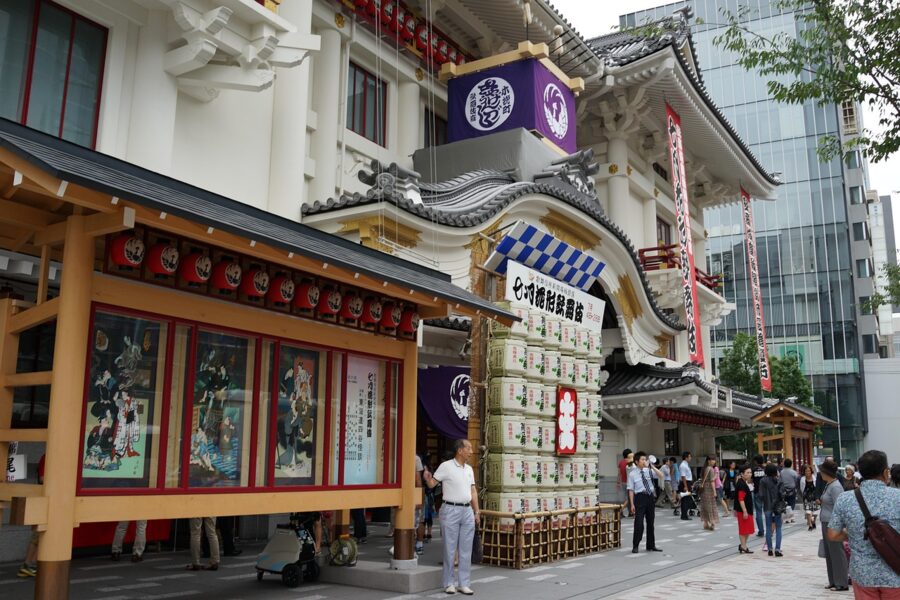
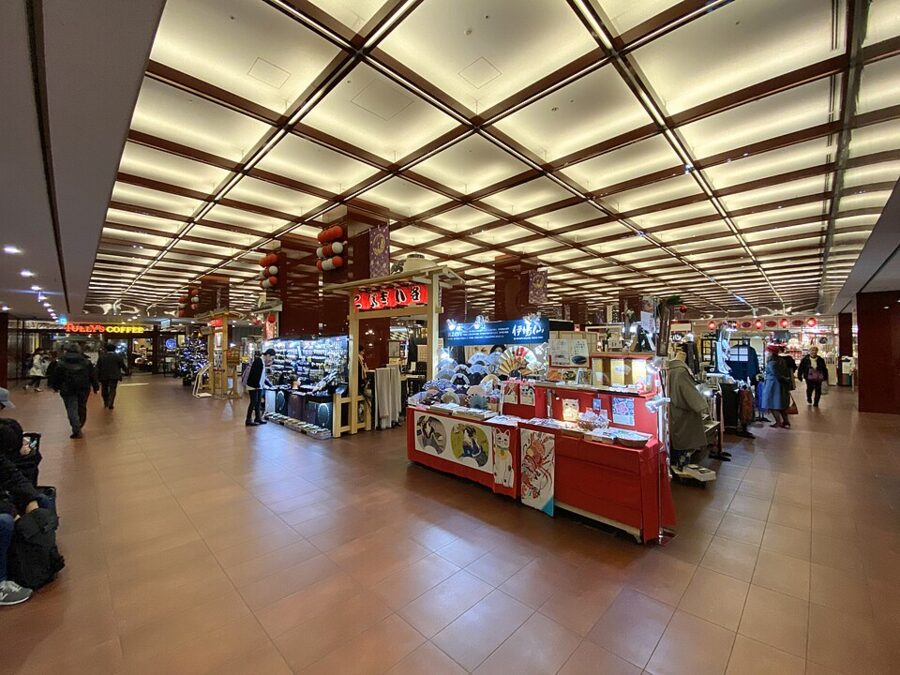
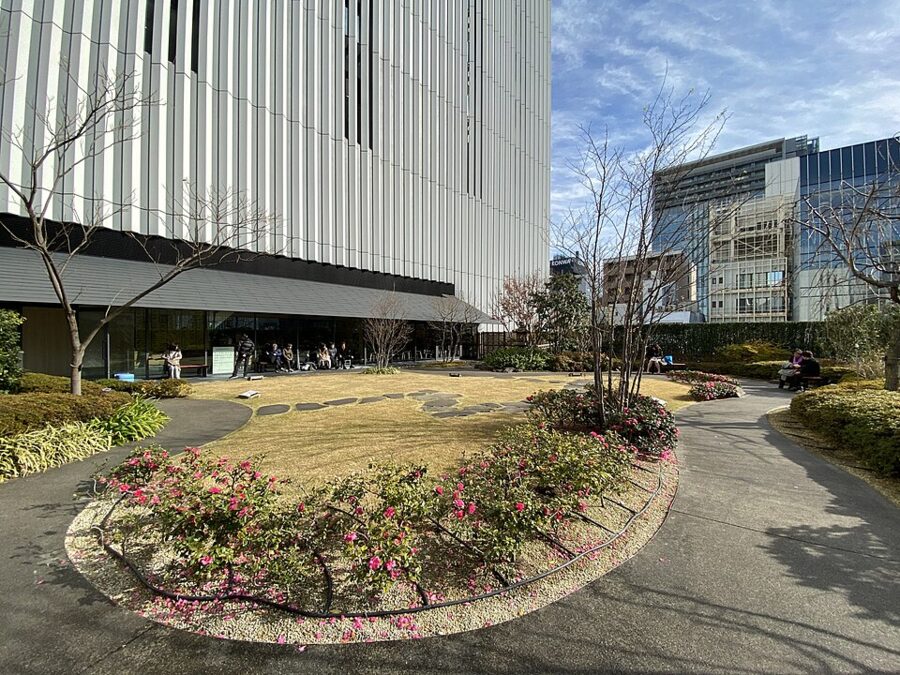
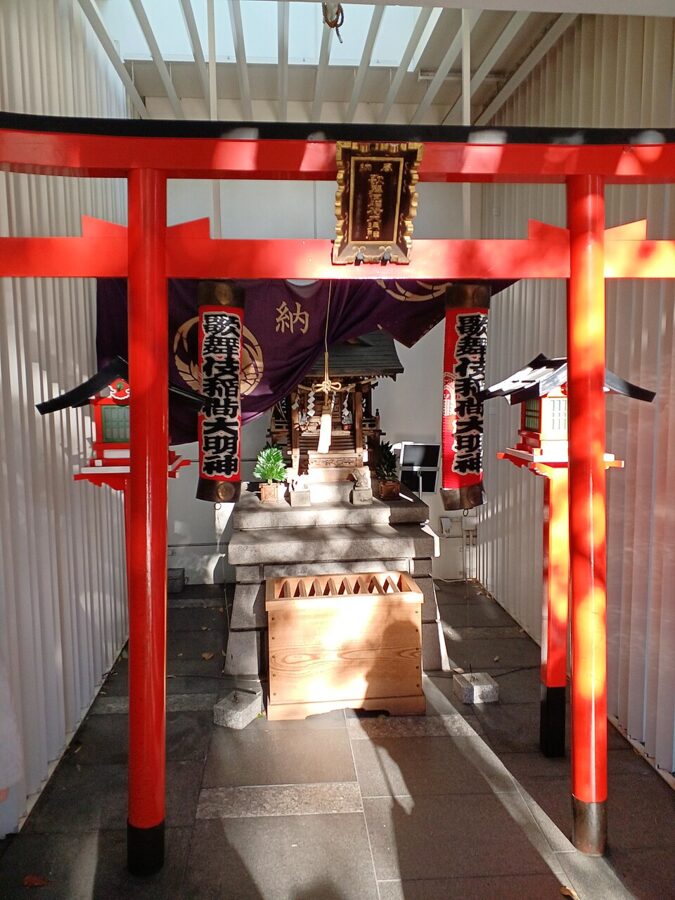
You do not need a ticket for the rest of the building. Kobikicho Hiroba, the shopping concourse on the second basement level, connects to the subway, sells kabuki souvenirs and boxed lunches, and is where the box office is. Up in the tower, the Kabukiza gallery corridor leads to a rooftop garden and a tea counter. Beside the theater is Kabuki Inari, the house shrine, which was moved out during the demolition and brought back for the new building.



Two other stages are within walking distance. The Shimbashi Enbujo, a few minutes south of the Kabukiza, opened in 1925 as a showcase for the Shimbashi geisha and was rebuilt on its present site in 1982; the geisha’s dance program, Azuma Odori, is still staged there each early summer, and the rest of the year it hosts kabuki, plays and musicals. The Kanze Noh Theater is under Ginza Six.
The free galleries
Ginza’s small commercial galleries are scattered on upper floors along Namiki-dori and in the 6-chome to 8-chome lanes, and most let you walk in without a word. The company galleries are the easiest to walk into.
- Shiseido Gallery: in the basement of the Tokyo Ginza Shiseido Building, 8-chome. Free. Open 11:00–19:00 on weekdays and Saturdays, 11:00–18:00 on Sundays and holidays, closed Mondays, including Mondays that are holidays.
- Le Forum at Maison Hermès: eighth floor, free, with one long show at a time on the gallery’s own page.
- Ginza Graphic Gallery: the design gallery run by the printer DNP’s foundation at 7-chome, about eight shows a year, listed on its exhibition page.
- Seiko House Ginza Hall: sixth floor of the clock tower building, for Japanese calligraphy, ceramics and lacquer.
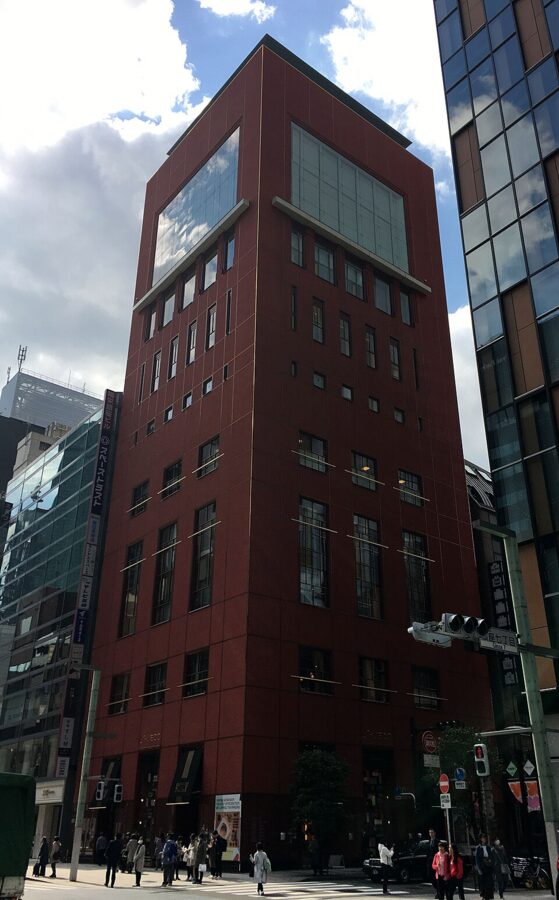
Shiseido is the old Ginza brand that explains the rest. It was founded here in 1872, the same year a fire burned the district down and the government rebuilt it in brick, and it never left. Its building in 8-chome holds the gallery, the Shiseido Parlour restaurant and cafe, and a ground-floor shop. The other names that have been on these blocks since the 19th century, Wako’s parent Seiko, Kimuraya and Itoya among them, are listed below where they are most useful.
The side streets and the old Ginza
Where the name came from
Ginza means “silver mint.” In 1612 the shogunate moved its silver coin office here from Sunpu (present-day Shizuoka), roughly where 2-chome is now, and the merchants’ street around it took the office’s name; it only became the official place name in 1869. A stone marking the spot, the Origin of Ginza monument, stands outside the Tiffany building in 2-chome. The postal code for the whole district is still one number, 104-0061.
The alleys and the shrines
Between the main streets, Ginza’s long, narrow blocks are cut by passages a person wide, and many of them lead to a shrine. Shops and offices kept their guardian Inari shrines through every rebuild, and Ginza’s street association has spent years publishing a series on them, Ginza Inari Tanbo.
- Toyoiwa Inari, 7-chome: reached by walking down a gap between two buildings; the red shrine and its stone foxes appear at the far end. Kabuki actors and people in the entertainment trade are said to visit it.
- Hodo Inari, 4-chome: in a narrow alley between Renga-dori and Namiki-dori, looked after by the shopkeeper across the way.
- The rooftop shrines: Mimeguri Inari on Mitsukoshi, Kakugo Inari in the Ginza Six garden, and Ryuko Fudoson on Matsuya.
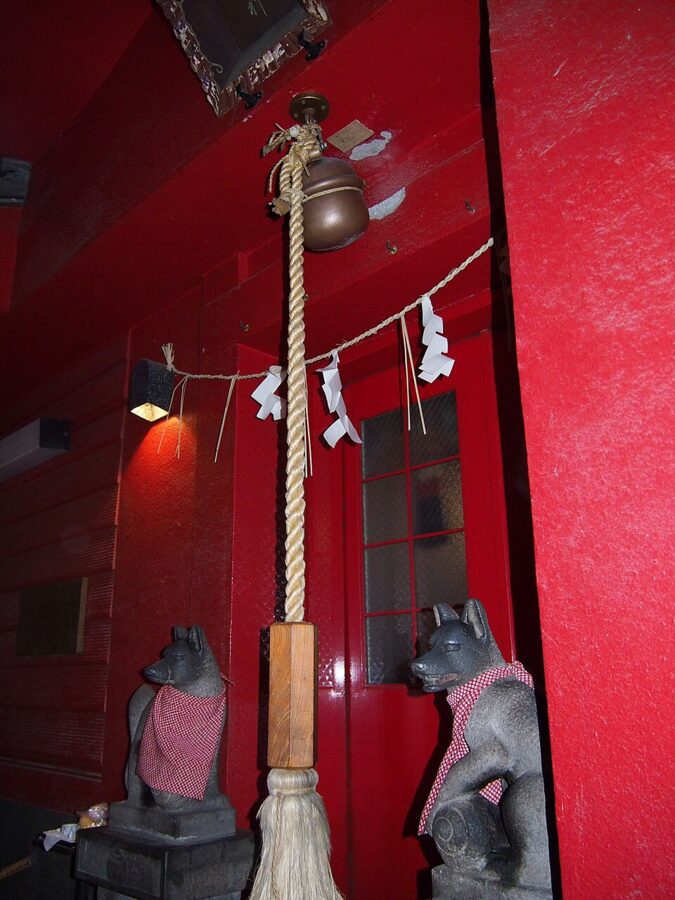

If you go looking, keep it quiet. These are working shrines in private passages, and the people you will meet in them are usually on their way to work.
Itoya: twelve floors of paper and pens
Itoya has sold stationery in Ginza since 1904; the red paper clip over the door on Chuo-dori is its sign. The main building, G.Itoya, runs to 12 floors, each with its own theme, and a second building, K.Itoya, sits behind it. The store’s hours are 10:00–20:00 on weekdays and 10:00–19:00 on Sundays and holidays. On the 11th floor is a small indoor farm growing lettuce behind glass, and on the 12th the restaurant Cafe Stylo serves it, 11:30–21:00 (last order 20:00).
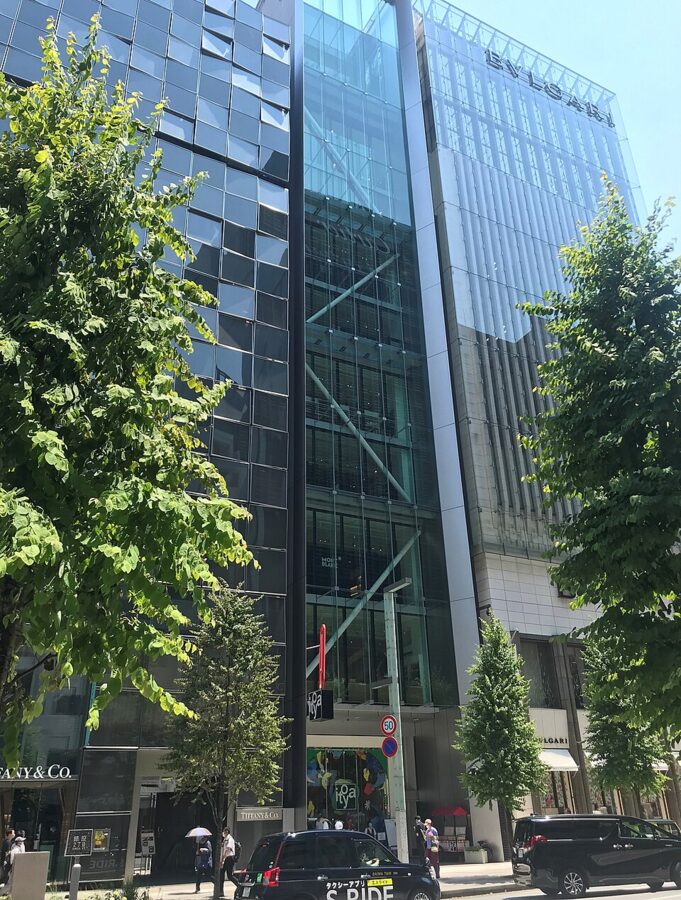

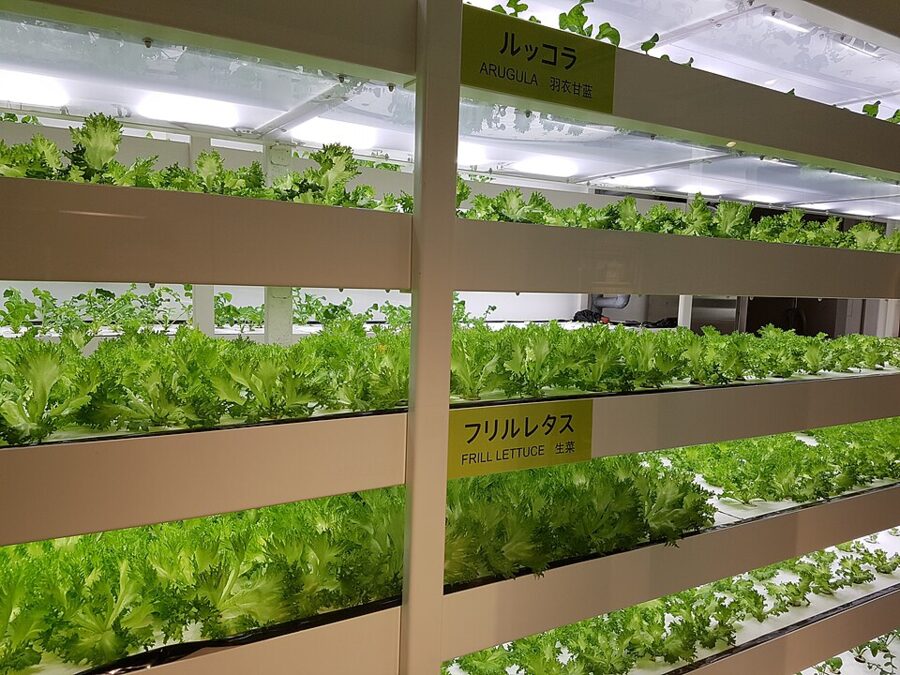

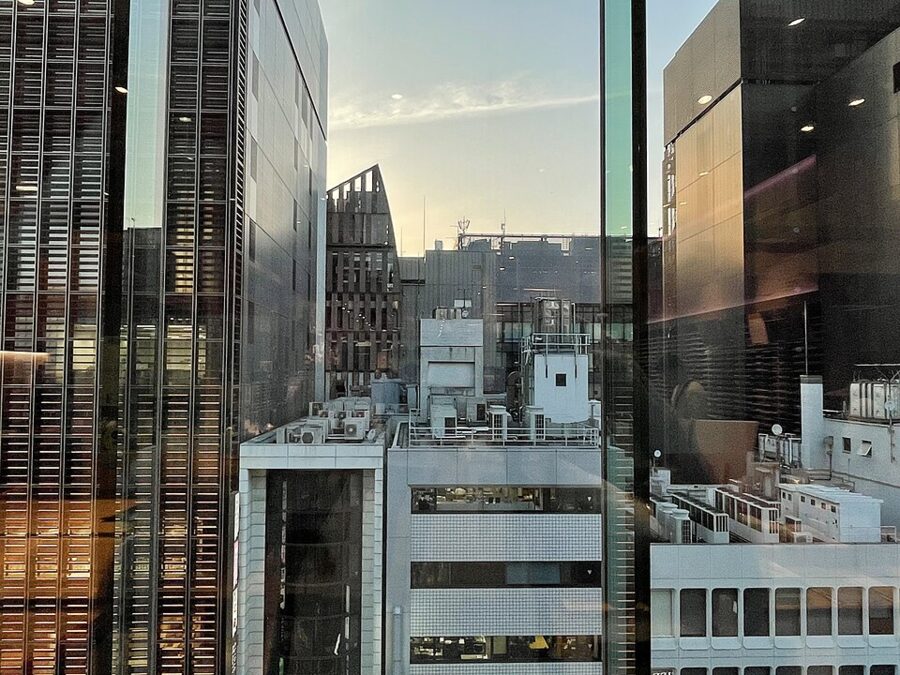

My advice: start at the top and take the stairs down. The store is laid out to be browsed floor by floor, and the elevators are slow on weekends.
The kissaten
Two of Ginza’s old coffee houses are still pouring in 8-chome, a few minutes’ walk apart.
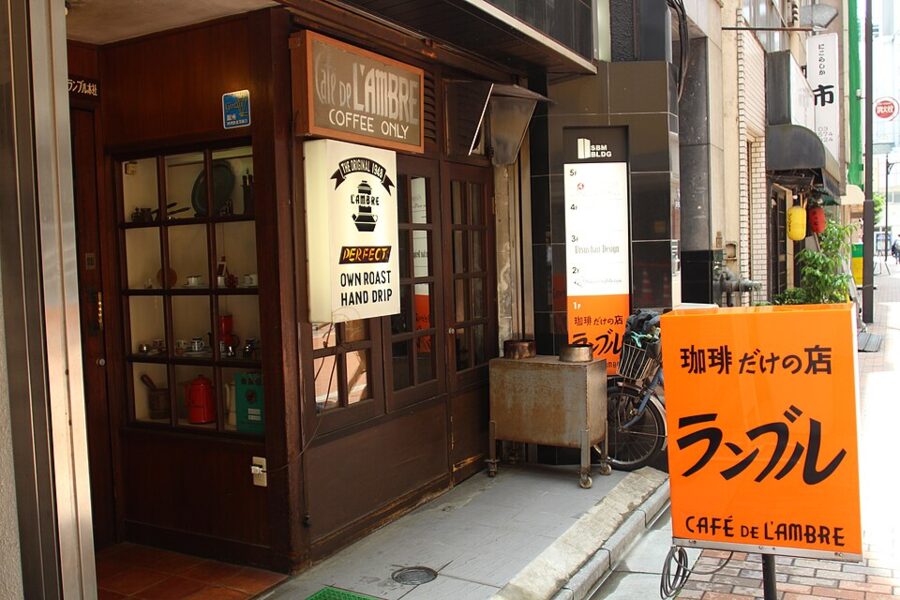
Cafe de l’Ambre, opened in 1948, calls itself a shop that serves “only coffee,” roasted on the premises and dripped through flannel. The posted hours are 11:00–20:00 on weekdays (last order 19:00) and 11:00–18:00 on Sundays and holidays (last order 17:00), closed Mondays. Prices on the whole menu went up on November 10, 2026.

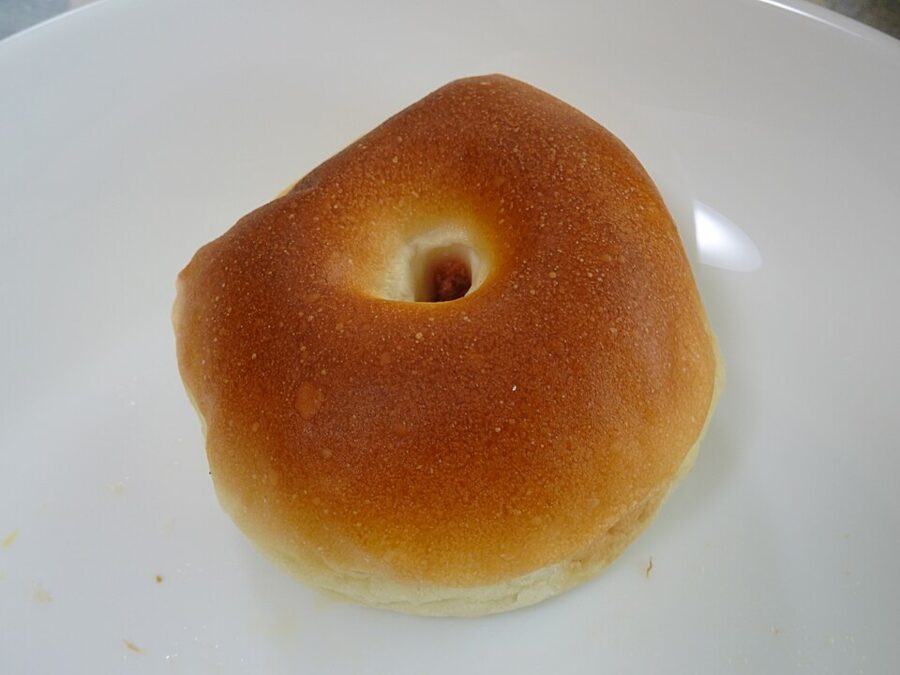
Cafe Paulista, around the corner, still roasts its own beans and sells them online, and it is the place for a cup with a plate of cake rather than a lecture on extraction. For bread, Ginza Kimuraya at 4-5-7, founded in 1869 and the bakery behind the bean-paste bun that became a national snack, sells from 10:00 to 20:00 every day except December 31 and January 1, with a restaurant on the floors above.

Eating at every price
The depachika and the food floors
The cheapest good meal in Ginza is in a department store basement. Mitsukoshi, Matsuya and Ginza Six all have *depachika*, food halls selling boxed lunches, sushi, sweets and gift food, and the rooftops above them are where you eat it. Go between 11:00 and 12:00 for the widest choice; by late afternoon the boxed lunches thin out and the gift counters take over. The Tokyo food guide covers what to order in a depachika and how to read the labels.
Lunch at the expensive places
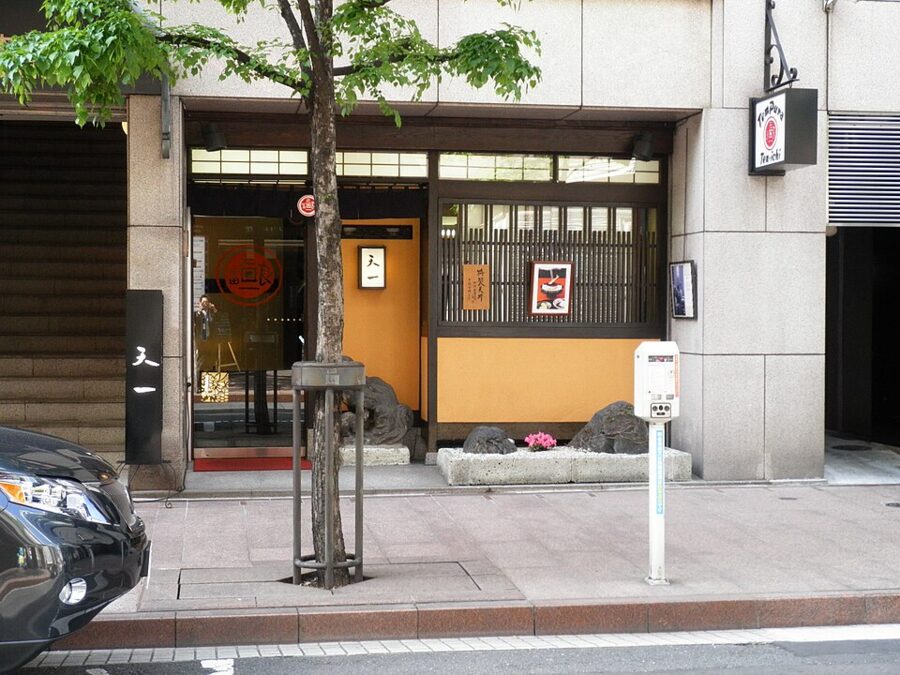
The rule for Ginza’s famous restaurants is to go at lunch. Tenichi, the tempura house, is a fair example: the main branch at 6-6-5 serves lunch 11:30–16:00, with the table course at ¥6,000 and the counter course, where the cook fries in front of you, at ¥11,000. Dinner there runs to 22:00 and costs more.

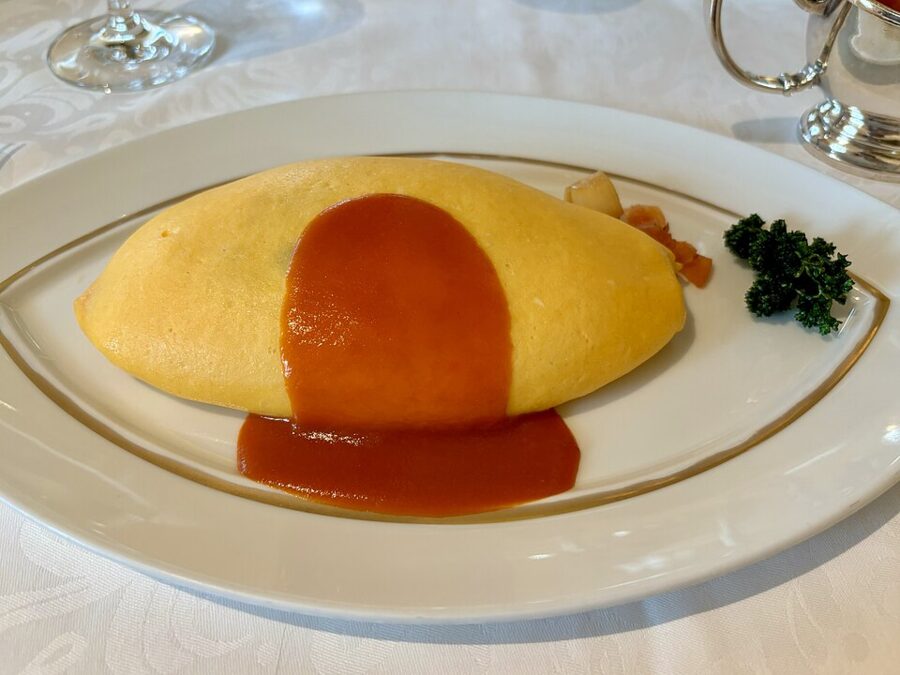
Shiseido Parlour is the other old house that suits a midday visit. Its 8-chome building has a restaurant on the fourth and fifth floors, serving the Western-style dishes Japan calls *yoshoku*, and a cafe on the third known for fruit parfaits. The omurice is the order.

Standing bars and the beer hall
Two of the best cheap drinks in Ginza are owned by the same brewer. Sapporo’s Black Label The Bar, in the first basement of Ginza Place, is a standing bar that pours one beer three ways; it opens 11:30–22:00 (last order 21:00), with a glass listed from ¥880.
The second basement of the same building holds Lion Ginza 5-chome, a beer hall run by Sapporo’s restaurant arm, which keeps up a beer business that began on this plot when the Cafe Lion opened in 1911.
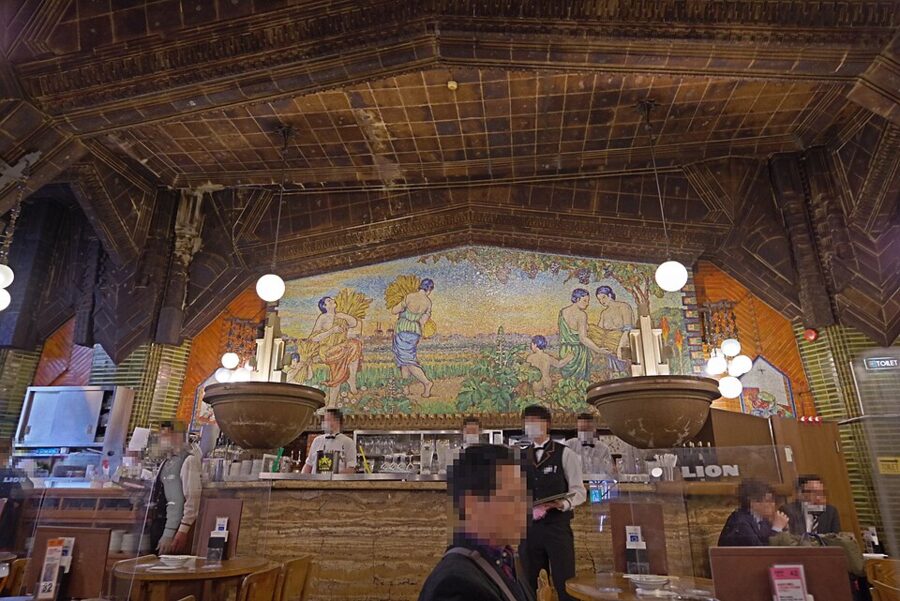
Beer Hall Lion Ginza 7-chome, a block south of Ginza Six, is the beer hall that opened in 1934 and has kept its original interior, mosaic mural and all. The hall’s hours are 11:30–22:00 from Sunday to Thursday (last order 21:30) and 11:30–22:30 on Fridays, Saturdays and the eve of holidays (last order 22:00). It has 280 seats and no closing day; from December 31 to January 3 it adds 10% to the bill.

Dinner and bars after dark
After 18:00, Ginza’s 6-chome to 8-chome lanes turn into a bar district stacked in elevators: cocktail bars and whisky bars on the fourth or seventh floor of narrow buildings, many with a seat or table charge, some with a dress code, and the members-only hostess clubs that give the area its reputation and its bills. Corridor-gai, the strip along the expressway on the Yurakucho side, is the more casual end. All of that, with prices and the questions to ask before you sit down, belongs to the Tokyo nightlife guide.
Next door on foot
Ginza runs into four neighborhoods without a break, and most days the best plan is to walk out of it. Walking times below are from the 4-chome crossing.
Yurakucho under the tracks
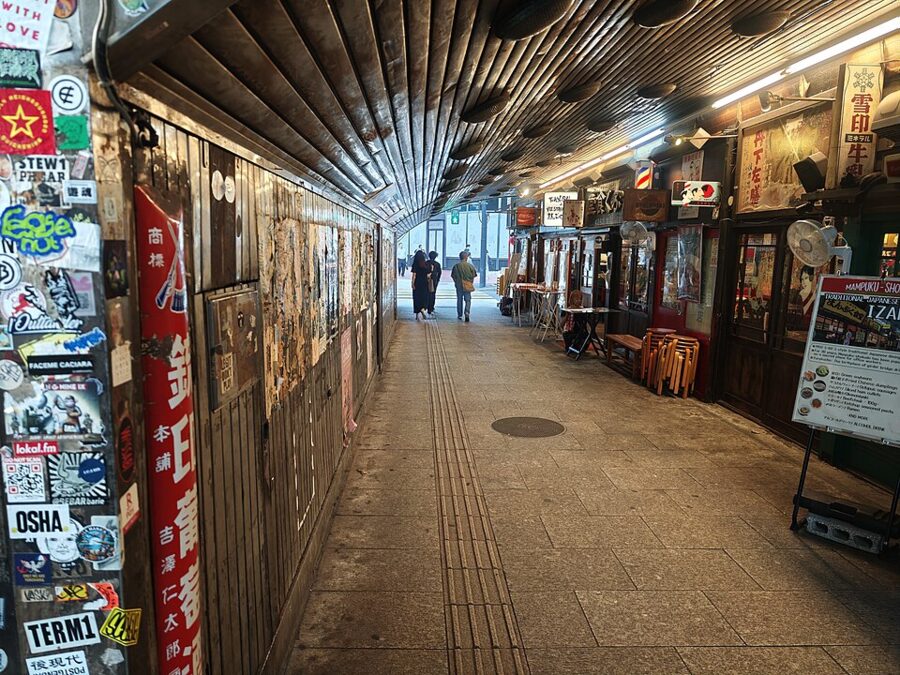
Five to ten minutes west, past the Sukiyabashi crossing. The brick arches carrying the JR lines between Yurakucho and Shimbashi stations are filled with small restaurants and bars, the *gado-shita* (literally “under the girders”), and a plate of yakitori under a passing train costs a fraction of anything in 4-chome.


Hibiya
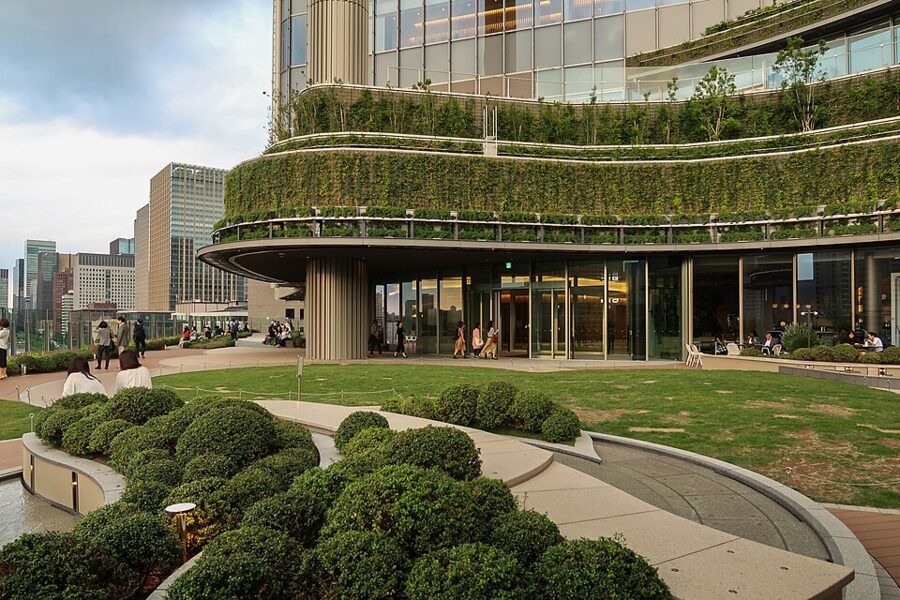
About ten minutes west through Yurakucho. Tokyo Midtown Hibiya, opened in March 2018, has a free sixth-floor garden that looks over Hibiya Park, Japan’s first Western-style park; past the park are the moats of the Imperial Palace.

Higashi-Ginza and the Kabukiza
Five to eight minutes east along Harumi-dori, across Showa-dori. This was Kobikicho, cut off from Ginza by a canal until the canal was filled in, and it still feels like a separate neighborhood, quieter and more residential, with the Kabukiza at its front door. The theater’s shop concourse still carries the old name.
Tsukiji Outer Market
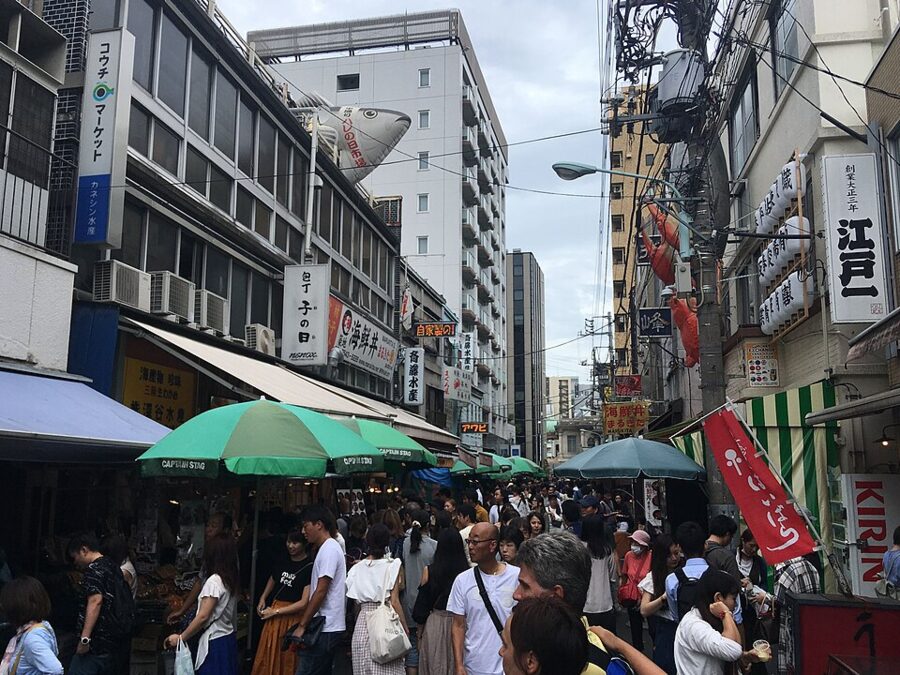
About 15 minutes on foot, straight down Harumi-dori past the Kabukiza. Go in the morning: many of the outer market’s shops close when Tokyo’s central wholesale market has a closing day, so check the market’s own calendar before going on a Wednesday or a Sunday.

Nihonbashi
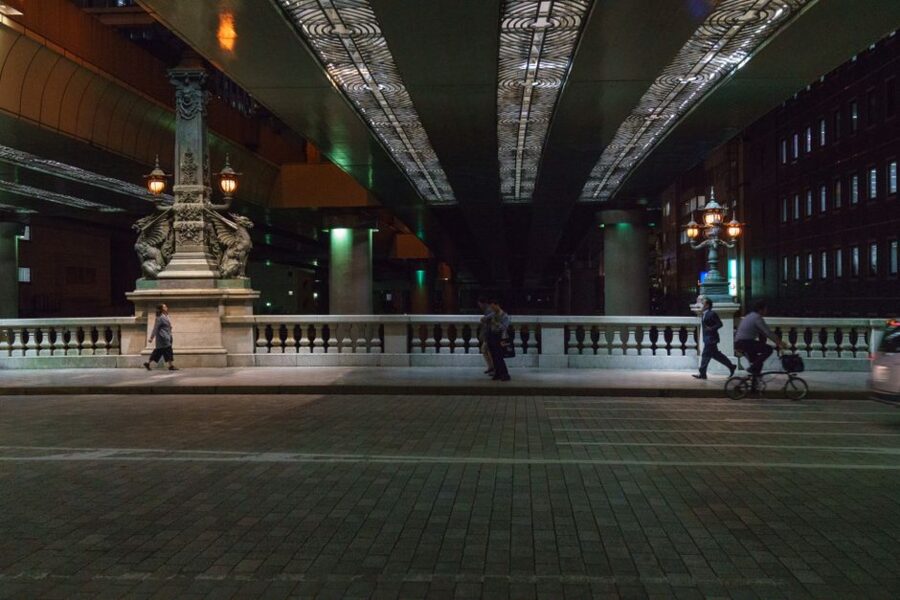
About 20 minutes north up Chuo-dori, through Kyobashi. It is the walk that shows how Ginza’s main street was laid out, as the first stretch of the old Tokaido road, and it ends at the bridge every highway distance in Japan is measured from.
For the bigger picture, the Tokyo neighborhoods guide sets Ginza against the rest of the city, and things to do in Tokyo has the sights beyond walking range.
Tax-free shopping and practical notes
Tax-free shopping changed on November 1, 2026
Since November 1, 2026, tax-free shopping in Japan has worked as a refund. Under the National Tax Agency’s new rules, stores charge foreign visitors the full price including consumption tax; you show your passport when you buy, customs confirms at departure that you are taking the goods out of Japan, and the store refunds the tax after that confirmation. You have 90 days from the date of purchase to leave with the goods.
The rest of the old rules were simplified at the same time. The minimum is ¥5,000 before tax at one store, with no separate categories for consumables, no ¥500,000 cap on them and no sealed bags. Keep the goods together until you leave the country: if you no longer have every item from one purchase record when customs checks, none of that record is confirmed. Department stores and Ginza Six have central tax-free counters; Ginza Six’s is open 10:30–20:30.
Hours, closing days and where to sit down
The big stores open at 10:00 (Mitsukoshi) or 10:30 (Ginza Six) and close at 20:00 or 20:30; restaurant floors stay open later, to 23:00 at Ginza Six. Department stores close around New Year, and each posts its own dates: Ginza Six and Mitsukoshi post their year-end hours in December. Galleries are another matter: the Shiseido Gallery closes every Monday, holidays included.
Sitting down for free is not easy at street level. The rooftops (Ginza Six until 23:00, the Kiriko Terrace at GinzaNovo, Mitsukoshi’s ninth-floor terrace) are the answer, along with the Kabukiza’s rooftop garden.
Luggage, information and smoking
Station coin lockers are small and few for a district this busy, so if you are carrying a suitcase between hotels, use the Ginza Six luggage counter, which takes bags of any size for the day. The same building’s Terminal Ginza is the main tourist information desk, open 9:00–21:00. Smoke only at the designated smoking spots; the street association publishes a map of them.
If you are choosing a base, the where to stay in Tokyo guide covers Ginza’s hotels against the rest of the city, and the Tokyo travel guide has the season-by-season picture.
The barriers go back across Chuo-dori at noon on Saturday. In November they come down again at 17:00, which leaves five hours: enough for the avenue, one roof, one basement and a single act at the Kabukiza, if you set an alarm for noon on Friday.