

Four railway lines stop at a station called Asakusa, and only three of them stop at the same one. The Tsukuba Express platform sits under Kokusai-dori about 600 m west of the Ginza Line, Toei and Tobu stations, and the operators do not treat the two sides as a transfer. Pick by the end of the district you came for: the Ginza Line’s Exit 1 comes up a couple of minutes from Kaminarimon, the temple’s outer gate, and the Tsukuba Express’s Exit A1 comes up half a minute from Asakusa Engei Hall.
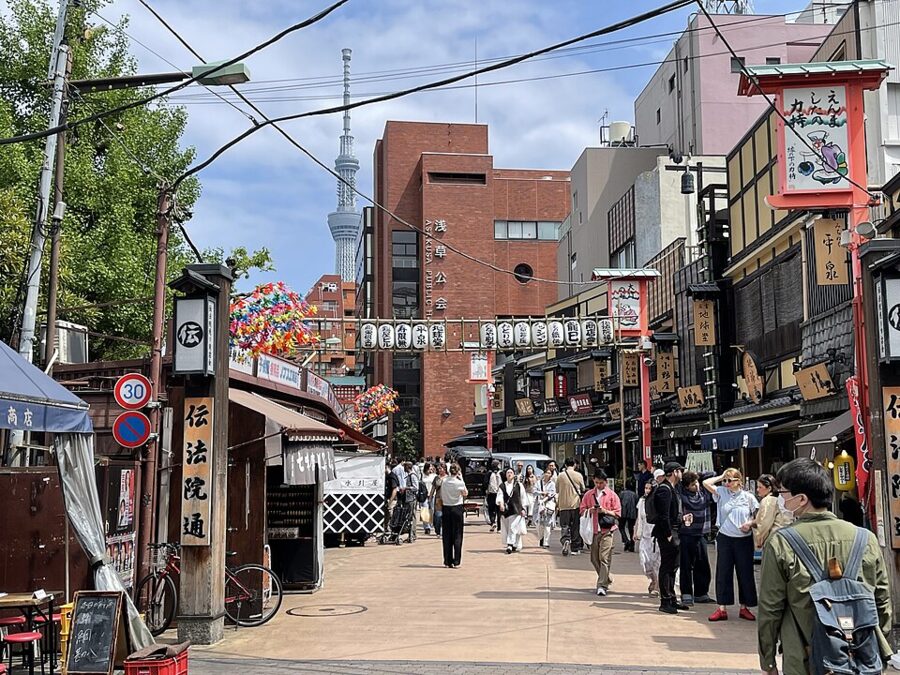

Asakusa (浅草) is the old entertainment and temple quarter of Taito ward, on the west bank of the Sumida River, and most people see a tenth of it. They come up at Kaminarimon, shuffle up Nakamise to Senso-ji, and leave. The rest of the district is a grid of covered arcades, rakugo theaters, stew bars with plastic stools on the street, a kitchenware street that sells to chefs, and a riverbank with boats to the bay and a footbridge to Skytree.
The day that works is simple. Reach the temple before 09:00, while the Nakamise shutters are still down, then walk west along Denboin-dori into Rokku for a rakugo matinee or a bowl of stew on Hoppy Street. Do Kappabashi on a weekday, never a Sunday. Finish at the river around dusk and cross to Skytree on foot, or take a boat downstream.

If you only have an hour, the Tokyo neighborhoods guide sets Asakusa beside the other districts. The district rewards a half day or more, and the prices and hours here are as the operators and venues post them in late 2026.

Getting in: the four stations called Asakusa
Three operators share one cluster of stations on the riverside end of the district, along Edo-dori by Azuma Bridge: the Tokyo Metro Ginza Line (G19), the Toei Asakusa Line (A18) and the Tobu Skytree Line (TS01). The fourth, the Tsukuba Express (TX03), is a separate station on the far side of the temple. Getting between the two sides takes 8 to 12 minutes on foot.
Tokyo Metro Ginza Line
This is the line most people arrive on, and the oldest subway in Asia: the stretch from Asakusa to Ueno opened on December 30, 1927. It runs from Asakusa through Ueno, Ginza and Omotesando to Shibuya in about half an hour, and Ueno is five minutes away. Asakusa is the end of the line, so you cannot overshoot.
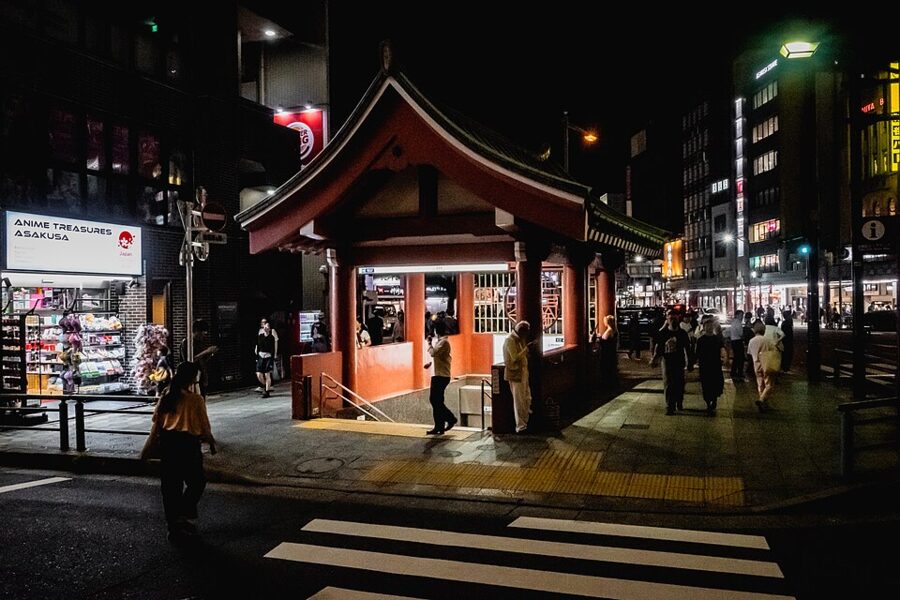
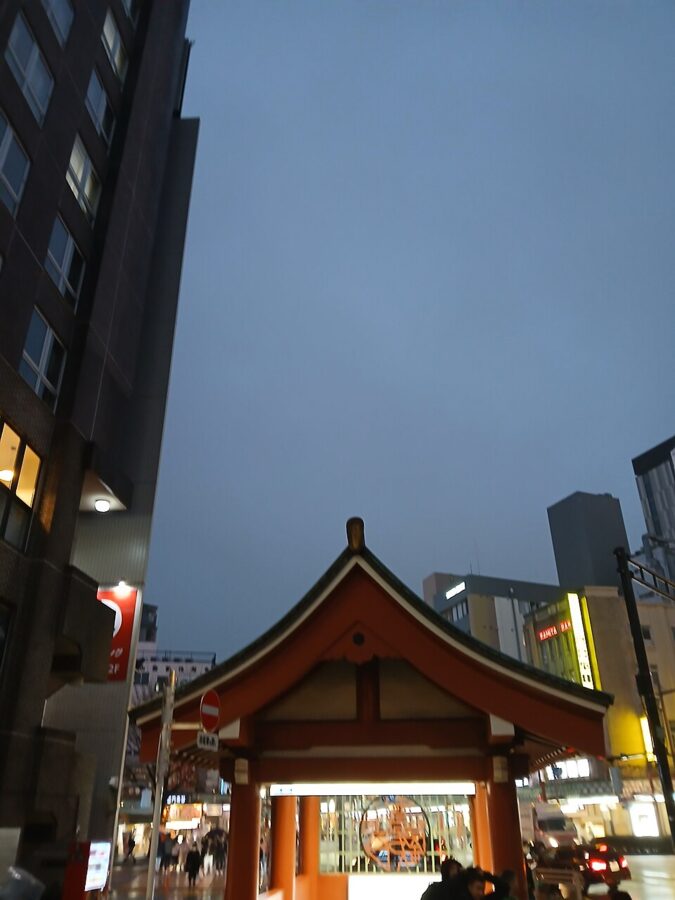
The station has three concourses that do not connect outside the ticket gates, and the exit you pick decides where you surface. The central concourse has Exits 1 to 4: Exit 1 is the one for Kaminarimon, Exit 3 comes up by Kamiya Bar, and Exit 4 is the red, temple-roofed entrance at the foot of Azuma Bridge, a registered tangible cultural property built to the winning design of a public competition. The north concourse, Exits 5 to 8, is on the Tobu side and joins the low underground shopping arcade beneath the street; Exit 5 is the one for the Sumida River Walk.

If you have luggage or a stroller, use the Kaminarimon and Senso-ji ticket gate in the middle of platform 2, opened on January 22, 2010, which has an elevator straight to street level. On May 23, 2026 Tokyo Metro added a transfer elevator and a second street-level elevator at the Tawaramachi end of the platforms.
Toei Asakusa Line
The Toei station sits slightly apart, under the west end of Komagata Bridge, and it is the one with direct trains to both airports. Like the Metro station it has two concourses that do not join outside the gates: the north side with Exits A3 to A5, and the south side with A1, A2a and A2b. Exit A4 is about five minutes from Senso-ji, A5 comes up beside Kamiya Bar, and the elevator to the street is at A2b. Exits A2a and A3 close at 22:00.
From Haneda, Keikyu trains run straight through onto the Toei Asakusa Line, so many reach Asakusa with no change; the Haneda Airport guide has the trains to look for. From Narita, the Keisei Access Express runs through to Asakusa for ¥1,380 in about an hour, which makes it the cheapest one-seat ride; the Narita Airport guide compares it with the Skyliner and a change at Ueno.
Tobu Skytree Line
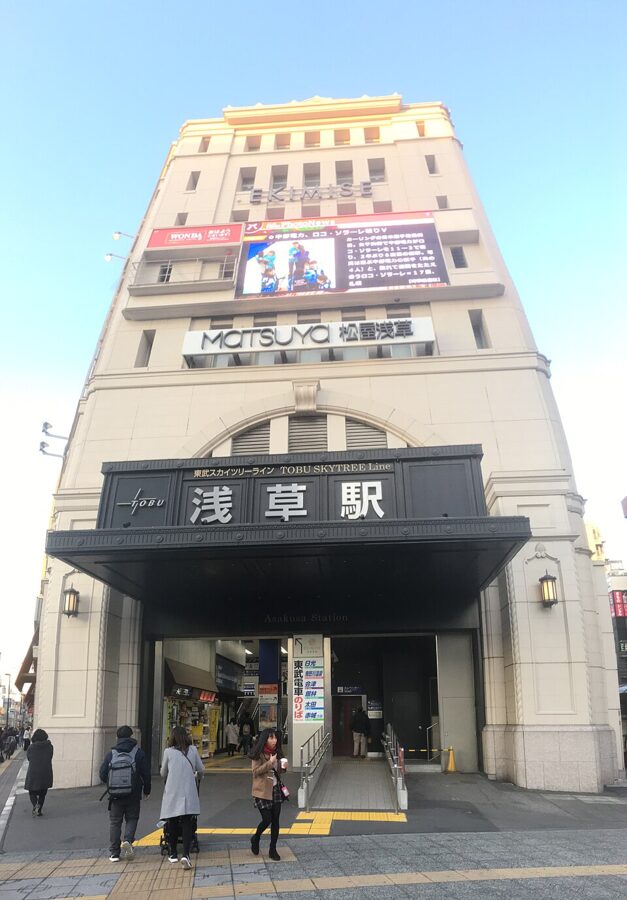
Tobu’s terminal is the 1931 Art Deco building with the clock, restored to its original face in May 2012, with the Matsuya department store and the Ekimise shopping floors inside it. The platforms are on the second floor and the trains leave on a tight curve straight onto the bridge over the Sumida, which is why only short trains can use the station. One stop and three minutes takes you to Tokyo Skytree Station.
The other reason to know this station is the north exit. It puts you on the steps up to the Sumida River Walk, the footbridge to Skytree, and the long-distance trains to Nikko and Kinugawa start here too: since July 15, 2023 platform 5 has been reserved for the Spacia X limited express. Changing between Tobu and the Toei line means going up to the street.
Tsukuba Express
The Tsukuba Express station opened on August 24, 2005, deep under Kokusai-dori in front of the Rox building, and it is the right station for the western half of Asakusa. Exit A1 is the one for Rokku, Asakusa Engei Hall and the Toyokan, Hanayashiki and the west side of the temple; Kappabashi-dori is five minutes on foot. Akihabara is two stops south.
The nearest other station to it is Tawaramachi on the Ginza Line, about 400 m south, which is also the closest subway stop for Kappabashi. If your hotel is on the Kokusai-dori side, Tawaramachi and the Tsukuba Express will save you more walking than the stations that carry the Asakusa name.
Senso-ji and the free terrace opposite
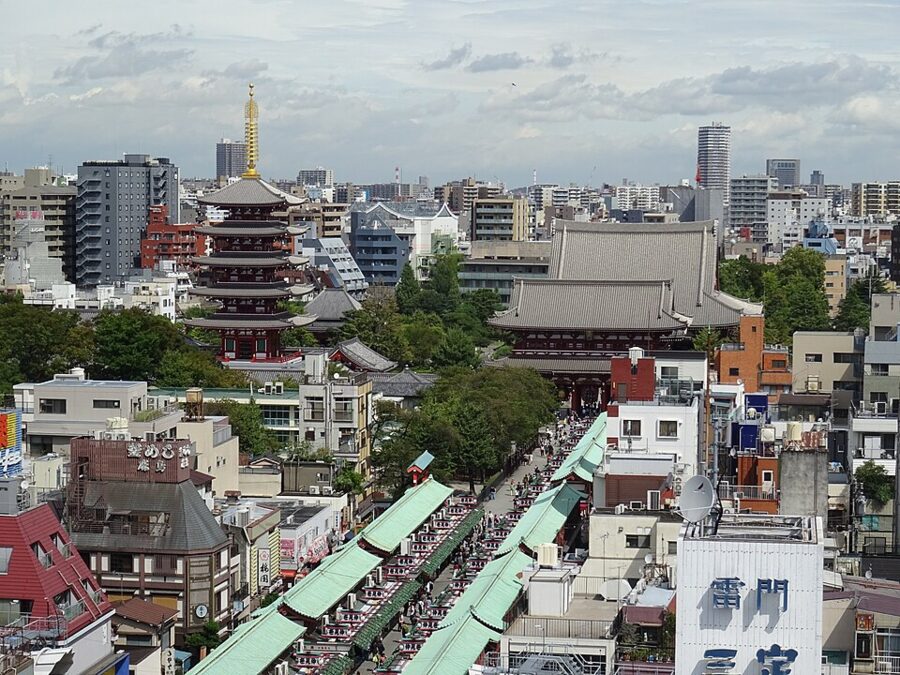
The temple is the reason the district exists: by its own founding story, two brothers fishing in the Sumida pulled a statue of Kannon from the river in 628. The main hall opens at 06:00 (06:30 from October to March) and closes at 17:00, the grounds never close, and every evening from sunset to about 23:00 the main hall, five-story pagoda, Hozomon and Kaminarimon are lit, as they have been since October 1, 2003, according to the temple’s light-up notice. Nakamise, the row of stalls between Kaminarimon and Hozomon, is at its most crowded from late morning to late afternoon, and at its best early or after the shops pull their shutters down, which are painted as a single long mural of old Asakusa. The Senso-ji guide covers the halls, the fortunes, the festivals and the best hours; things to do in Tokyo gives it a section beside Skytree.
Across Kaminarimon-dori from the gate, the Asakusa Culture Tourist Information Center is worth five minutes for its roof. The Taito ward building has an information desk on the first floor (Japanese, English, Chinese and Korean, 09:00–20:00), a currency exchange, free seats on the sixth floor where you may eat your own food, and a free terrace on the eighth floor, open 09:00–22:00, that looks straight down Nakamise to the temple. The view at night, with the shutters down and the hall lit, is better than any of the paid ones in the neighborhood.

The streets, and what each one is for
Asakusa reads best as a set of parallel streets running north from Kaminarimon-dori toward the temple and Rokku. From east to west: Nakamise, then Orange-dori, then the Rokku Broadway, with Denboin-dori cutting across all of them at the top and the covered Shin-Nakamise arcade cutting across halfway. Kappabashi-dori is the outlier, a ten-minute walk further west.
Kaminarimon-dori
The wide street in front of the gate is where the rickshaws wait and the tour buses unload, and where you will be asked several times whether you want a ride. It has the arcades with red pillars on both sides, the old shops for sweets and senbei, and at its east end Kamiya Bar on the corner by the bridge. Use it to get your bearings, then leave it.
Shin-Nakamise and the covered arcades
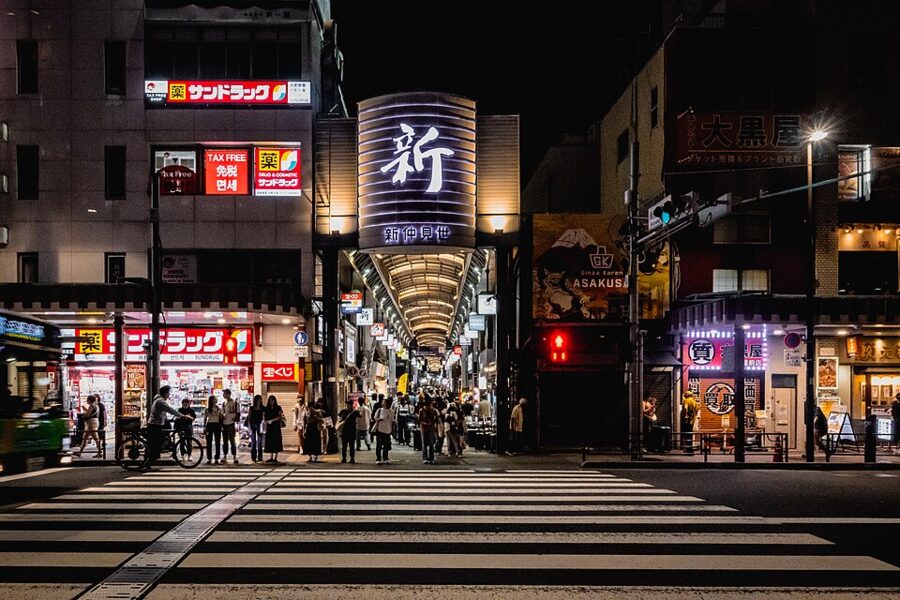
Shin-Nakamise is the long roofed arcade that crosses Nakamise halfway up and runs east toward the station and west toward Rokku. It is the rainy-day route through the district and the cheapest place to buy the things Nakamise sells, because the shops are not paying for the view of the temple. Its east entrance, with the big character for “new” over it, is a few steps from the Ginza Line’s underground arcade.
North of Rokku, Hisago-dori is another covered street, quieter, running up toward Kototoi-dori, with small restaurants and a fruit parlor. Between them, these arcades let you cross most of the district without an umbrella, which matters through the rainy season and the summer heat, June to September.

Denboin-dori
Denboin-dori runs east to west across the top of Nakamise, just short of Hozomon, and takes its name from Denbo-in, the temple’s head residence, whose garden is attributed to Kobori Enshu and has been a national Place of Scenic Beauty since 2011; it is normally closed. The street was rebuilt in the 2000s with Edo-style shopfronts, and the hanging signs are shaped like the goods an Edo merchant would have sold. The pillars of its gateways carry demon-face roof tiles that once sat on Hozomon.
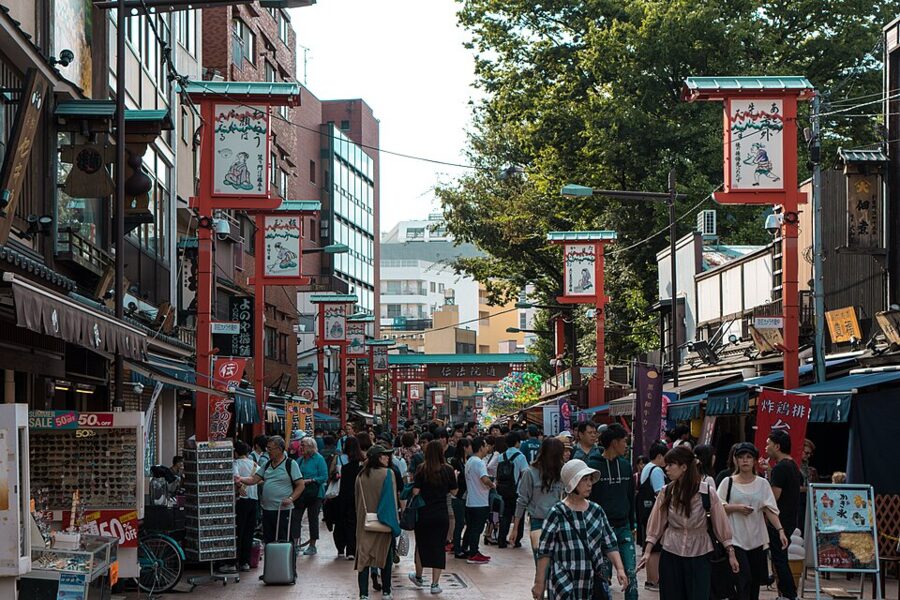

It is the street for small specialists. Yonoya, the boxwood comb specialist at Asakusa 1-37-10, is open 10:30–17:00 and closed Wednesdays; Daikokuya, the tempura house with the line outside, is a few doors away. Walk west and the street turns into Rokku, past the brick bulk of Asakusa Kokaido.
The western stretch is in the middle of a change. The 32 shops that stood on the roadway itself had been in dispute with Taito ward over the land since about 2014, and under the court settlement the ward announced on December 24, 2025, their owners agreed to pull the buildings down and hand the road back by the end of July 2026.
Orange-dori
Orange-dori runs north from Kaminarimon-dori to Asakusa Kokaido, the public hall, and the name is younger than it sounds. Until the ward office annex on the site was pulled down in March 1974 this was Kuyakusho-dori, Ward Office Street; when the hall opened in October 1977 the shop owners renamed it, and the orange paving that gives the name some sense was relaid across the full width of the road on December 23, 2015.
It is the most comfortable of the north-south streets: wide, with room on the sidewalk, which is also why the rickshaws like it. Funawa, the sweet shop founded in 1902 that invented the sweet-potato imo-yokan bar here, has its main shop on it, and so do the Kamawanu shop for printed cotton tenugui cloths and Nakasei, a tempura house open since 1870. The hall itself hosts a New Year kabuki season in January.
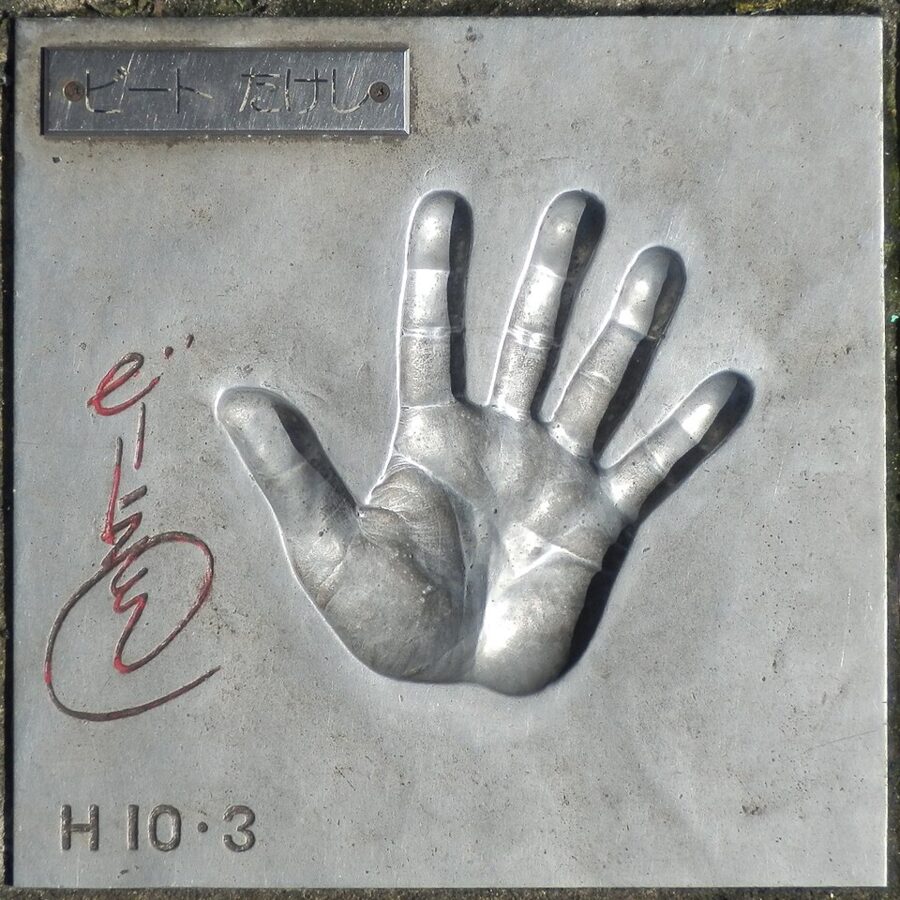
In front of the hall, the Stars’ Square has the handprints and signatures of comedians, actors, singers and rakugo performers tied to Asakusa, set in the pavement. The square filled up years ago, so new prints are added along the Orange-dori sidewalk each year. Takeshi Kitano started as a comedian in the Rokku strip-theater intervals, and his prints are here.
Hoppy Street
Hoppy Street (ホッピー通り) is the nickname for the Koen Hondori shopping street, which runs north toward Hanayashiki a block east of the Rokku Broadway. Both sides are lined with small bars that put tables, plastic stools and yellow awnings out onto the road, and the street’s other nickname, Nikomi-dori, is the dish: beef or offal stewed for hours in miso or soy. The drink is Hoppy, a low-alcohol beer-flavored mixer that you top up with shochu.
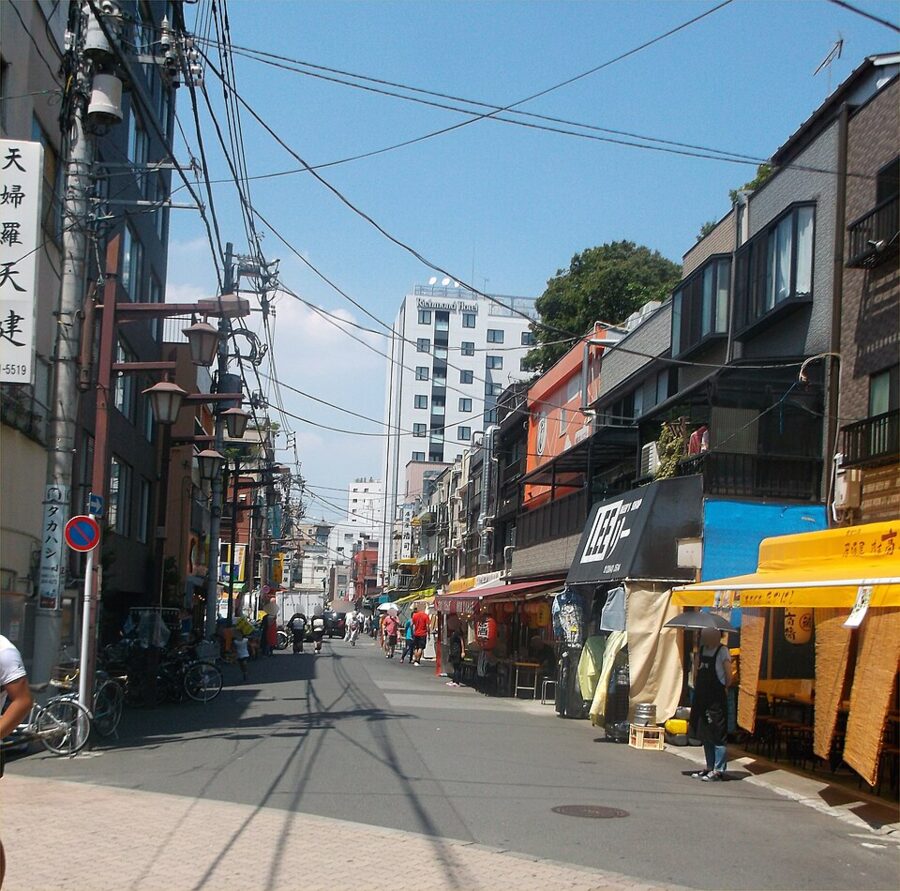

The bars open around midday and run to 22:00 or 23:00, so this is daytime drinking as much as night. It is cheap by Tokyo standards, between ¥1,000 and ¥3,000 a head for stew, skewers and two drinks. Sho-chan, the beef-stew counter at Asakusa 2-7-13 that has been at it since 1951, is open 12:00–21:00 (last order 20:30) and closed Mondays and Tuesdays; Asakusa Sakaba Okamoto’s Hoppy Street branch runs 11:00–23:00, to 22:30 on Sundays.
Nobody here will pull you in by the sleeve, but read the menu board before you sit: a few places add a charge per head or an otoshi, the small dish that comes with the table. If the board does not show it, ask before you order.
Kappabashi-dori
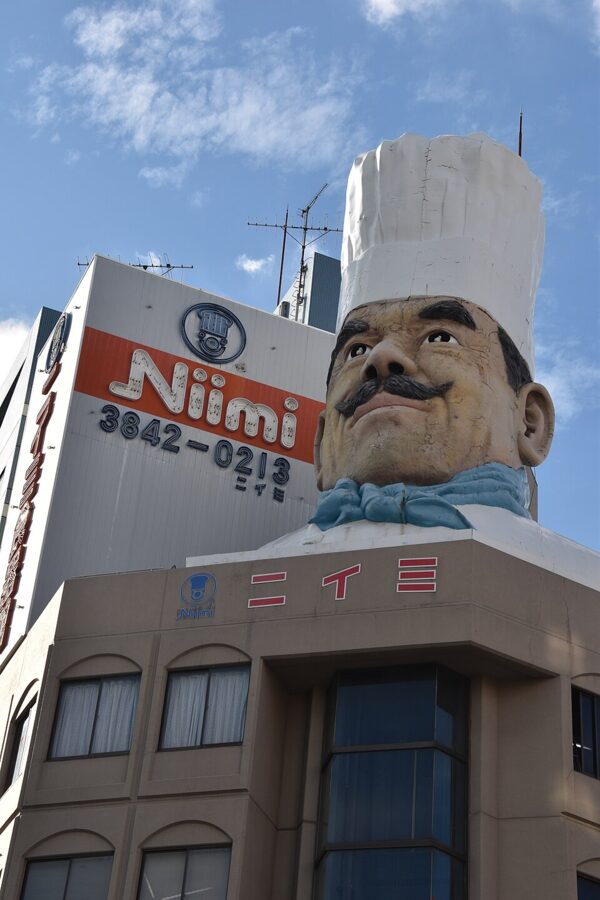
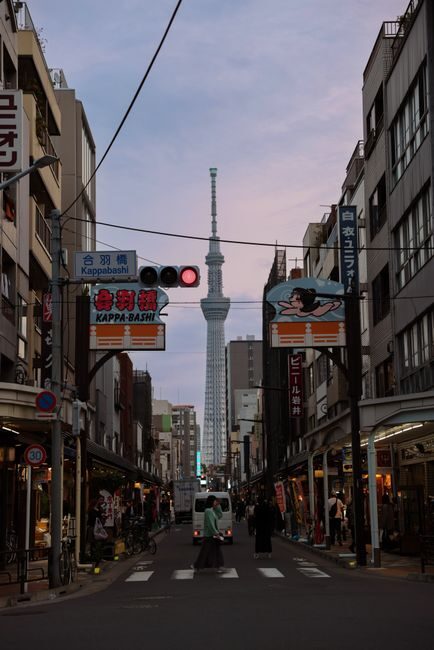
Kappabashi-dori (かっぱ橋道具街) is the kitchen street, roughly 800 m of shops for restaurant equipment between Asakusa and Ueno: knives, pots, lacquerware, noren curtains, paper lanterns, plastic food samples and the giant chef’s head that watches the southern end from the corner building at Kikuyabashi. Nearly every shop sells to the public, one item at a time. The street’s own association says about 70 percent of its shops close on Sundays and public holidays, so this is a weekday or Saturday trip.

Nobody agrees on the name. One version says low-ranking samurai of a nearby estate hung their homemade raincoats, kappa, to dry on a bridge here; the other says a local merchant called Kappaya Kihachi paid to drain the swampy land around 180 years ago, helped by the river imps, also kappa, that he had once been kind to. The street has chosen the second story for its golden kappa statue and its mascot.
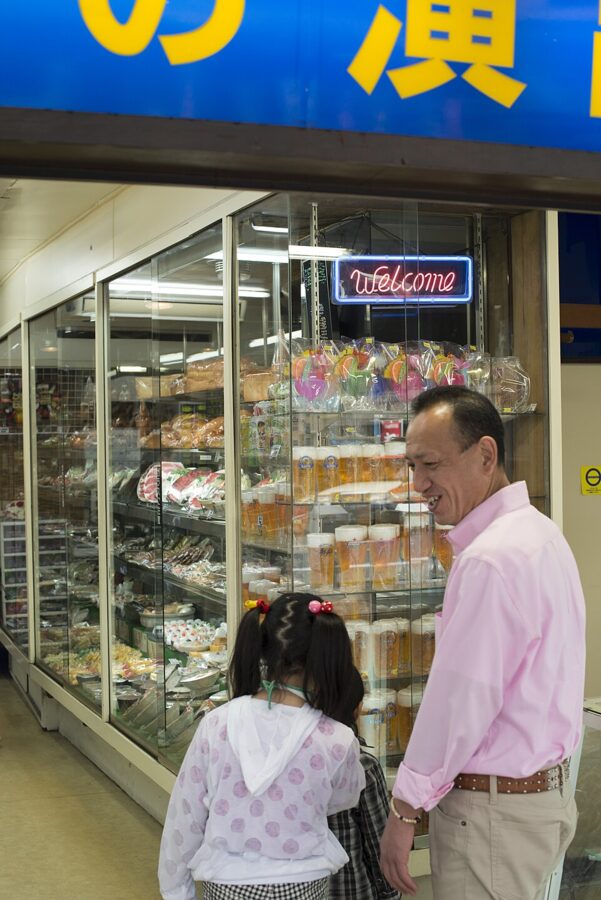

Two shops make the trip on their own. Kama-Asa sells Japanese kitchen knives, with staff who will help you choose, and Ganso Shokuhin Sample-ya, the food-sample maker, runs paid workshops where you make a plastic sample of your own. From the station side it is a ten-minute walk west along Kaminarimon-dori and Asakusa-dori; Tawaramachi on the Ginza Line and the Tsukuba Express station are both about five minutes away. The street holds its Dogu Matsuri sale every October around October 9, the “tools day” (in 2026 it ran October 6–12).
What to skip
Skip Nakamise between 11:00 and 16:00 on a weekend unless you like standing still. Skip Kappabashi on Sundays. Skip the 12-minute rickshaw loop if what you wanted was a tour (more on prices below), and skip the chain cafes on Kaminarimon-dori, which charge for the address. The Don Quijote on the Rokku side is the same store as everywhere else, with the same lines at the tax-free counter.
Rokku: the old entertainment district
Rokku (六区) means “sixth district”: when the temple grounds were turned into Asakusa Park in the 1880s, the city divided them into numbered sections, and the sixth, built up with the earth dug out for a pond west of the temple, became the show quarter. Japan’s first full-time cinema, the Denkikan, opened here in 1903. It peaked in the late 1950s, when the strip between the temple and Kokusai-dori was packed with revues, comedy, strip shows and cinemas.
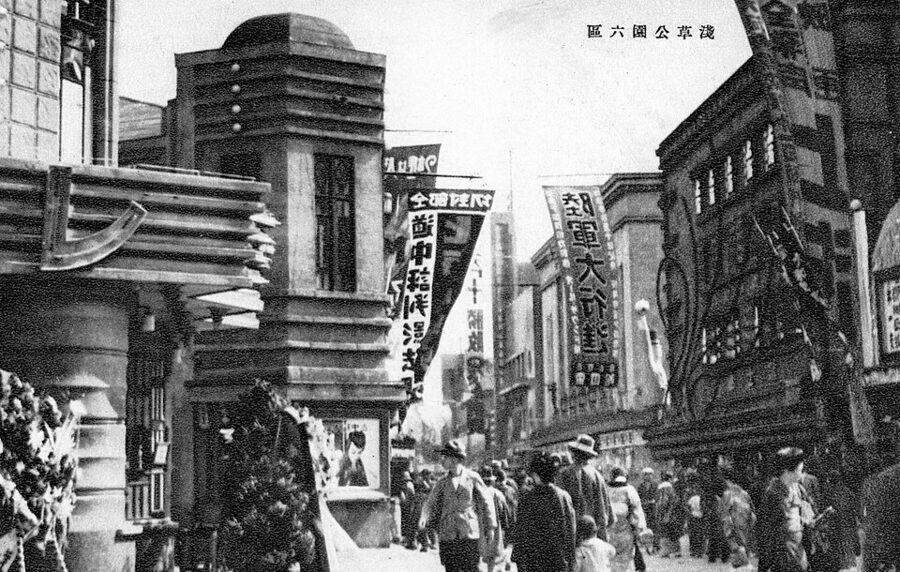
Television and the shift of Tokyo’s nightlife west to Shinjuku and Shibuya emptied it in the 1960s and 1970s, and the last five cinemas closed in September and October 2012. What is left is a 300 m main street, the Rokku Broadway, between Sushiya-dori and Hisago-dori, with an off-track betting hall that fills on weekends, new hotels on the old cinema sites, and the theaters that never stopped.
Asakusa Engei Hall and the Toyokan
Asakusa Engei Hall is one of Tokyo’s four full-time yose, the variety halls where rakugo storytellers sit on a cushion and tell comic stories, with comedy duos, magicians, jugglers and paper cutters between them. It plays every day of the year in two blocks, 11:40–16:30 and 16:40–21:00, and with 340 seats it is the largest of the four. The two rakugo associations alternate in 10-day runs, with a special program on the 31st.
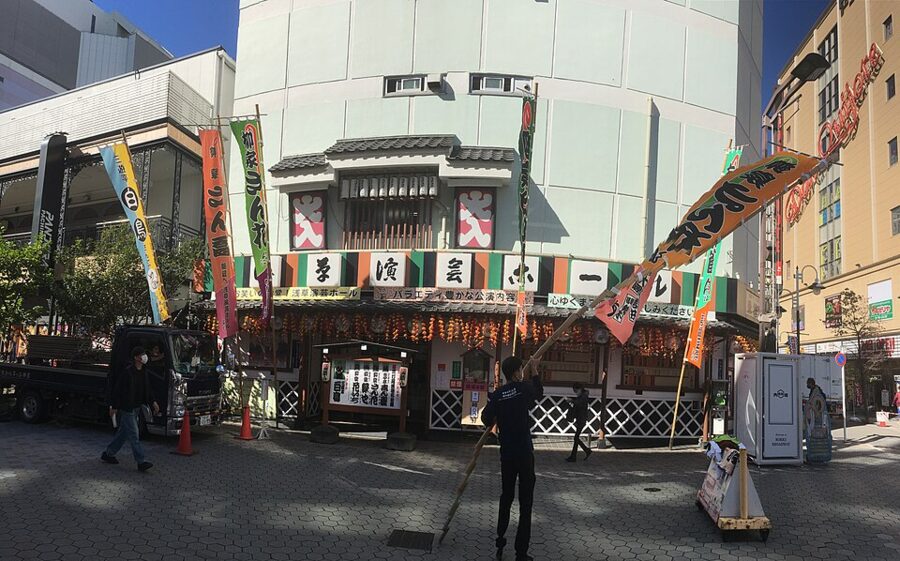

The 2026 ticket prices are ¥3,500 for adults and ¥2,500 for students, cash at the window from 11:00; the hall takes advance bookings only for groups of 10 or more. From 18:00 the adult ticket drops to ¥2,500, and from 19:00 to ¥2,000. There is no change of audience between blocks, so one ticket lets you stay from the first act to the last, but you cannot go out and come back in.
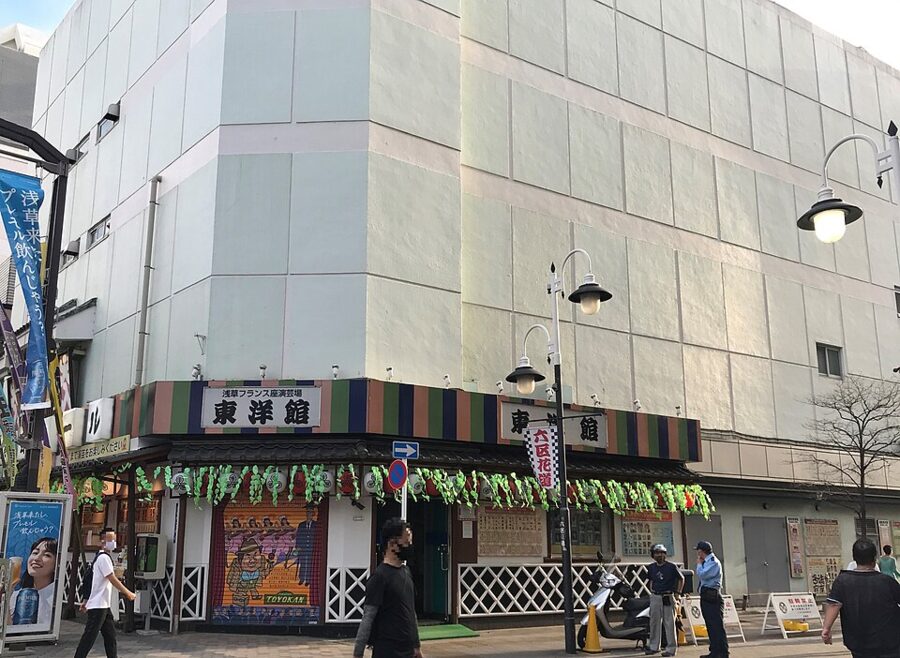

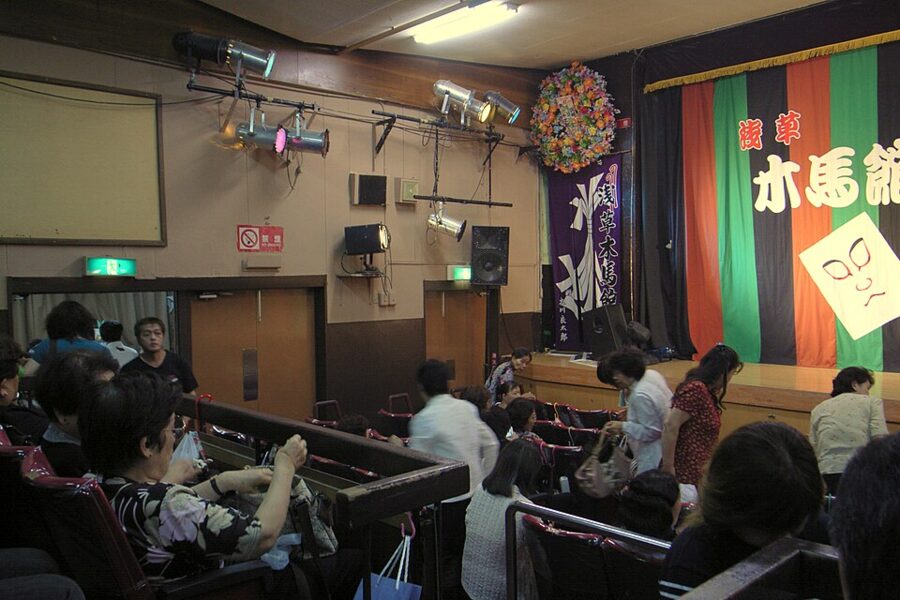
It is all in Japanese, with no subtitles, and I would still go. Rakugo is a physical art, a fan and a cloth standing in for every prop, and the jugglers and paper-cut artists need no translation. Buy the 19:00 ticket, sit for two hours, and leave when you have had enough. The hall sells beer inside but does not allow you to bring your own.
The entrance on the right of the same building leads up to the Asakusa Toyokan, the former France-za strip theater where Kitano learned his trade, now the only hall in Tokyo given over entirely to the iromono, the manzai double acts, skits, magic and impressions that fill the gaps between rakugo elsewhere. The adult ticket is ¥3,000, students ¥2,500, same-day only. A block north, the Mokubakan stages taishu engeki, the touring popular theater of sword fights and dance numbers, upstairs, with rokyoku ballad-storytelling on the ground floor.

Hanayashiki
Hanayashiki, behind the temple’s west side, opened in 1853 as a flower garden and is counted as Japan’s oldest amusement park: 5,800 m² of rides wedged between houses, with a roller coaster that runs past people’s balconies and is the oldest operating coaster in the country. Under the 2026 price list, entry is ¥1,600 for adults, and rides cost extra: tickets are ¥100 each or 11 for ¥1,000, an unlimited-ride pass is ¥3,000, and the one-day pass with entry and unlimited rides is ¥4,600. It is open roughly 10:00–18:00, varying with the season and the weather, with last entry 30 minutes before closing.
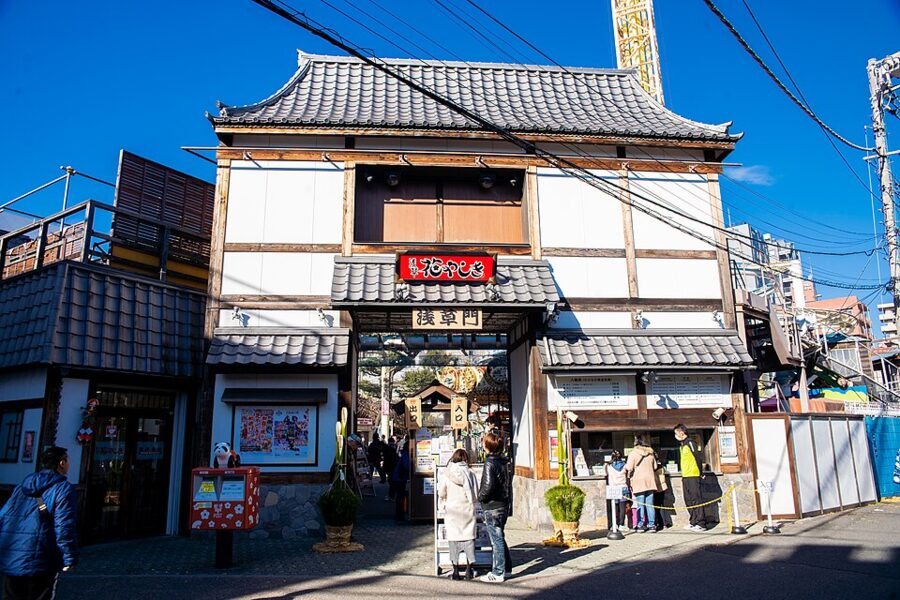

Is it worth it? For children under about ten, yes, and children four and under ride free with a paying adult. For adults it is a curiosity: walk past the gate on Hanayashiki-dori, look up when the coaster goes by, and put the ¥1,600 toward a rakugo ticket instead.
The river: water buses, the riverbank and the bridge to Skytree
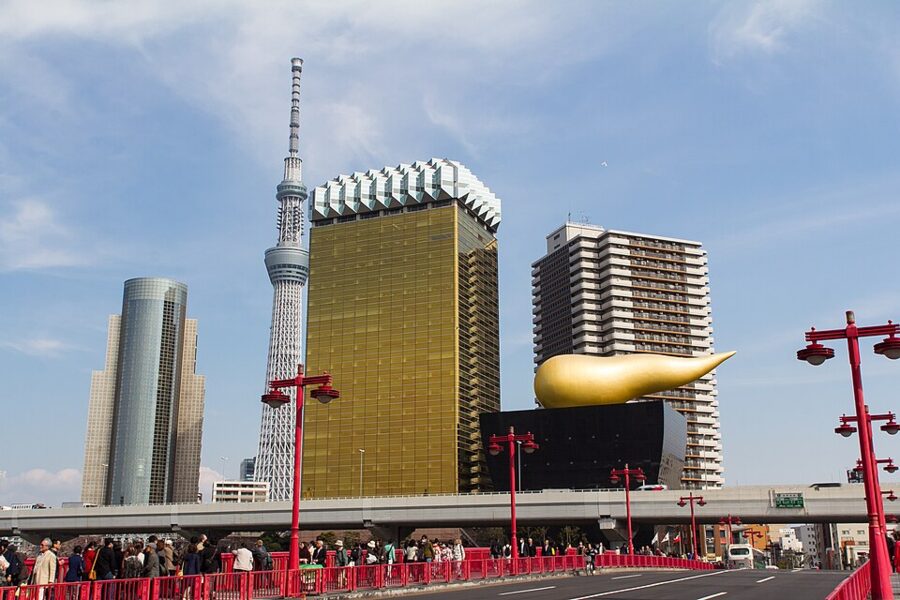
The Sumida River is two minutes east of Kaminarimon, and most people only see it from Azuma Bridge, the red bridge by the station, with the Asahi Breweries tower and its golden flame on the far bank and Skytree behind. That view is the photograph. The better use of the river is the boats, the park on its west bank and the footbridge upstream.

The water buses
Tokyo Cruise runs the water buses from the Asakusa pier beside Azuma Bridge, down the Sumida under a dozen bridges to the bay. There are three useful runs from Asakusa, and the fares and times for late 2026 are below. Fares are one way; adults are 12 and over.
| Destination | Adult fare | Time | Notes |
|---|---|---|---|
| Hama-rikyu Gardens | ¥1,180 | about 35 min | Garden entry included; tickets only from the machine at the Asakusa pier; no reservations |
| Hinode Pier | ¥1,000 | about 40 min | Standard boat; a Hinode ticket does not let you off at Hama-rikyu |
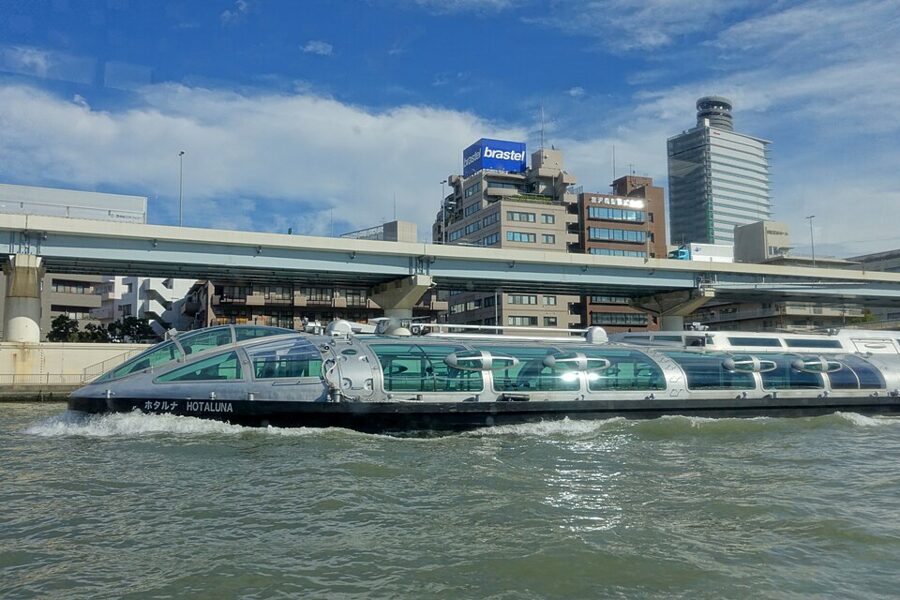
| Odaiba Seaside Park | ¥2,000 | about 50–65 min | On Himiko, Emeraldas or Hotaluna, depending on the departure |
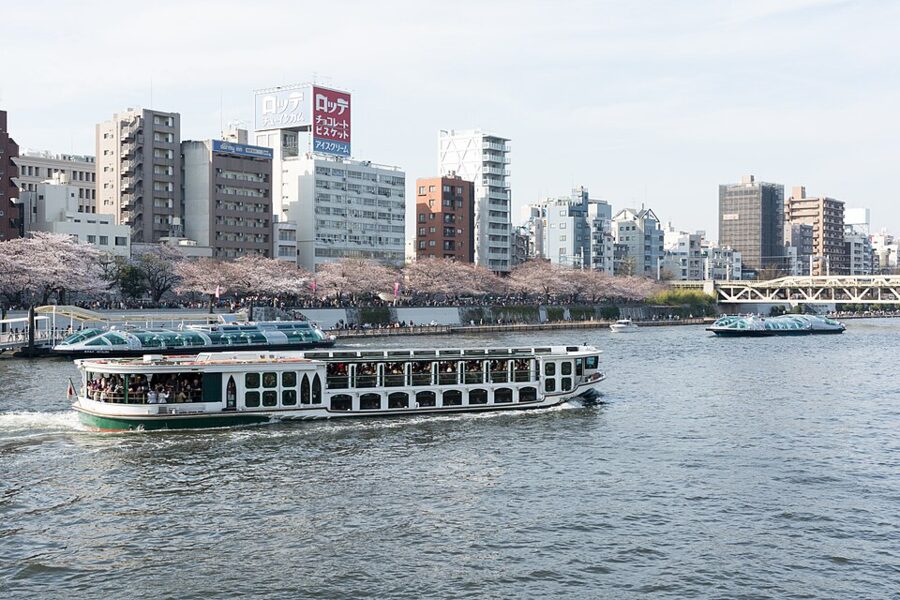

The Hama-rikyu run is the one I would take. The ticket includes entry to the garden, a former shogunate duck-hunting ground with a tidal pond and a teahouse on the water, and you walk out of the garden into Shiodome. In the winter months it leaves Asakusa only a couple of times a day, so check the timetable before you plan lunch around it.
The Odaiba boats are the silver, bug-eyed ones designed with the manga artist Leiji Matsumoto, and they are the reason many people ride at all. Each of the three rests on a set Tuesday every month, plus the following day, except in August. Reservations online close at 17:00 the day before, and passengers who booked board first, which matters on weekends.
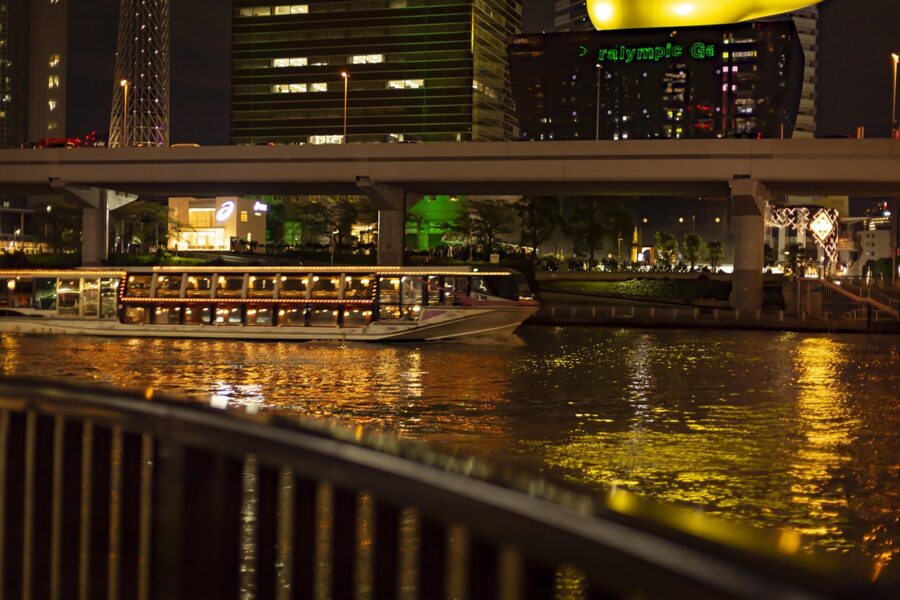
The second operator on the river, the Tokyo Mizube Line run by the Tokyo Metropolitan Park Association, stopped in January 2026 and returned on October 17, 2026 using the city’s new disaster-response boat Raiden, which seats about 140. Its Asakusa–Odaiba cruise runs mainly Wednesday to Sunday. The roofed yakatabune you see at night, lit with lanterns, are dinner boats, most of them booked by a party rather than seat by seat.
Sumida Park and the riverbank
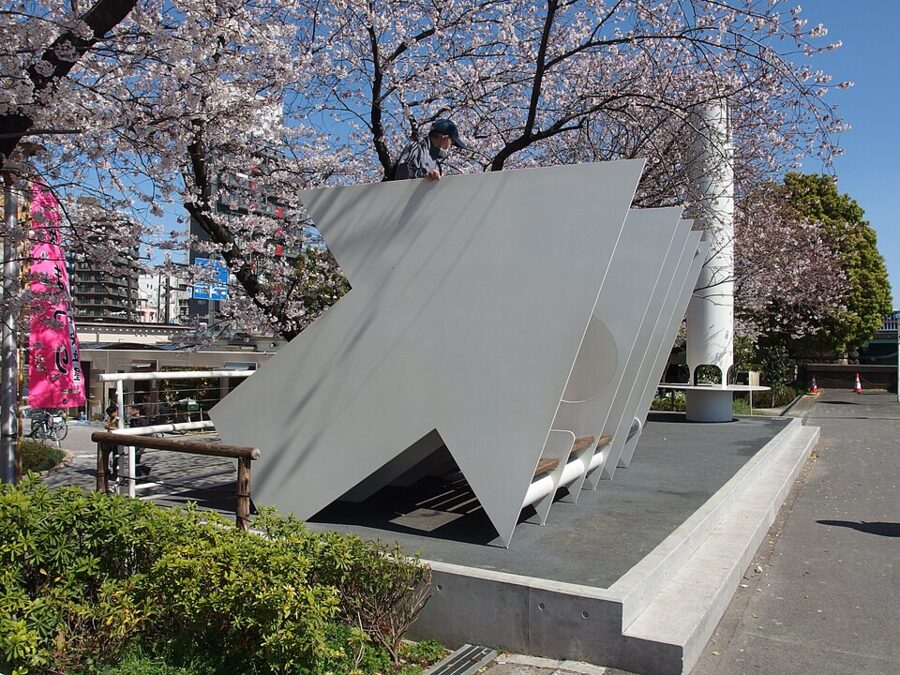
North of Azuma Bridge, Sumida Park runs along both banks, and the stretch on the Asakusa side is where the cherry trees are. Late March to early April it is packed from morning to night; the rest of the year it is a quiet riverside path with benches and joggers, and the easiest place in the district to sit down for free. In late July the Sumida River Fireworks fill both banks, and the streets around the station run one-way for pedestrians that night.

The Sumida River Walk to Skytree
The quickest way to Tokyo Skytree on foot is the Sumida River Walk, a footpath hung off the side of the Tobu railway bridge that opened in June 2020. Start at the north exit of the Tobu station or Exit 5 of the Ginza Line, climb the steps, and walk across with the trains rattling past on the other side of a glass screen. It is about five minutes to the far bank.
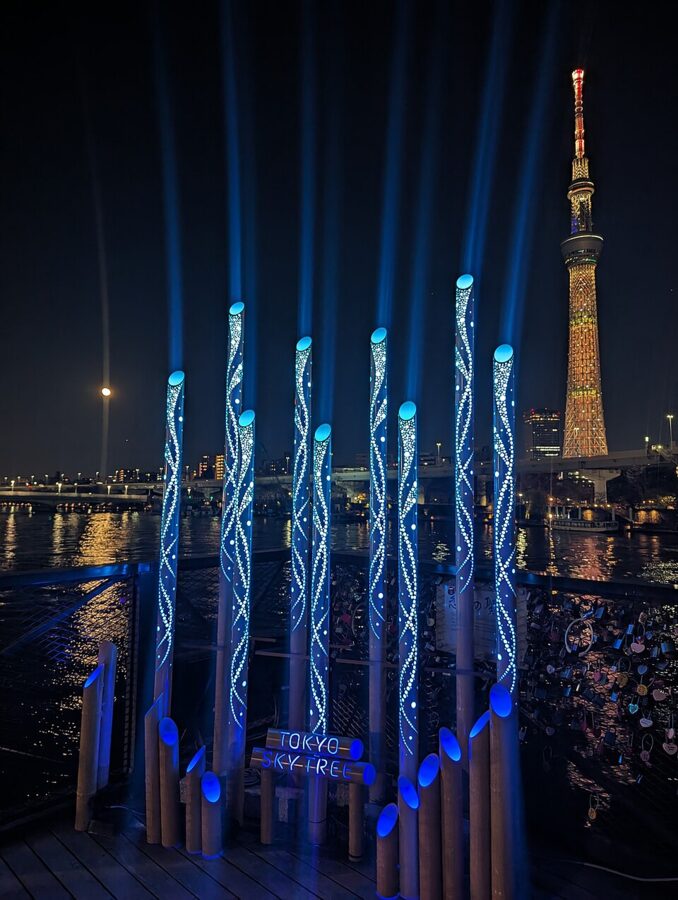

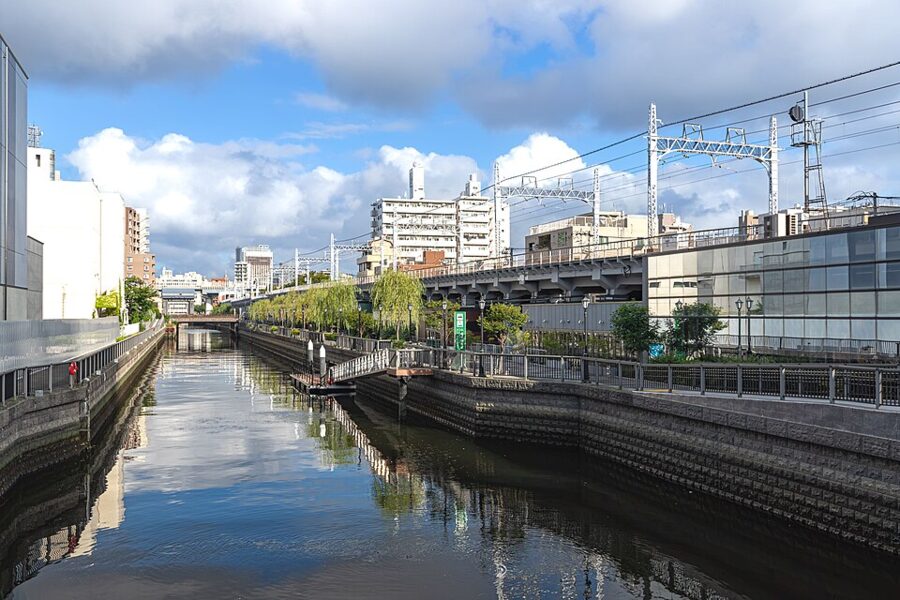
On the Sumida ward side you come down at Tokyo Mizumachi, a row of cafes, a bakery and shops in the arches under the Tobu viaduct, opened on June 18, 2020. Follow the Kitajukken River east under the tracks and the tower is in front of you the whole way; from the Asakusa bank it is about 20 minutes to the foot of it. Do this walk at dusk and you reach Skytree as it lights up.

Eating in Asakusa, at every price
Asakusa eats like an older Tokyo: tempura, eel, sukiyaki, loach, soba, Western-style yoshoku from the 1920s and sweets that have barely changed in a century. Most of the famous places have been open for generations and keep early hours, closing at 20:00 or 21:00, so eat dinner early here and drink later. The Tokyo food guide covers the dishes city-wide; the prices below are each restaurant’s own posted range per person.
Tempura
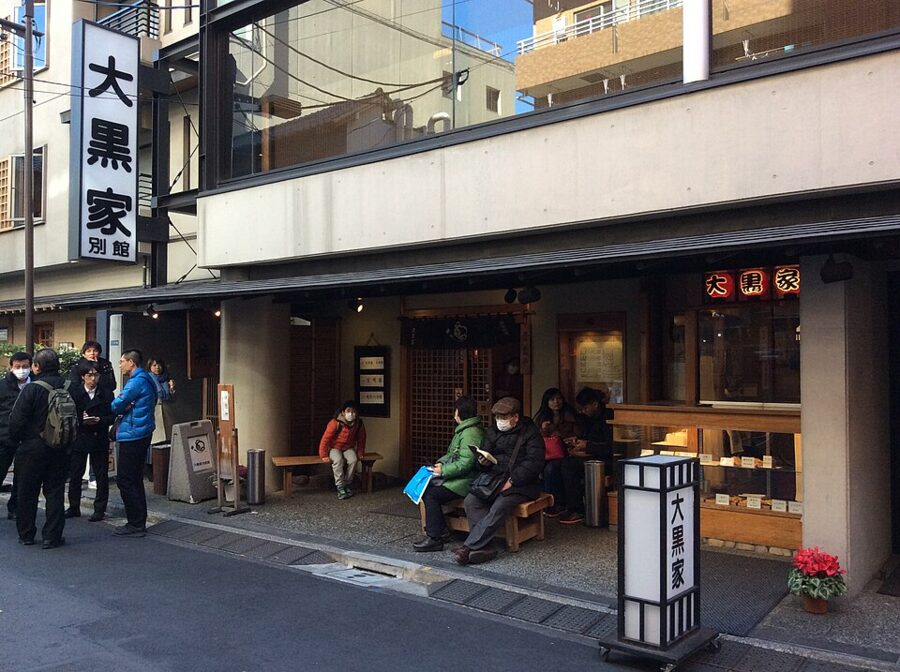
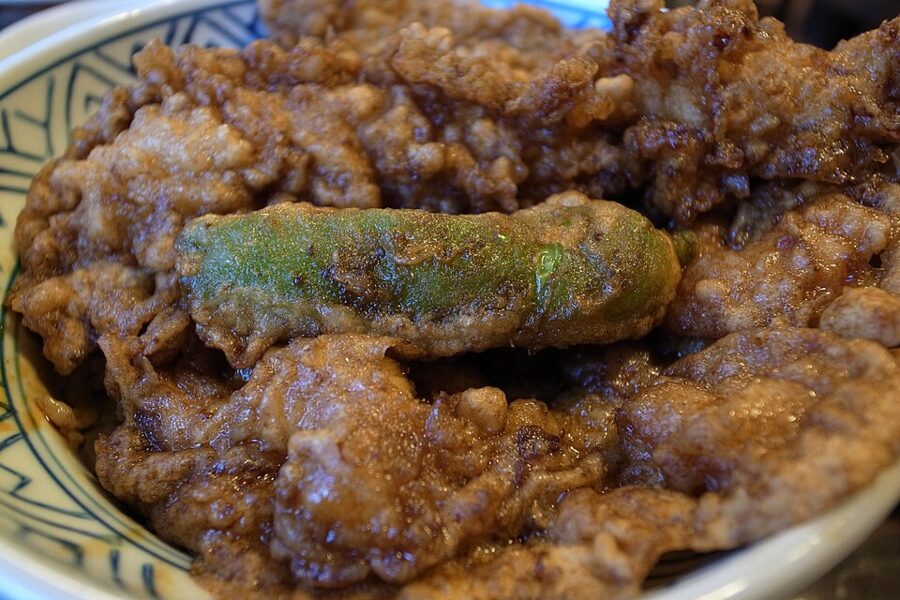
Asakusa tempura is darker and heavier than the pale Ginza style, fried in sesame oil and often served as tendon, a bowl of rice with the tempura soaked in a sweet soy sauce. Daikokuya (大黒家天麩羅), at Asakusa 1-38-10 on Denboin-dori, is the one with the line: open 11:00–20:00, about ¥2,000–3,000 a head, and its tendon comes almost black. Go at 11:00 or after 15:00 to avoid the worst of the wait.

Kaminarimon Sansada, right beside the gate at Asakusa 1-2-2, is the easy walk-in option for a group, at about the same price; it is closed Thursdays. Aoi Marushin, at 1-4-4, is the bigger, more formal house, open 11:00–21:00 and closed Mondays, with lunch around ¥2,000–3,000 and dinner around ¥5,000–6,000. For the expensive end, Nakasei on Orange-dori, open since 1870, has a garden and private rooms; it closes on Tuesdays and Wednesdays.

Unagi
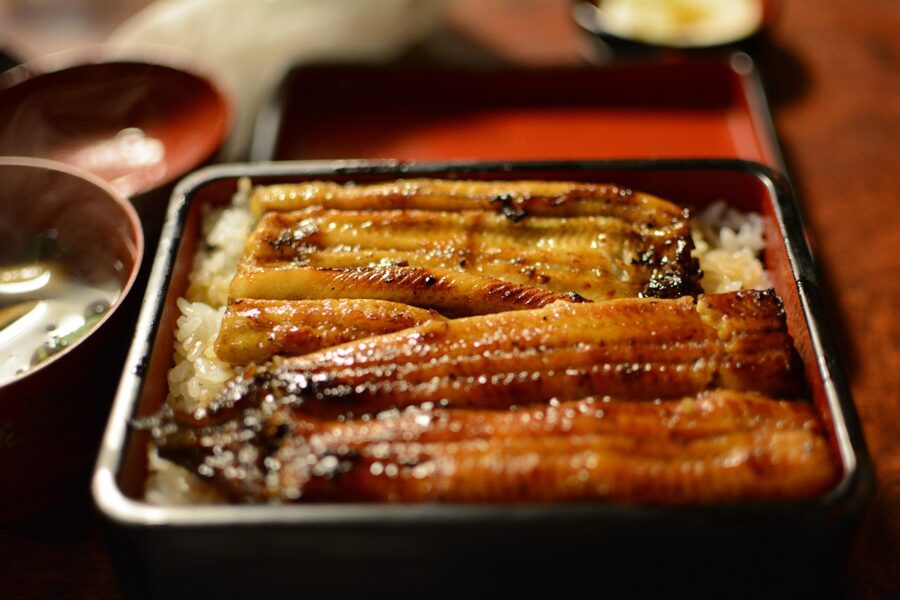
Eel is the splurge dish, grilled over charcoal, glazed and served over rice as unaju. Asakusa Unatetsu, at Hanakawado 1-2-11 by the station, does eel on skewers as well as on rice and stays open all day, 11:00–21:00; lunch is about ¥4,000–5,000. Komagata Maekawa, on the riverbank at Komagata 2-1-29, is the formal option with a view of the Sumida, open 11:30–21:00, lunch from about ¥6,000. Irokawa, a tiny counter at Kaminarimon 2-6-11, serves lunch only, 11:30–14:00, and closes Sundays.
Sukiyaki and gyunabe
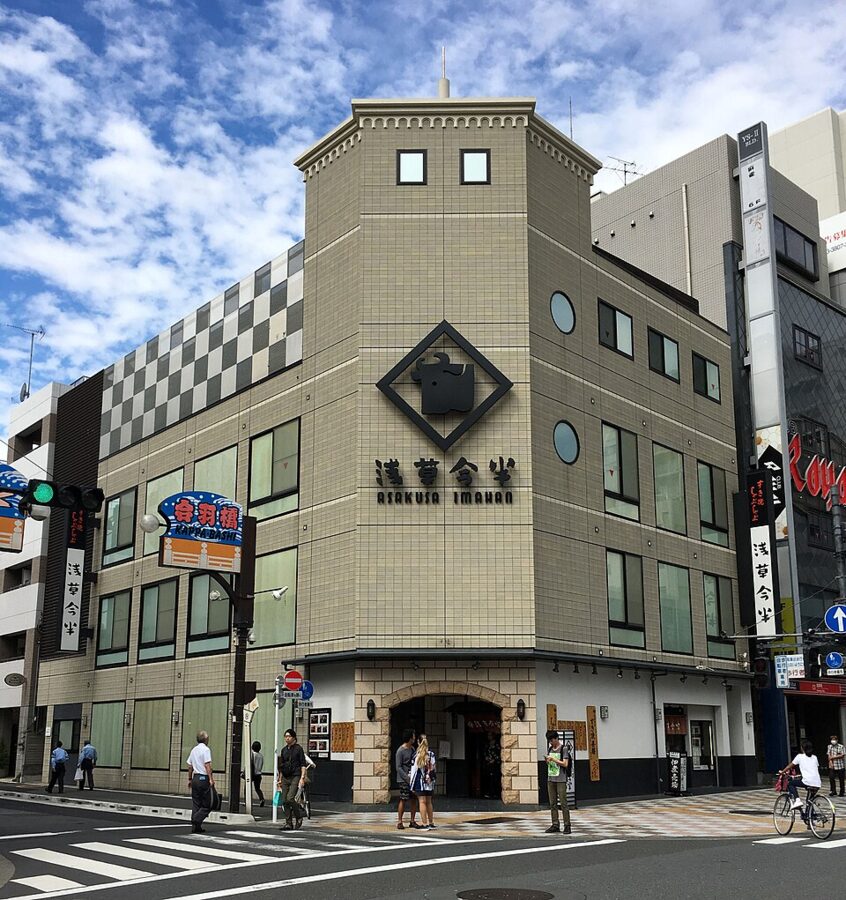
Beef hot pots reached Tokyo in the 1870s, and three Asakusa houses carry the tradition. Asakusa Imahan‘s main restaurant on Kokusai-dori, founded in 1895, is the expensive one, with sukiyaki and shabu-shabu of Japanese black beef cooked at the table by staff, and dinner from about ¥15,000 a head. Chinya, at Hanakawado 2-16-1, does the same at a wider range: lunch from about ¥3,000, dinner ¥10,000 and up, last food order 20:00.
Yonekyu, at Asakusa 2-17-10 behind Rokku, serves gyunabe, the older, simpler beef hot pot, in a wooden house. It is open 12:00–21:00 (last order 20:00), closed Wednesdays, at about ¥6,000–8,000 a head.
Dojo at Komagata Dozeu
Komagata Dozeu has served loach, small freshwater fish, since 1801 from an Edo-style merchant house on Edo-dori, five minutes south of the station at Komagata 1-7-12. You sit on the floor at long shared boards and cook the fish in a shallow iron pan on a small brazier, burying it in chopped green onion. The street-side upper floor has no windows, built so that no one would look down on a passing lord’s procession.
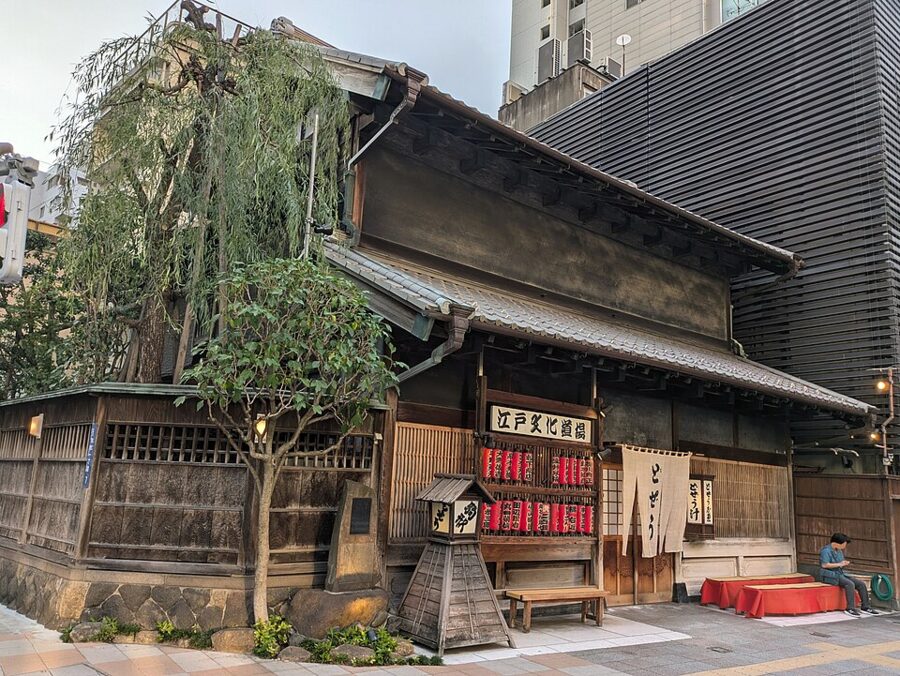

It is open 11:00–20:00 with irregular closing days, and a meal runs about ¥3,000–5,000. The loach pot is the dish; if whole small fish are not for you, order the loach soup and the eel instead.
Okonomiyaki and monja
Sometaro, at Nishi-Asakusa 2-2-2 near Tawaramachi, is an okonomiyaki house in a wooden building where you cook your own on a griddle set into the table, at about ¥2,000–3,000 a head. It keeps short hours: 12:00–14:30 and 17:30–20:30 on Mondays and Thursdays, lunch only on Fridays, 12:00–20:30 at weekends, closed Tuesdays and Wednesdays. For monja, the runnier Tokyo cousin scraped off the griddle with a small spatula, Tsurujiro at Asakusa 1-20-8 is the easy choice, closed Wednesdays.
Soba, yoshoku and the cheap end
Namiki Yabusoba, at Kaminarimon 2-11-9 south of the gate, serves cold soba with a sharp dipping sauce for about ¥1,000–2,000, 11:00–19:00, closed Wednesdays and Thursdays. Owariya, at 1-7-1, is the place for tempura soba, with two huge prawns in the bowl; it closes Fridays and shuts at 16:00 on Thursdays. Both are lunch places; go before 12:00.
Yoshikami, at 1-41-4 in Rokku, serves Western-style dishes, beef stew, hamburg steak, omurice, at about ¥2,000–4,000; it is open 11:30–21:30 and closed Wednesdays and Thursdays. Mizuguchi Shokudo, at 2-4-9 in Rokku, is the old diner where locals drink beer at lunch over fried fish and ginger pork for under ¥2,000, open 10:00–20:00, closed Tuesdays and Wednesdays. For breakfast, the Pelican bakery near Tawaramachi bakes only bread and rolls, 08:00–17:00, closed Sundays, and sells out.

Kamiya Bar and Denki Bran
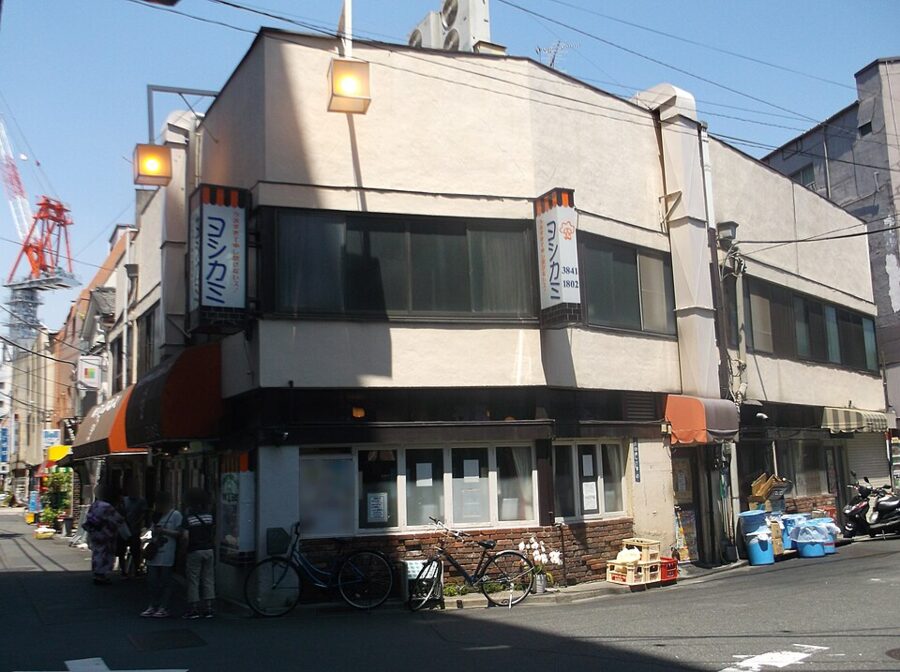
Kamiya Bar, on the corner by Azuma Bridge at Asakusa 1-1-1, calls itself Japan’s first bar. Its founder opened a liquor shop here in 1880, renamed it Kamiya Bar in 1912, and invented Denki Bran, a brandy-based cocktail of gin, wine, curacao and herbs whose exact recipe is still secret. The 1921 building is a registered tangible cultural property.
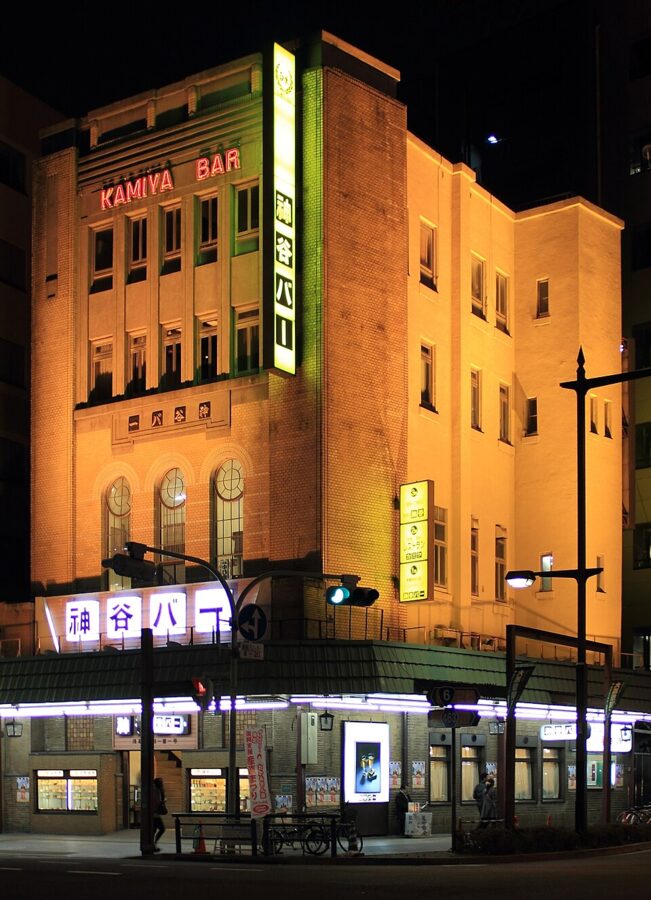

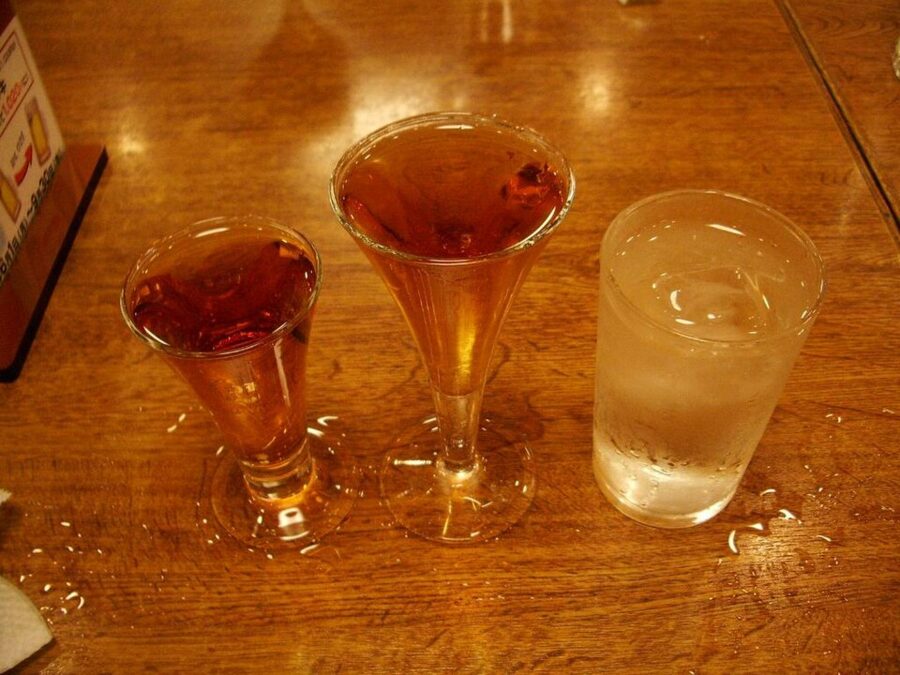
The ground-floor bar is a big, bright hall of shared tables where you buy tickets at the door, cash only, then hand them over for your drink and food. Denki Bran comes at 30 percent alcohol, or 40 percent for the “Old”; locals chase it with a draft beer. Kamiya Bar is open 11:00–20:00 (last order 19:30) and closed Tuesdays and two Mondays a month, and the second-floor restaurant does steak and hamburg.

Sweets and snacks
The snacks are part of the walk. Asakusa Kagetsudo’s main shop, at 2-7-13, bakes a giant melon bread from 09:00 until it sells out, usually around 16:00, every day. Funawa’s main shop on Orange-dori (10:00–19:00, no closing day) sells the original imo-yokan and has a cafe upstairs for mitsumame, agar jelly with fruit and syrup.
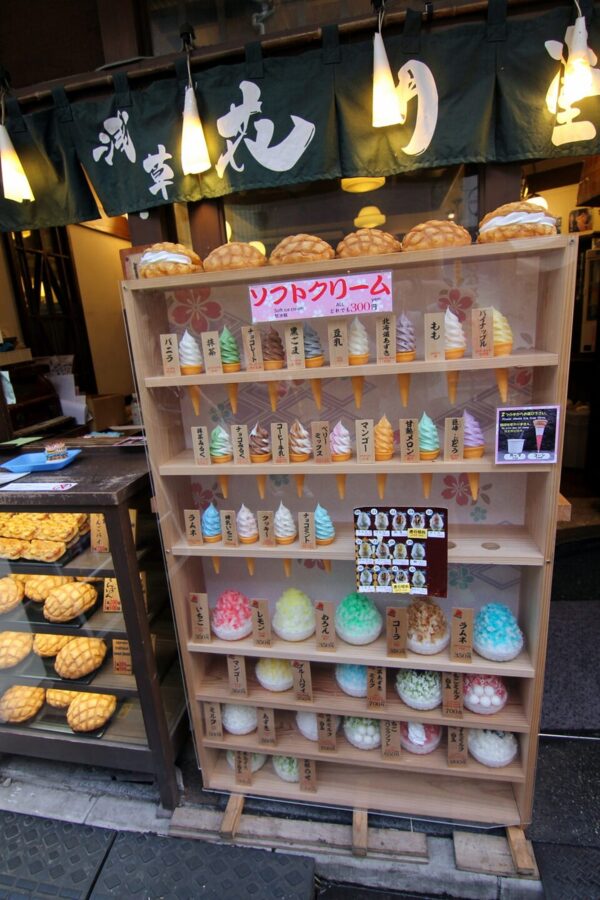

On Nakamise, Kimuraya Ningyoyaki Honpo makes small castella cakes in the shape of the pagoda and the lantern, and Kokonoe fries agemanju, sweet buns in tempura batter. Kibi dango Azuma, at 1-18-1, sells millet dumplings rolled in soybean flour by the stick. Umezono, at 1-31-12, is the old sweet shop for awa-zenzai, warm millet with sweet red beans, and Kameju, near the tourist center at Kaminarimon 2-18-11, makes the fat, soft dorayaki pancakes people line up for.

One rule on Nakamise: eat where you buy. The Nakamise shops ask that you finish at the stall or in its doorway rather than walking along a street that is shoulder to shoulder by late morning.
Rickshaws, kimono and souvenirs
Rickshaws: what a fair price is
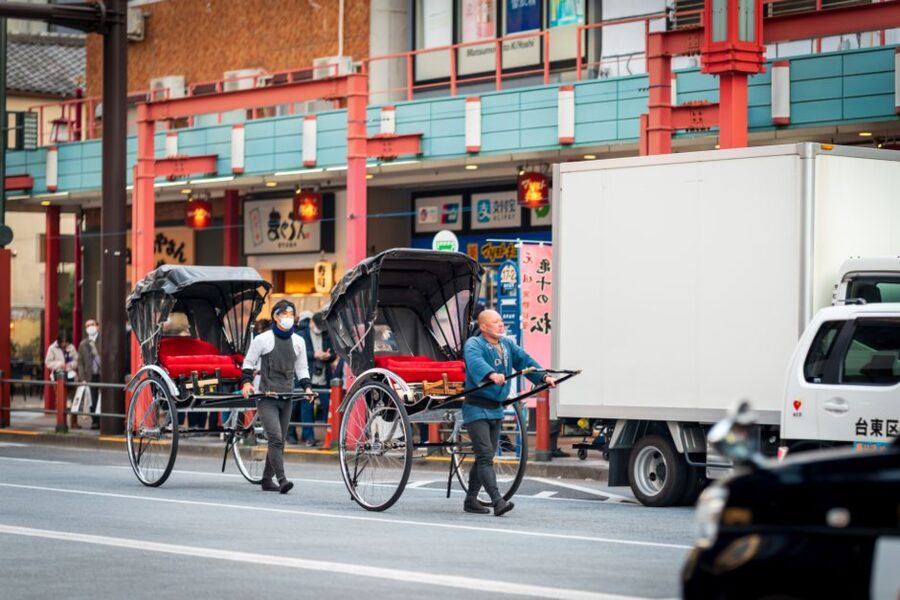
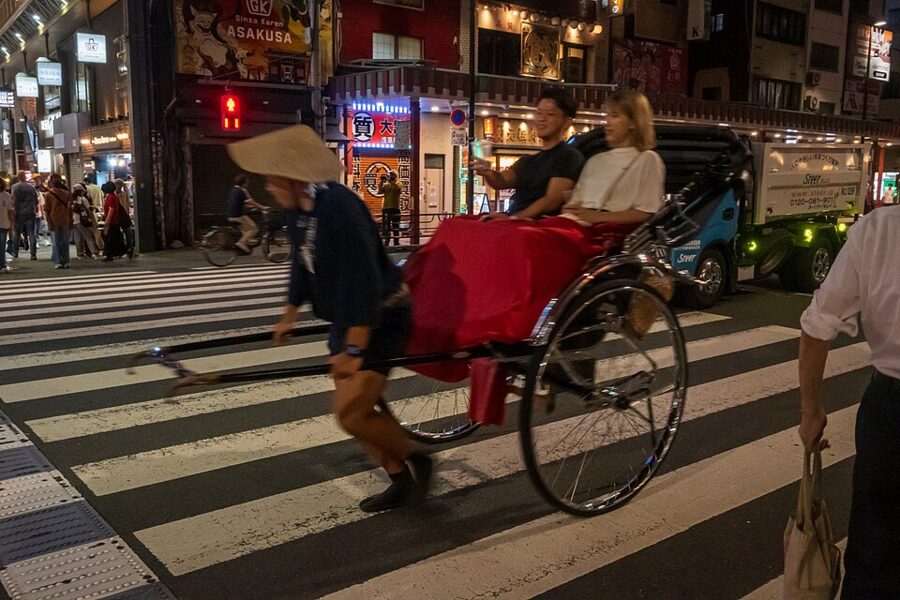
The pullers on Kaminarimon-dori are mostly fit young guides who run, talk and take your photos, and a good one is fun. The trouble is the price, which is per car, by time, and not always said up front. The benchmark is Ebisuya’s Asakusa price list, by the gate at Asakusa 1-34-2, open from 09:30.

| Time | Two people, per car | One person |
|---|---|---|
| 12 min (no reservations) | ¥5,000 | ¥4,000 |
| 30 min | ¥10,000 | ¥9,000 |
| 45 min | ¥15,000 | ¥13,000 |
| 60 min | ¥20,000 | ¥16,000 |
Before you sit down, agree on three things: the minutes, the total for the car, and where it ends, because finishing far from the stand can add a return charge. The 12-minute ride is a loop around the gate and a photo; 30 minutes gets you into the back streets, which is the point. Jidaiya, the other long-standing company, works the same streets, and other operators post their prices on boards at their stands.
Kimono rental
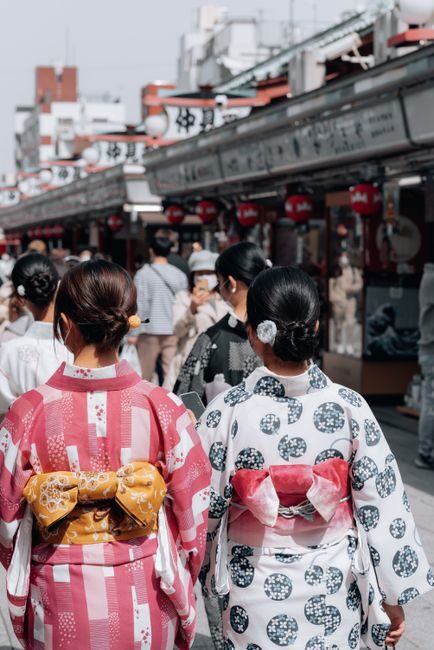
Kimono rental shops line the streets around the temple, and the advertised price is the floor. At VASARA, which has three Asakusa shops, the plain plan starts at ¥3,400, plans with brighter patterns at ¥5,478 and the retro-modern sets and men’s kimono at ¥6,930, with hair styling sold on top. Shops open 09:00 and want the kimono back by 18:00, though some sell next-day return.
Compare like with like: whether the price includes the obi you chose, the bag, the sandals and the hair set, and when you must be back. Weekday mornings mean less waiting for a dresser. Walking in a rented kimono is common enough here that nobody will look twice.
Souvenirs worth carrying home
Buy things Asakusa makes. Yonoya’s boxwood combs on Denboin-dori last a lifetime and pack flat. Kamawanu‘s printed tenugui cloths cost little and weigh nothing, and Hakocho, at 1-4-5 and open since 1874, makes paulownia boxes covered in cloth by the old kimekomi technique, open 10:00–18:00 every day.
For cooks, a knife from Kama-Asa on Kappabashi is the best thing you can buy in the district; carry it in checked luggage, not in the cabin. Edible souvenirs: Funawa’s imo-yokan keeps a few days, the rice crackers on Nakamise keep longer, and the Kamiya Bar shop on Kaminarimon-dori (10:00–19:00, closed Tuesdays) sells Denki Bran by the bottle. Skip the plastic samurai swords.
When to go
Early is the rule. The temple grounds are quiet before 08:00, Nakamise fills from about 10:00 and is solid from late morning, and the district empties again after dark, when the light-up starts and the souvenir stalls close. Weekdays are calmer than weekends everywhere except Kappabashi, which is quietest on Sundays only because most of it is shut.
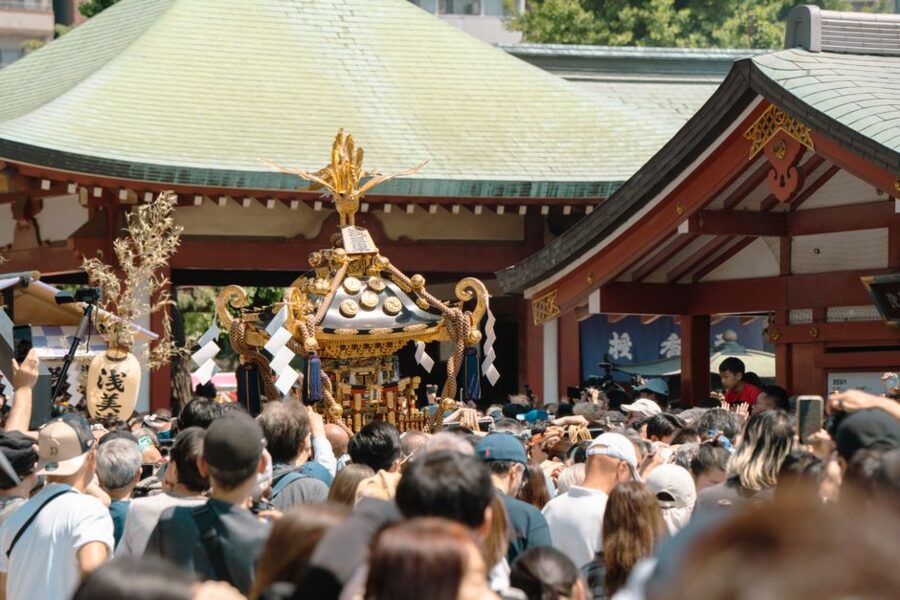
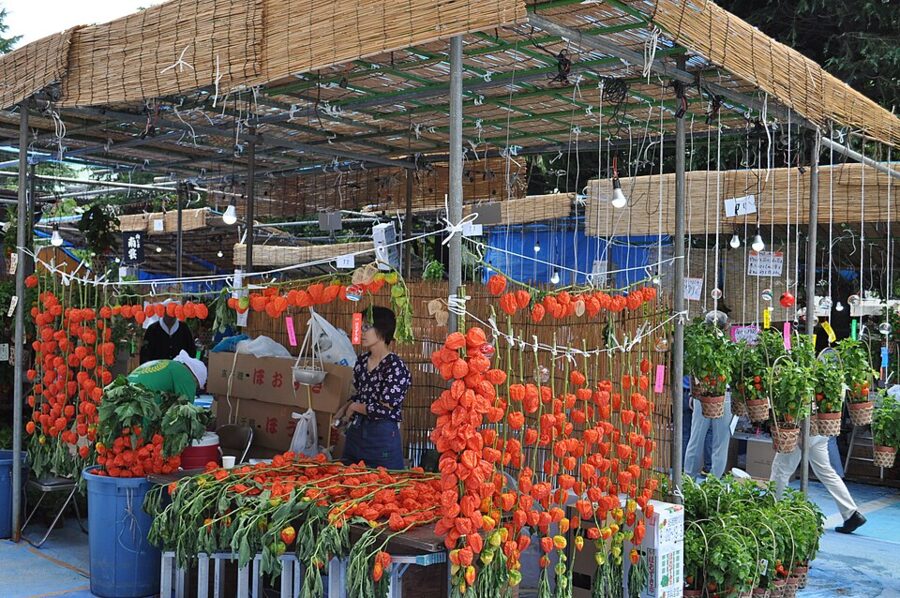
The big dates are fixed every year. The Sanja Matsuri, the festival of Asakusa Shrine, runs Friday to Sunday around the third Saturday of May, with portable shrines carried through 44 neighborhoods and about 1.8 million people over the three days. The Hozuki-ichi ground-cherry market fills the temple on July 9 and 10, and the Hagoita-ichi, the fair for decorated battledores, runs December 17–19. New Year is the most crowded time of all, from the evening of December 31 through January 3.
For the weather month by month, the Tokyo weather guide has the numbers. The short version for Asakusa: late March to early April for the cherry trees on the river, November for clear days and the ginkgo in the temple grounds, and an umbrella and the covered arcades from June to September.

Staying in Asakusa
Asakusa is one of the cheaper places in central Tokyo to sleep, with business hotels, river-view hotels and hostels within a few minutes of the stations, and it suits the east side of the city and the Narita trains. The trade-off is distance: Shinjuku and Shibuya are 30 to 40 minutes away, and the district is quiet after 22:00. The where to stay in Tokyo guide weighs it against the other districts, and the best hotels in Tokyo guide names the hotels.
One change for day trippers: the tourist center opposite Kaminarimon stopped storing suitcases on March 31, 2026, as part of the ward’s effort to get luggage off the crowded streets. Leave bags at your hotel or in station lockers before you come, because pulling a suitcase up Nakamise at noon is not possible in any useful sense.
Where to go next on foot
Skytree is the obvious next stop, 20 minutes east over the Sumida River Walk. Kappabashi leads on to Ueno: from the kitchen street it is about 15 minutes on foot to Ueno Station, the park and the museums. South along the river, Kuramae is a quieter grid of workshops and small roasters, one stop on the Toei Asakusa Line or a 15-minute walk.
For the rest of Tokyo, the Ginza Line takes you straight to Ginza and Shibuya, and the Tsukuba Express takes you two stops to Akihabara. The getting around Tokyo guide covers the passes and the IC cards. For drinking after Asakusa’s early closing, Tokyo nightlife points west, and Golden Gai in Shinjuku is the next room over in spirit.
And if you are heading home from Rokku at night, remember the station that is not quite Asakusa: the Tsukuba Express is the one under your feet on Kokusai-dori, and the Ginza Line is 600 m away on the other side of the temple, where the hall is lit until 23:00.