

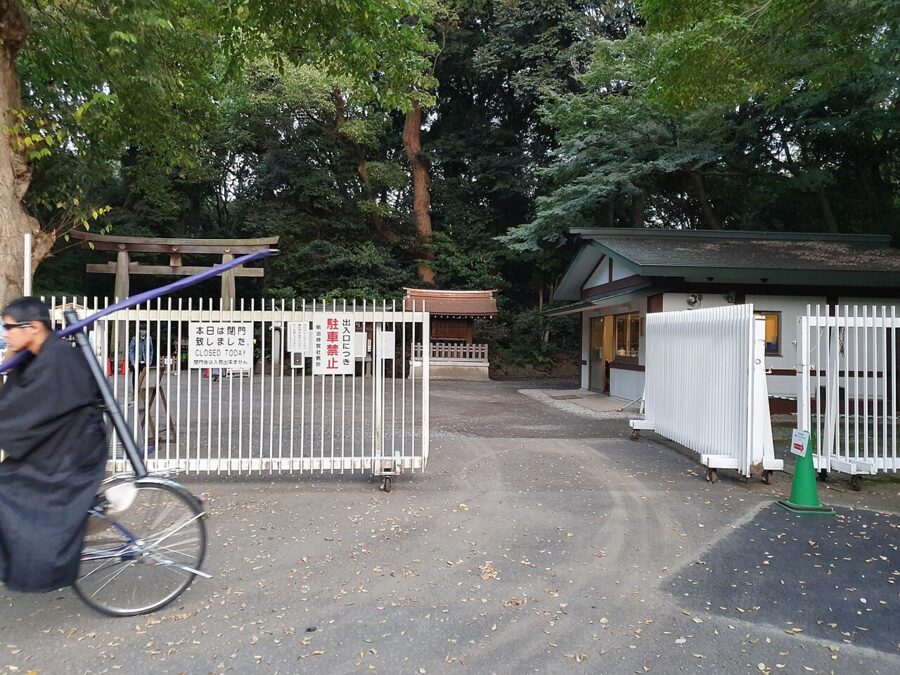
Meiji Jingu (明治神宮) charges nothing at the gate and keeps the sun’s hours. It opens at sunrise and shuts at sunset, so the posted times move every month, from 05:00–18:30 in June to 06:40–16:00 in December, and a winter visit left until after lunch ends with a priest closing the gate in front of you.
Use the Harajuku Gate. It is a minute’s walk from JR Harajuku Station on the Yamanote Line and from Exit 2 of Meiji-jingumae (Harajuku) Station (C03, F15), and it puts the sake barrels, the museum and a café on your way in. From any of the three gates the main hall is about ten minutes on gravel, and nothing stops you leaving by another one: the Yoyogi Gate for Shinjuku, the Sangubashi Gate for the Odakyu Line.
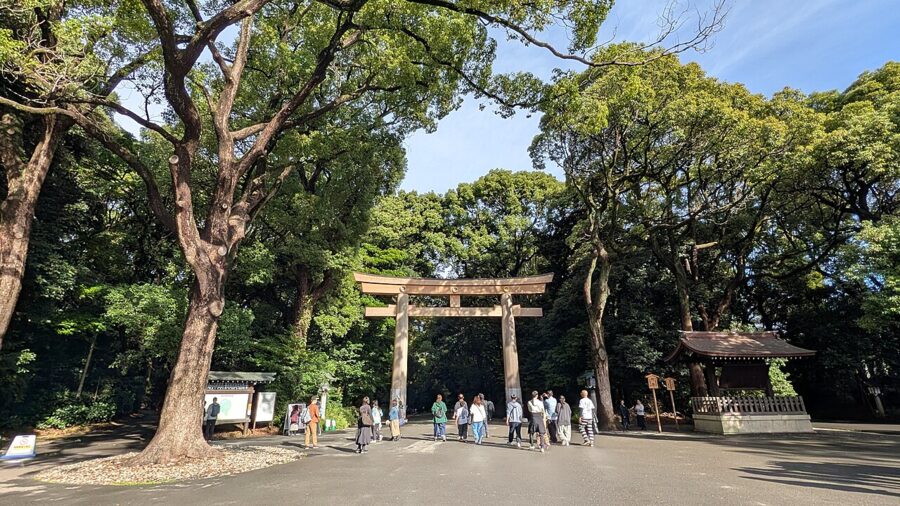

Go early. At the gate by about 08:00 you have the forest mostly to yourself, and by the time you reach the courtyard the amulet and goshuin counters are about to open at 09:00, as is the Inner Garden, with the museum following at 10:00. Weekday mornings beat weekend afternoons by a distance, and the first three days of January are a different event altogether.
Two things cost money. The Inner Garden asks a ¥500 maintenance fee and the Meiji Jingu Museum charges ¥1,000 for adults; the shrine, the forest, the barrels and the courtyard are free. The shrine’s own estimate is about an hour for the shrine alone and two with the garden and museum, which is right, unless it is June and the irises are out.

Gates, hours and what is free
The shrine is open every day of the year and the hours are set by the sun. These are the gate times as the shrine posts them on its visiting page for late 2026; they repeat each year.
| Month | Gates open | Gates close |
|---|---|---|
| January | 06:40 | 16:20 |
| February | 06:20 | 16:50 |
| March | 05:40 | 17:20 |
| April | 05:10 | 17:50 |
| May | 05:00 | 18:10 |
| June | 05:00 | 18:30 |
| July | 05:00 | 18:20 |
| August | 05:00 | 18:00 |
| September | 05:20 | 17:20 |
| October | 05:40 | 16:40 |
| November | 06:10 | 16:10 |
| December | 06:40 | 16:00 |
The buildings inside keep shorter hours, mostly 09:00 to about 16:00, so a 06:10 arrival in November buys you the forest and the outside of the hall but not an amulet. The New Year is the exception to the table: the gates stay open all night from December 31 into January 1 and close late for the first four days.
The three gates suit three directions. The Harajuku Gate (原宿口), the south one, is the one to start from: JR Harajuku (JY19) is across Jingu Bridge, Meiji-jingumae (Harajuku) is a minute away, and the South Approach behind it carries most of what there is to see before the hall. The Yoyogi Gate (代々木口) in the north is about five minutes from JR and Toei Oedo Line Yoyogi Station and from Kita-sando Station (F14), and it is the closer gate for Shinjuku, one stop up the Yamanote Line. The Sangubashi Gate (参宮橋口) on the west side is five minutes from Odakyu Line Sangubashi Station, two stops from Shinjuku on the local trains, and it is the quiet one.
JR Harajuku and JR Yoyogi are on a Japan Rail Pass; the subway and the Odakyu Line are not. All five stations take a Suica or any other IC card, and Shibuya is one stop south of Harajuku on the Yamanote Line if the shrine is your morning and the crossing your afternoon.
What is free: the grounds, the forest, the approaches, the barrels, the courtyard and the lawn north of the hall. What costs money: the Inner Garden (¥500), the Meiji Jingu Museum (¥1,000 for adults, ¥900 for high school students and younger, free under school age), the Treasure House on the days it opens, and whatever you buy at the counters, where an ema wooden plaque is ¥500. The amulet counters, the Kaguraden and the goshuin counter take cash only; the restaurants and gift shop take cards.
The shrine’s answers to common questions settle the rest. There is nowhere inside to leave a suitcase, so use the station lockers first. Bicycles stay at the racks by each gate, cars come in only through the Yoyogi Gate, wheelchairs are lent at the entrances, and there is no official guided tour. Wi-Fi exists only in the restaurants and shops.
The walk in: torii, barrels and a forest planted for a century
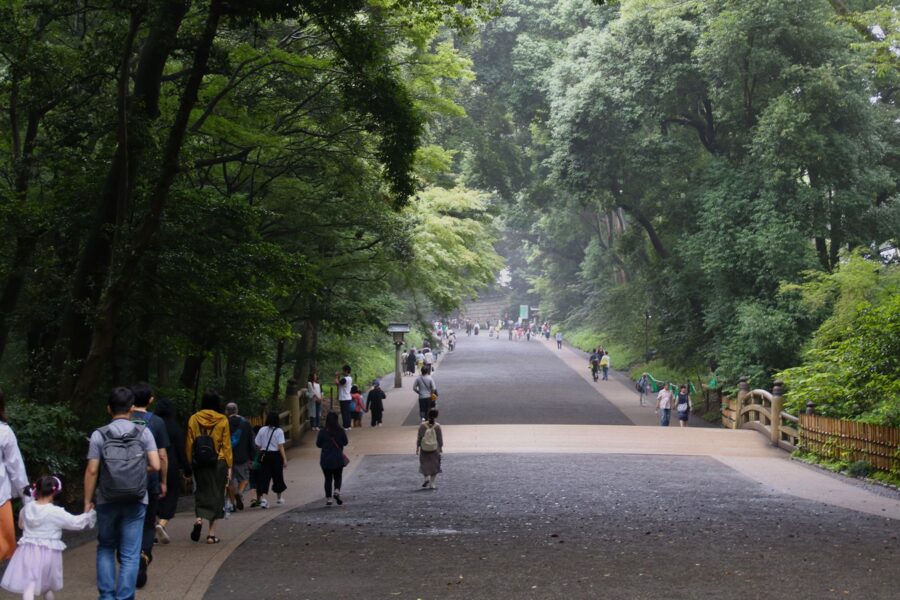
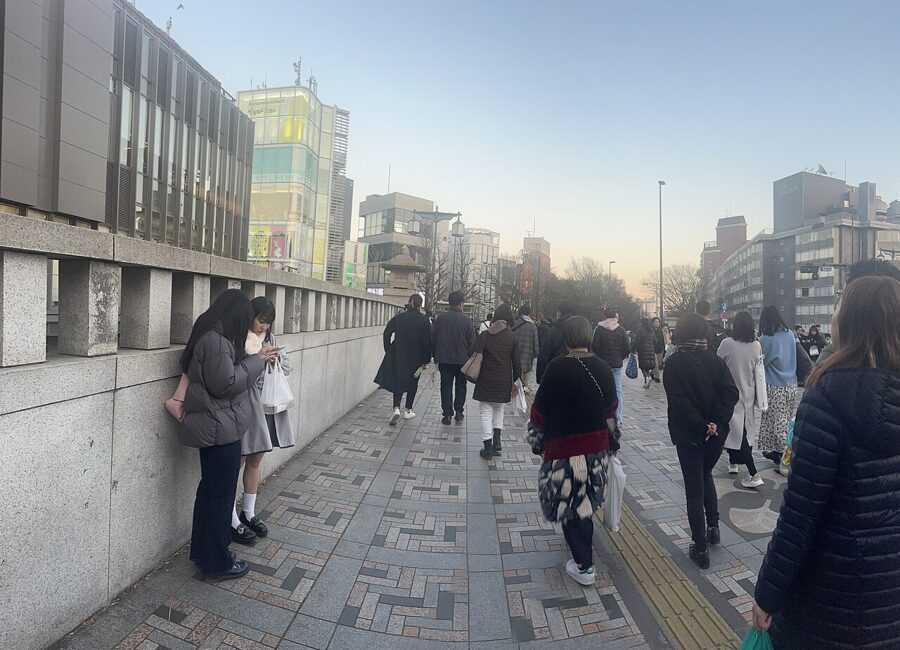
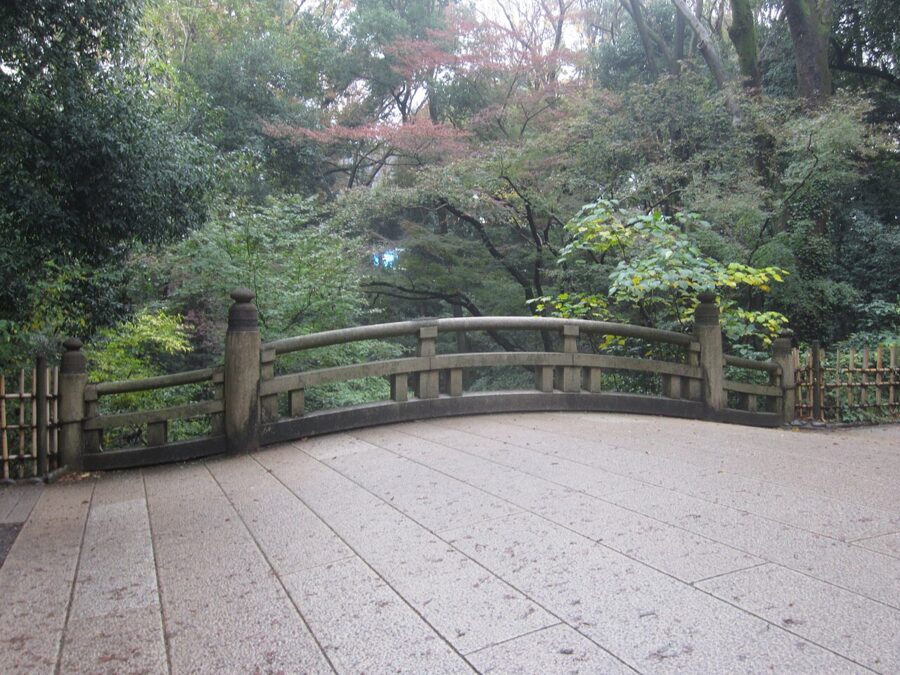
From JR Harajuku you cross Jingu Bridge, finished in September 1920, two months before the shrine opened, and pass under the first torii onto the South Approach. The gravel is deliberate: the shrine explains that the small stones, tamajari, are laid to keep the way pure, and that treading on them is meant to settle you before you reach the hall. The middle of the path is seichu, the way of the gods, and people walk to the sides of it.

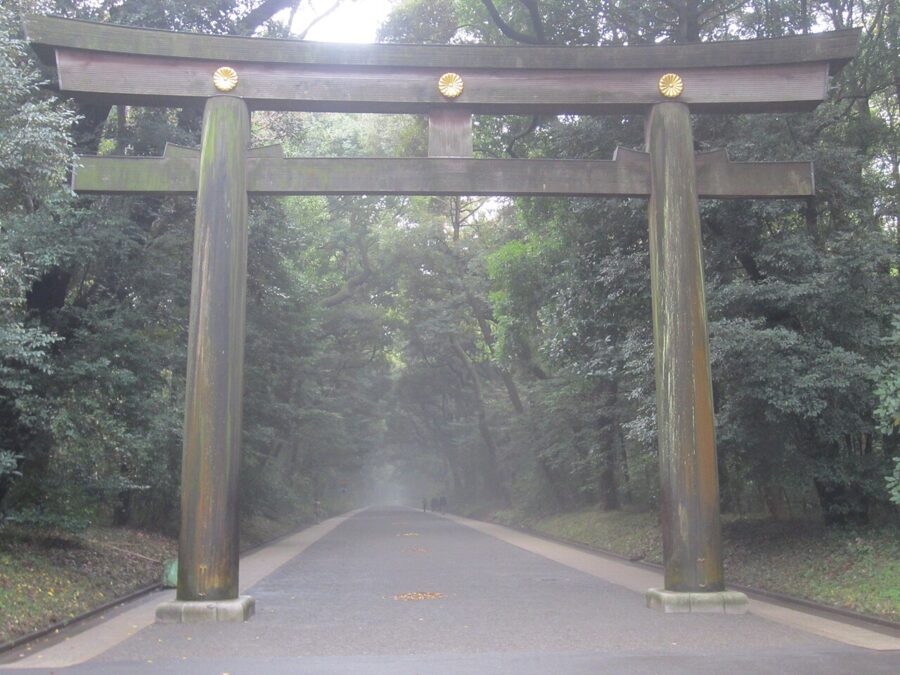
About halfway along, the South Approach meets the North Approach at the Otorii, the grand torii. It is 12 meters high and 17.1 meters wide, its pillars are 1.2 meters thick, and together they weigh 13 metric tons, which makes it the largest wooden torii of the myojin style in Japan. Most people bow once before walking through it.
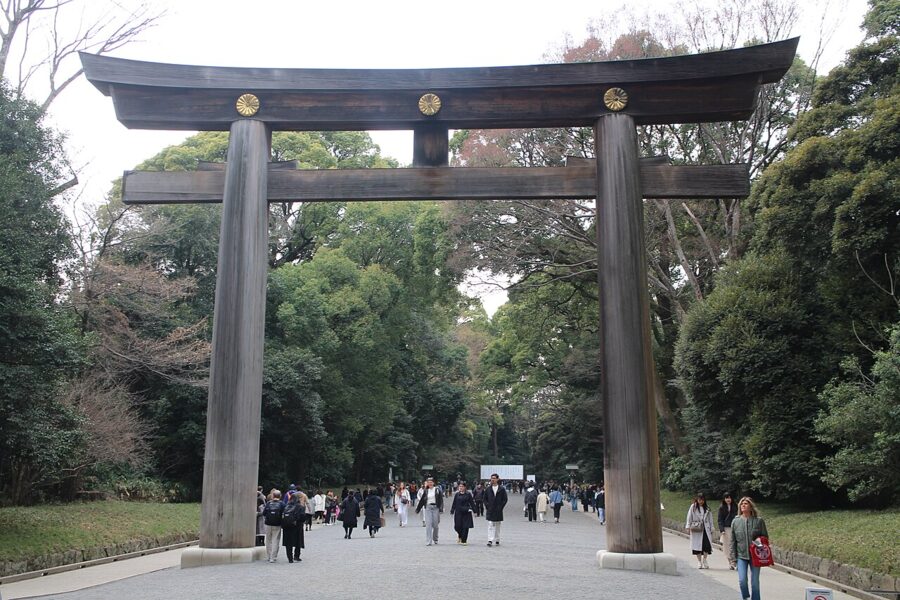
The story of this gate is the one the shrine tells best in its question-and-answer pages. The first Otorii, built in 1920 from a 1,200-year-old cypress cut on the Alishan range in Taiwan, was struck by lightning at about 15:15 on July 22, 1966. No cypress of that size was left in Japan, and a Tokyo timber merchant went to Taiwan several times until he found one; the logs reached Tokyo Bay in the summer of 1971.
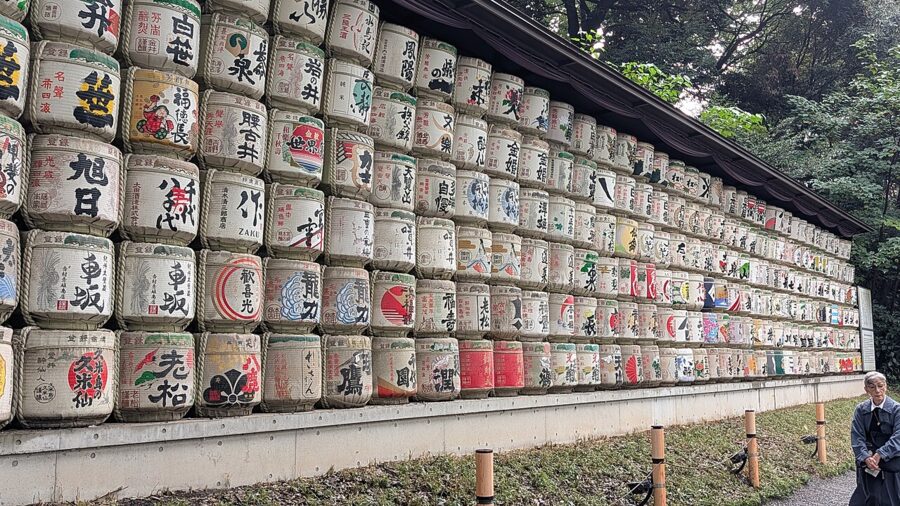
On the South Approach, just before the Otorii, the barrels face each other across the path. On one side is the wall of straw-wrapped sake barrels, offered every year by the members of the shrine’s national association of sake brewers. They are decorative and empty; the sake itself goes to the shrine in bottles.

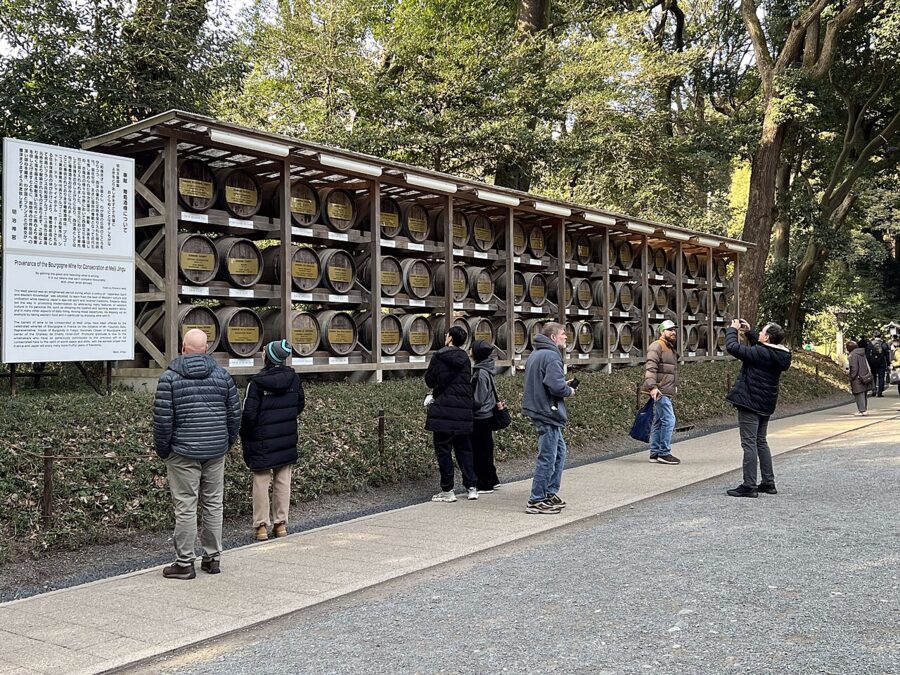
On the other side are the wine barrels. In 2006 a group of Burgundy wine houses each gave the shrine a barrel in memory of Emperor Meiji, who took to French food and French wine, and Burgundy has sent wine to the shrine every year since. The shrine presents the pairing as the Meiji period in one view: Western imports set beside Japanese rites.
The forest is the reason the walk feels long. Before the shrine, this was the Minami-Toshima imperial estate, mostly farmland and rough ground. About 100,000 trees were donated from all over Japan and beyond it, from Sakhalin in the north to Taiwan in the south, and youth associations from across the country sent volunteers to plant them and lay the approaches, 110,000 of them counted over the course of the works.
The foresters who planned it, Honda Seiroku, Hongo Takanori and Uehara Keiji, chose evergreen broadleaf trees such as chinquapin, oak and camphor, because Tokyo’s smoke was already killing the city’s old trees in the 1910s and they expected cedar to die. The prime minister, Okuma Shigenobu, wanted a cedar forest like the avenues at Ise and Nikko and called their plan a thicket; the foresters told him cedar needs damp valleys and would not thrive on the Kanto loam of Yoyogi, and they won. Their 1921 plan was written to let the woods sort themselves out over a hundred years.
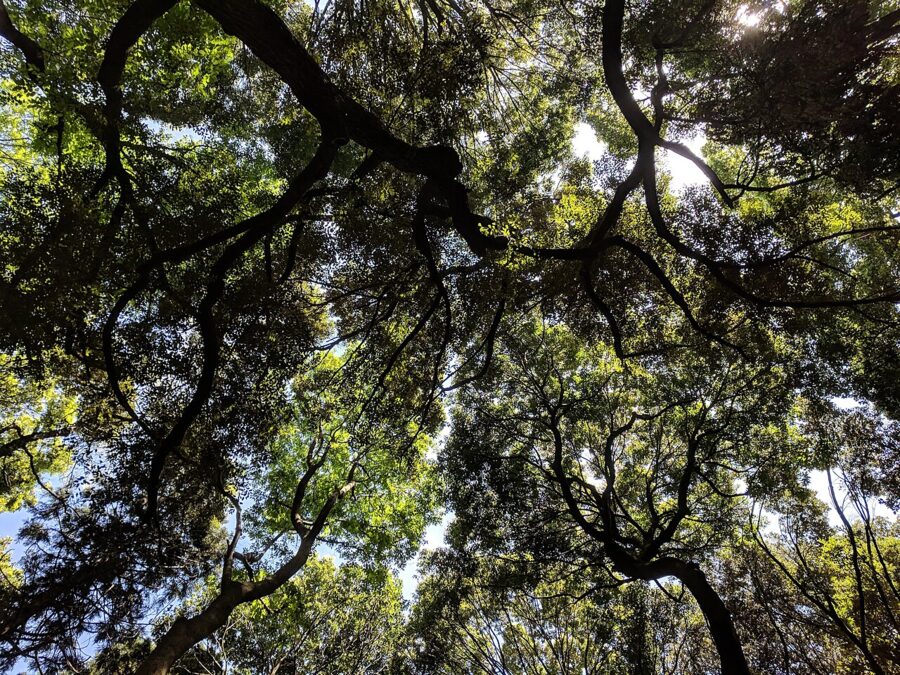

It worked. The shrine’s own account of the forest gives about 120,000 trees of 365 species at the founding, including those already on the land, and about 36,000 trees of 234 species in the second grounds survey, published in 2013: fewer trees, much bigger ones. The same survey recorded some 3,000 kinds of living things, endangered species among them. The forest covers about 70 hectares, and the name of the district comes from it too: Yoyogi, the shrine says, is named after a fir that grew here generation after generation.
The main shrine: burned in 1945, rebuilt in 1958
The shrine was dedicated on November 1, 1920, to Emperor Meiji, who died in July 1912, and Empress Shoken, who died in April 1914. It is not a tomb: the emperor is buried in Kyoto. More than 500,000 people came on the first day, and the crush was bad enough that the shrine stopped handing out amulets.
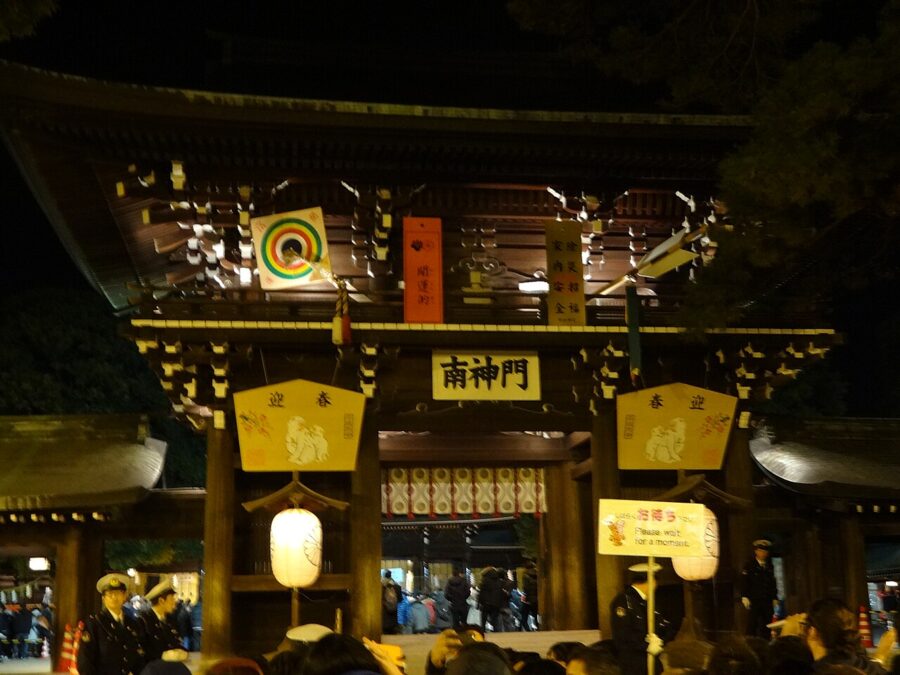
On the night of April 13–14, 1945, incendiary bombs burned the main hall and the worship hall. The broadleaf forest did not burn, and people sheltered in it. A few original buildings survived, among them Minami Shinmon, the two-story south gate you walk through to reach the courtyard.
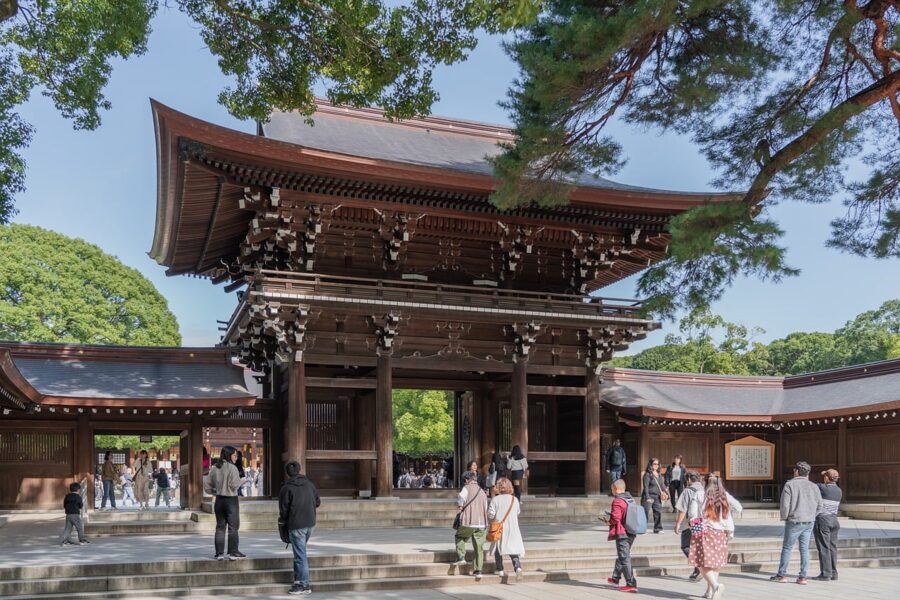
The rebuilding was paid for by public subscription, about ¥600 million gathered from companies, Tokyo districts and every prefecture, and the new hall was consecrated on October 31, 1958. The architect, Sunami Takashi, made one change that matters to anyone visiting: he removed the middle gate that used to stand between the worship hall and the main hall, where before the war the public was held back while officials went on. The roofs, cypress bark in 1920, came back in copper as a guard against fire.
The hall is built in the nagare-zukuri style, the most common shrine form in Japan, with a front roof that runs long to cover the steps. According to the shrine’s precinct guide, the timber is mostly Japanese cypress from Kiso in Nagano Prefecture. You pray at the gehaiden, the outer worship hall at the front; inside, the priests make food offerings to the two enshrined spirits every day at 08:00 and 14:00.
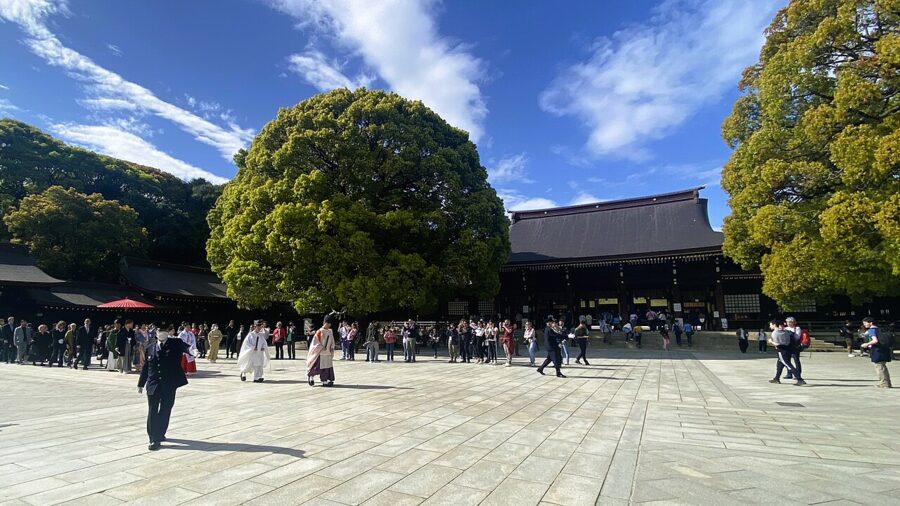

Look for what is missing. There are no stone guardian lion-dogs, the komainu most shrines put on the approach; the shrine says its pair is kept inside the inner sanctuary, and it guesses the designers thought outdoor ones did not suit the style of the buildings. There are also no fortune slips with bad luck in them.
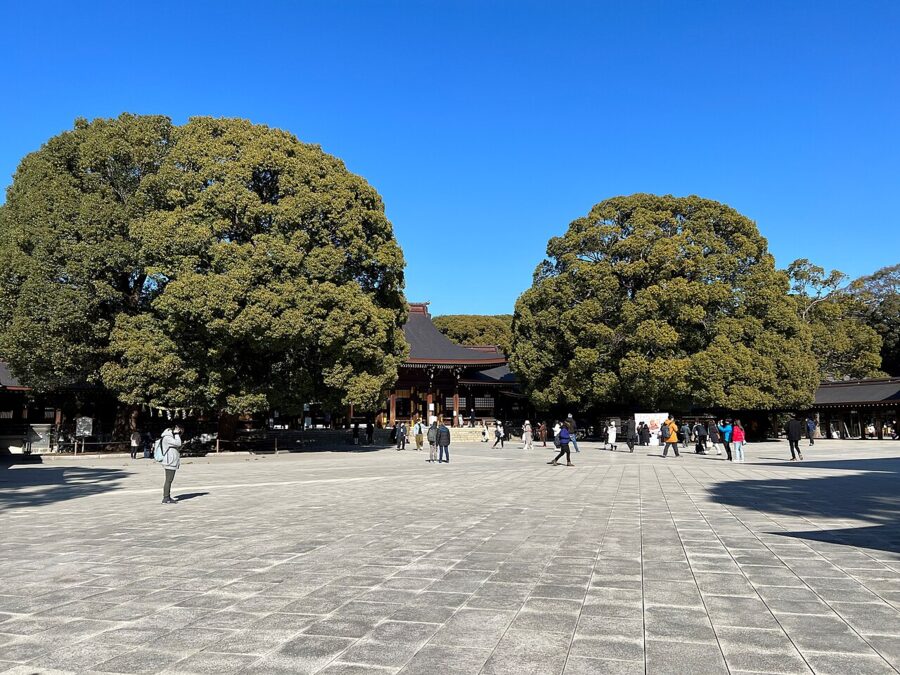
In the courtyard stand the Meoto Kusu, two camphor trees planted as saplings in 1920 and joined by a sacred rope. They are the shrine’s symbol of a sound marriage, and the place people come to pray for one. To the right of the hall, as you face it, is the Kaguraden of 1993, where priests conduct private prayers for children’s shrine visits, ward-off-misfortune rites and the like; entry is for people taking part.
The centenary of the founding fell on November 1, 2020. The building projects that marked it are the ones you see today: the museum on the South Approach, opened in October 2019, and the new first torii at the Harajuku Gate, put up in 2022.
The Inner Garden, the irises and Kiyomasa’s Well
The Inner Garden (明治神宮御苑) is the reason the shrine is in Yoyogi at all. It was the garden of a daimyo residence of the Kato family in the early Edo period and of the Ii family from 1640; the government bought the land in 1874, and around 1893 Emperor Meiji had it laid out as a walking garden for Empress Shoken, whose health was poor. The emperor came once, in January 1886; the empress came nine times by June 1909.
Entry is through the garden’s north gate, signposted from the South Approach, for the ¥500 fee. The garden’s posted hours are 09:00–16:30 in March–October and 09:00–16:00 in November–February, open every day. In June it opens at 08:00 and closes at 17:00, or 18:00 on weekends.
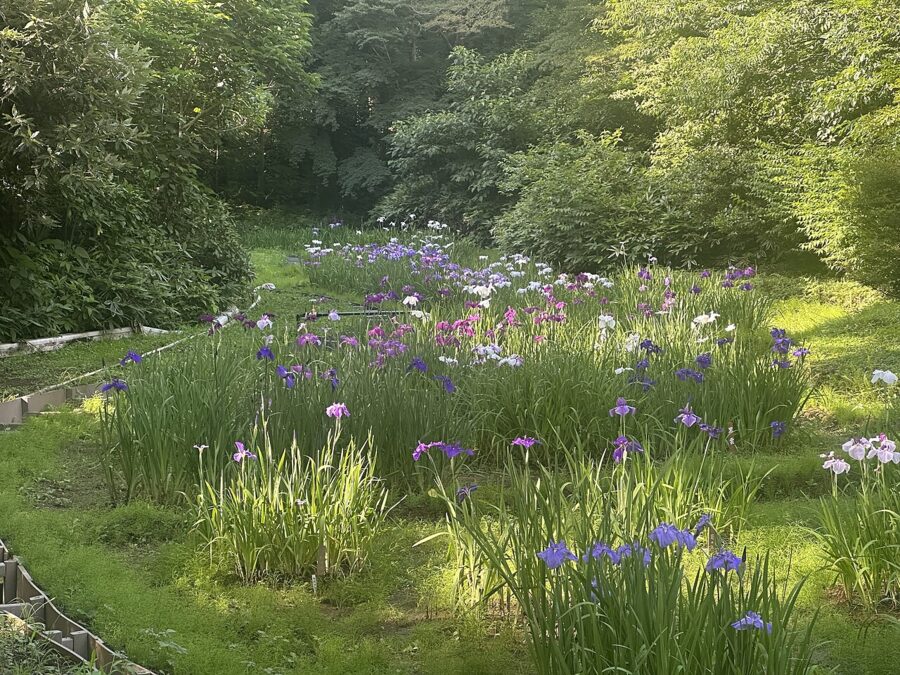

The irises are the garden’s event. Emperor Meiji had a rice paddy turned into an iris field for the empress in 1903; there were some 80 varieties when the shrine was built, and there are about 150 varieties and 1,500 plants of the Edo strain today, among them old cultivars such as Kujukami and Miyako no Tatsumi bred in the late Edo period. The field is laid out so you cannot see it all at once and have to walk the path round it.
The shrine keeps an iris diary each June with a count of open flowers. In 2026 the first blooms were reported on May 28, the count reached 4,897 on June 5 and was still 3,770 on June 12, and a limited-edition iris goshuin went on sale on May 30. That is the pattern to plan on: the last days of May to mid-June, early in the morning, on a weekday.
At the far end of the garden path is Kiyomasa’s Well (清正井), a spring credited to the general Kato Kiyomasa. It runs at an average of about 60 liters a minute and stays near 15°C all year, and its water feeds the iris field and the South Pond before flowing under the shrine bridge on the South Approach to the Shibuya River.
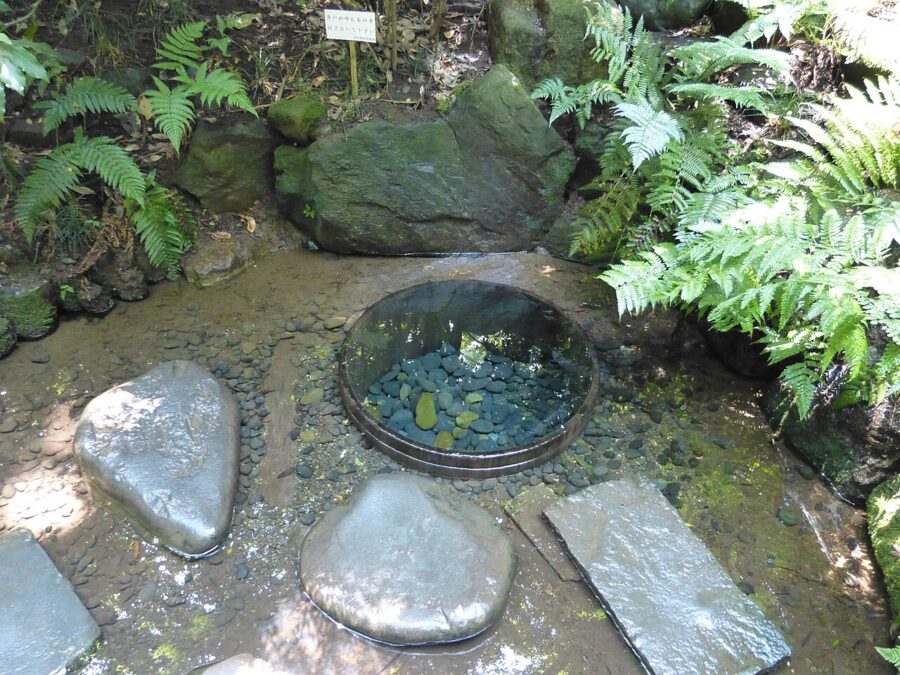

Whether Kiyomasa dug it, the shrine itself will not swear to. Its account is that his son Tadahiro certainly lived on the estate and Kiyomasa may not have, that the well is a rare horizontal one, and that a survey in 1938 traced its source to shallow groundwater west of the main hall. The legend has been attached to this land for centuries, and the shrine is content to pass it on.

Above the South Pond stands Kakuuntei, the rest house Emperor Meiji built for the empress in 1900, burned in the war and rebuilt in 1958; it is now a tea room. On the pond’s edge is the fishing platform where the empress liked to fish, putting back everything she caught. Water lilies flower on the pond in summer, migrating birds arrive from late autumn, and the maples around it turn in late November and early December.
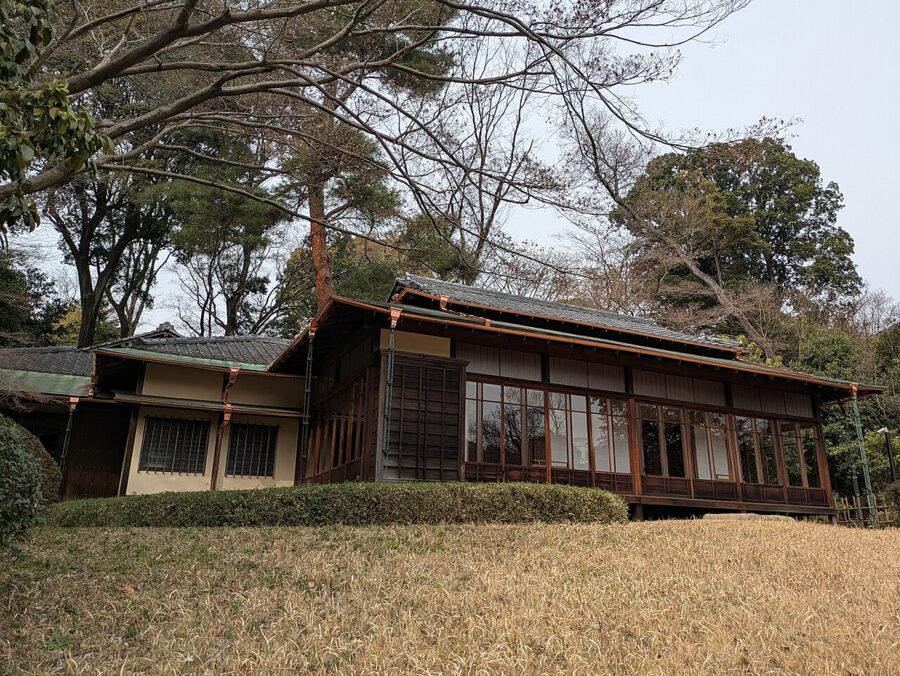

Is it worth ¥500 outside June? In late November, yes, for the pond and the colors. In February, only if you want somewhere quiet; the iris field is bare beds and the well is the main event.
The Meiji Jingu Museum and the Treasure House
The Meiji Jingu Museum opened on the South Approach, five minutes on foot from JR Harajuku, in October 2019 as part of the centenary projects. Kengo Kuma, who also designed the National Stadium, gave it a long, low sloping roof meant to sit under the trees, and about 3,200 square meters over two floors.
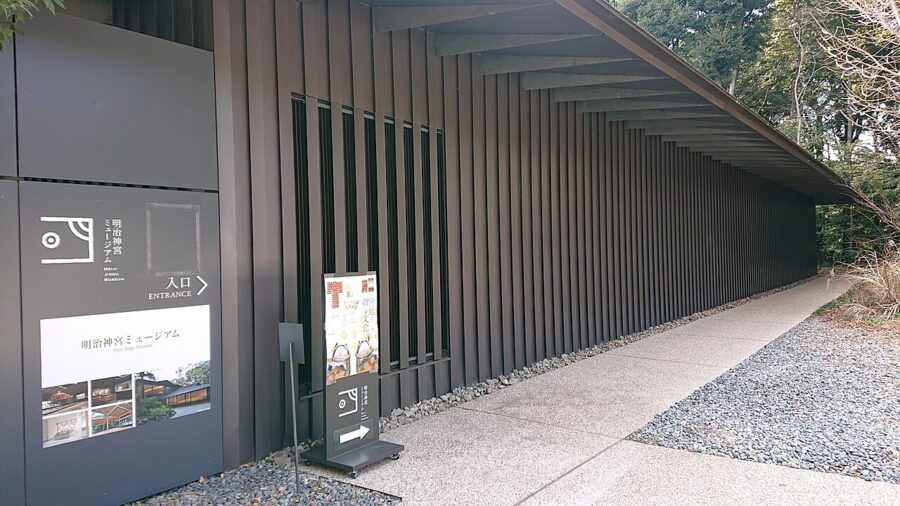

Inside, the forest room explains the shrine and its daily round, and the treasure room holds objects connected to the emperor and empress: Edoardo Chiossone’s official portraits of the couple and the restored six-horse state carriage among them. A third room changes its exhibitions regularly, and the museum closes between them.
The museum’s posted terms for late 2026: open 10:00–16:30 with last entry at 16:00; closed Thursdays, unless the Thursday is a public holiday, and during exhibition changeovers. Adults pay ¥1,000, high school students and younger and groups of 20 or more ¥900, and children below school age go free, as do holders of a disability certificate. Children of elementary school age and under must come with an adult.
Is it worth an hour? For the carriage and the portraits, yes, and the building is a pleasure on its own. If you have only an hour for the whole shrine, skip it and do the courtyard and the barrels properly.
The Treasure House is the older building, at the north end of the grounds past the lawn. It was finished at the end of October 1921, a year after the shrine, in reinforced concrete shaped like the log storehouse of the Shosoin in Nara, and it was designated an Important Cultural Property in June 2011. It closed for repairs in 2017 and reopened in 2021, and since the museum took over its collection it opens only for limited periods announced on the shrine’s Treasure House page.
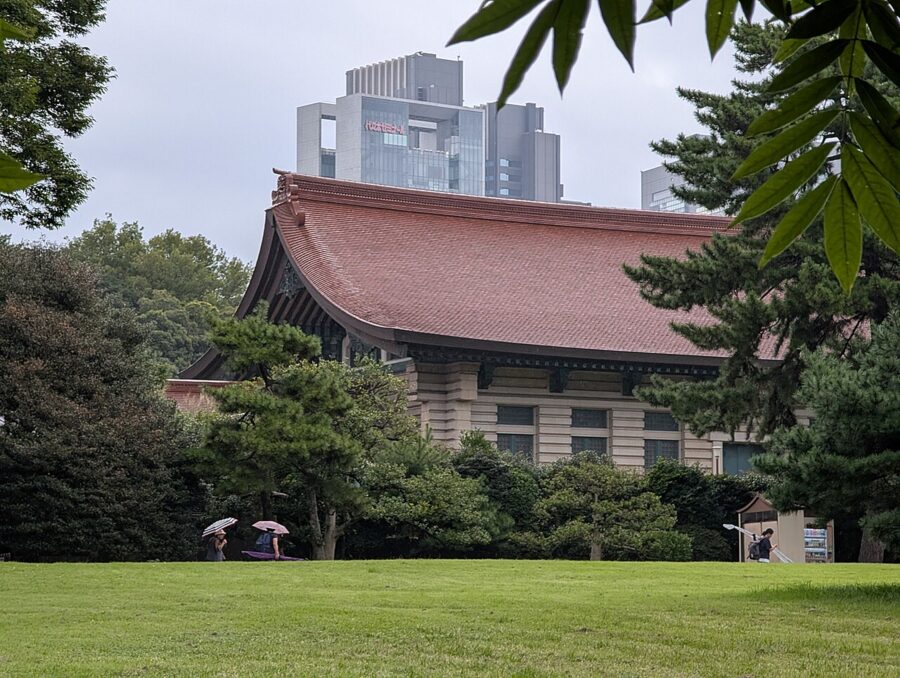
By the North Pond in front of it is the Kameishi, a rock shaped like a turtle that people touch for luck, and each March the pond is used for the nagashi-bina rite, when paper dolls carrying a year’s impurities are set adrift for the doll festival.
Etiquette: bows, water, coins and cameras
Nobody checks your religion at the gate. The shrine’s etiquette page sets out a short routine, and doing it reasonably well is a courtesy, not a test.
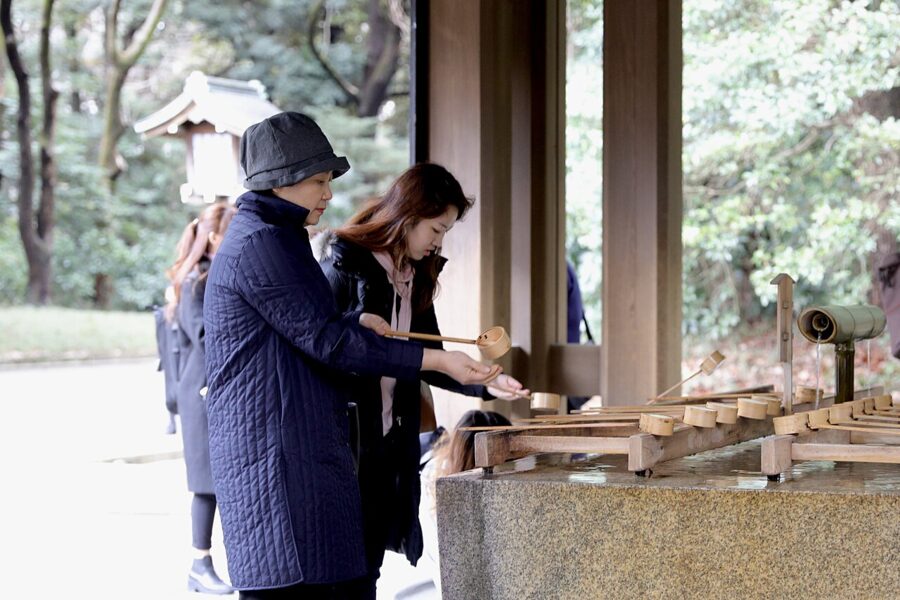
At each torii, going in and coming out, people stop and bow once. Then wash at a temizuya, a water basin; there are three around the courtyard, on its south, east and west sides. Take the ladle in your right hand and rinse your left hand, then your right, pour water into your left hand and rinse your mouth from it, rinse your left hand again, and tip the ladle up so the last water runs down the handle. Do not put the ladle to your lips and do not throw coins in the water.

At the hall: put a coin in the offering box if you want to, bow twice, clap twice, keep your hands together for a wish if you have one, and bow once more. At a Buddhist temple such as Senso-ji you would put your hands together without clapping; here the clap is the point.
Photography is allowed almost everywhere. The exceptions, in the shrine’s words, are the front of the main hall where people are praying and the amulet counters. Drones are banned, filming or promotional photography needs permission, and the shrine asks people not to bring a hired professional photographer for commemorative portraits. Eating, drinking and smoking are for the designated areas only, and running and sports are not allowed on the grounds.
Omikuji, ema and goshuin
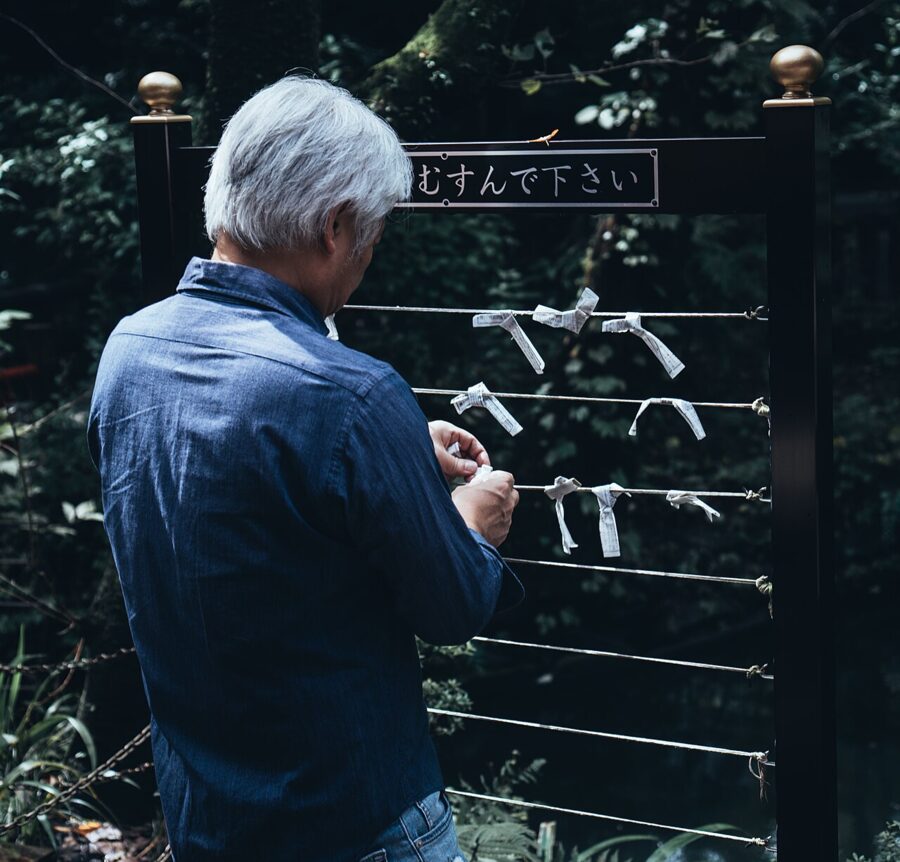
The fortune slips here are not fortunes. Meiji Jingu’s omikuji, called Omikokoro (大御心), carry no good or bad luck; each is one of 30 waka poems chosen from the 93,032 written by Emperor Meiji and the 27,825 written by Empress Shoken, with a short explanation. The shrine’s page on its talismans dates them to the New Year of 1947, when they were mimeographed on rough paper and cost ¥1; an English version with 20 of the poems has been offered since 1968.

An ema, the wooden plaque you write a wish on, costs ¥500 at the amulet counter. Write it in any language, hang it on the rack around the sacred tree in the courtyard, and the priests offer it at the morning rite; eventually the plaques are burned. Over the New Year the plaques carry the year’s zodiac animal instead of the shrine crest.
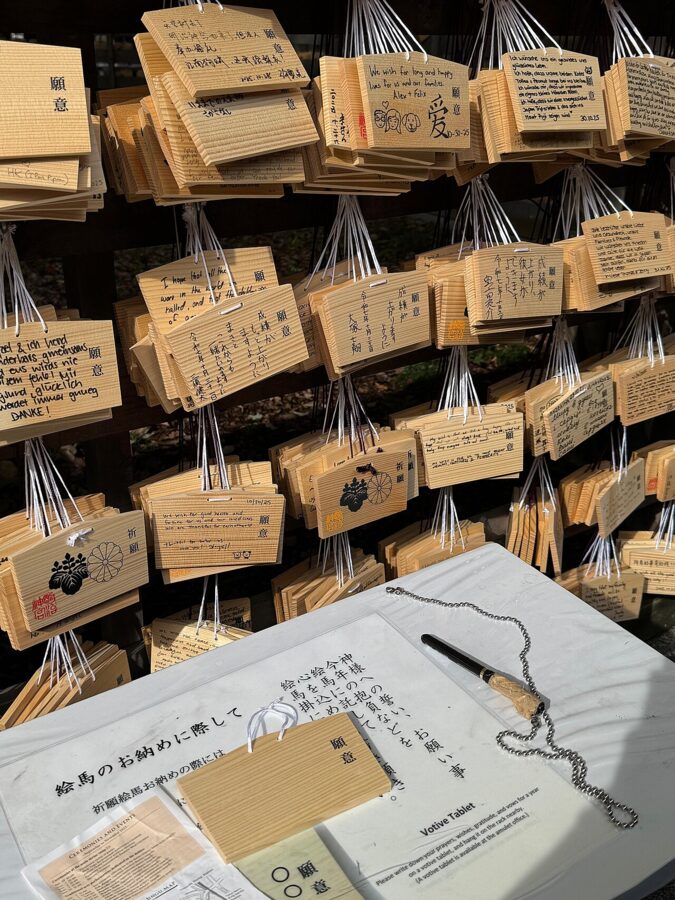

The goshuin, the brush-and-stamp record of a shrine visit, is written at the Nagadono, the counter in front of the Kaguraden, from 09:00 until the gates close; the shrine warns that the counter sometimes moves for the day. Special editions appear for the iris season and for the autumn festival from November 1. Get it after you have prayed, not before.
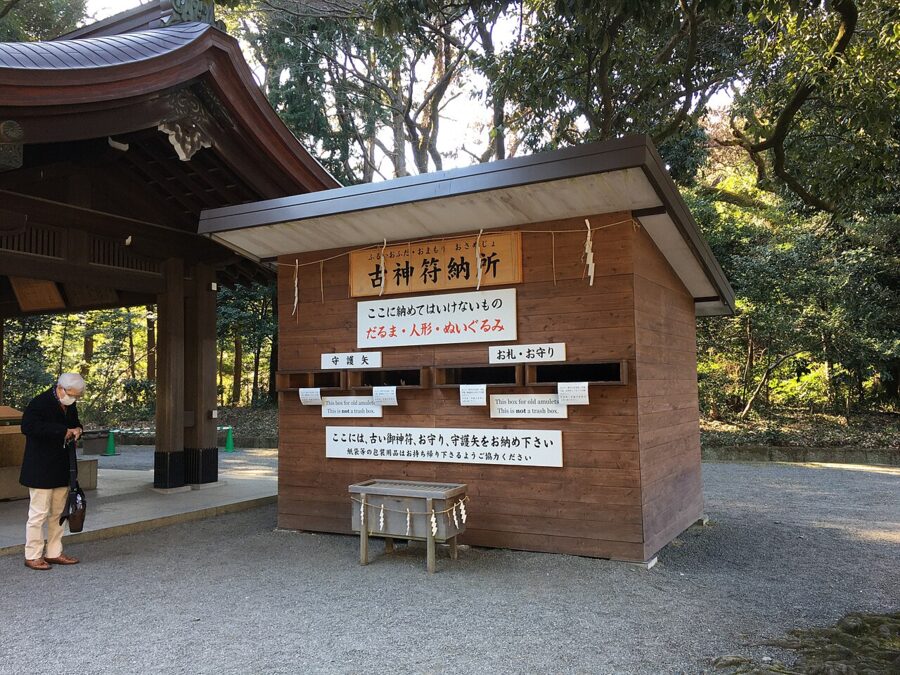
Of the amulets, the shrine’s own picks are the brocade health charm that it calls its signature, and Kodama, a small wooden bell made from the shrine’s sacred trees. Old Meiji Jingu talismans and charms can be returned at the shed to the right of the south water basin; it takes only the shrine’s own, not charms from other shrines or New Year decorations.
The shrine’s year: New Year, weddings and the autumn festival
New Year
Meiji Jingu draws more people for hatsumode, the first shrine visit of the year, than any other shrine or temple in Japan in most years; the national tourism organization puts the number at nearly three million in the first days of January. The pattern repeats: the gates stay open through the night of December 31, close at 18:30 on January 1, at 18:00 on the 2nd and 3rd and at 17:30 on the 4th, and go back to the normal 16:20 after that.
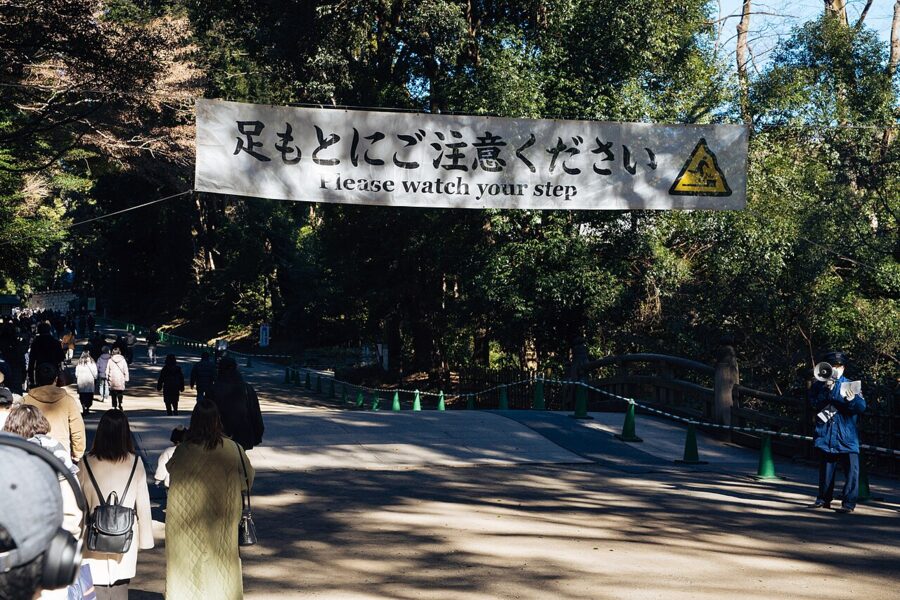

By the shrine’s own count, the worst hours are 22:00 on December 31 to 03:00 on January 1, and anything after 10:00 on the first three days. No cars enter for the first three days; the amulet counters move out to the parking lot by the Meiji Jingu Kaikan hall and the west lawn; food stalls open in a space set aside for them from December 31; and the Inner Garden is entered by its east gate rather than the north. The shrine posts each year’s times on its New Year page in December.
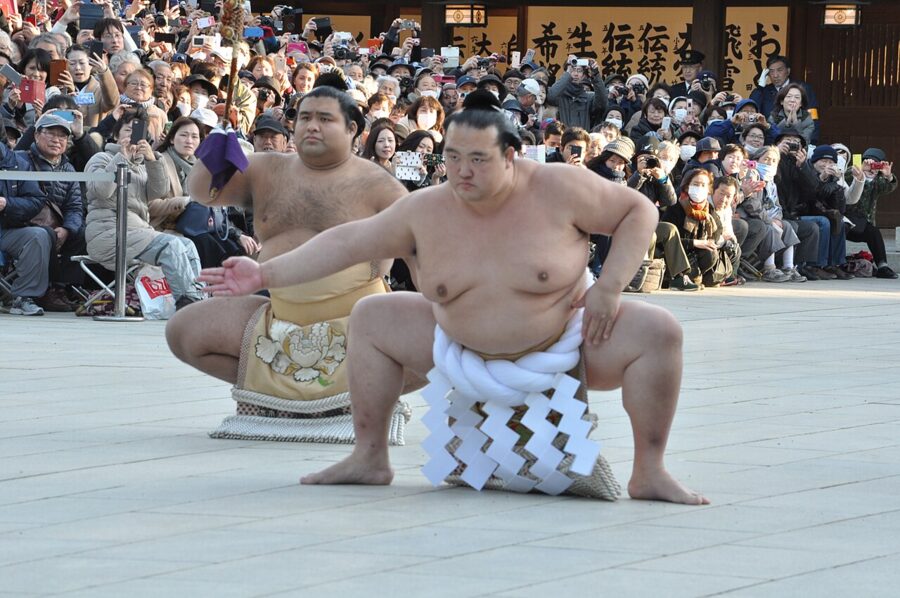
My verdict: if you want the New Year atmosphere without the crush, go at opening on January 2 or 3, or any morning from January 4 to the first weekend, when the decorations are still up. In early January, usually in the days before the January sumo tournament, the yokozuna performs a ring-entering ceremony in front of the hall, and it pulls its own crowd.

Weddings
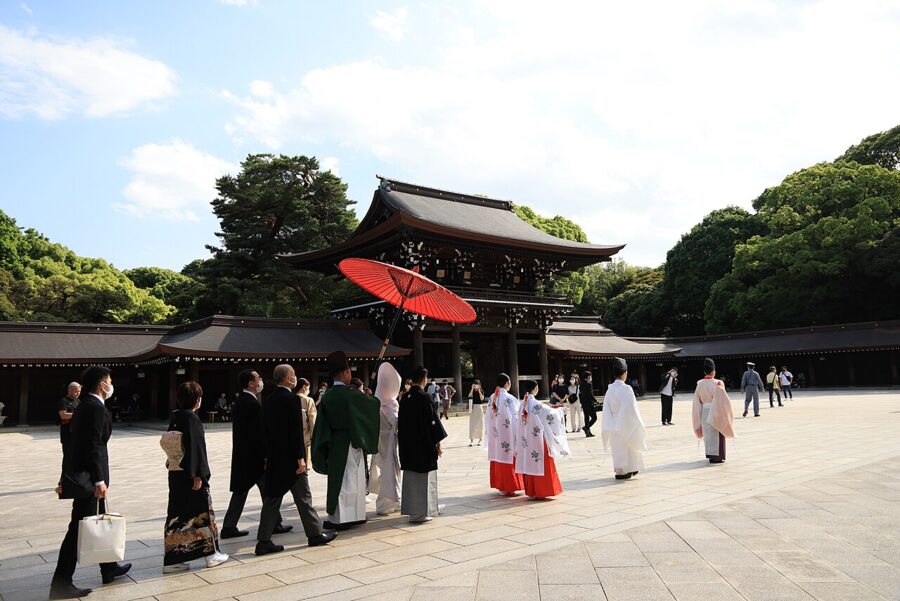
Weddings are what most people stumble into. A Shinto ceremony here begins with the sanshin, the procession led by priests and shrine maidens across the courtyard to the Hosaiden hall, the bride in white under a red parasol. The weddings are run by Meiji Kinenkan, the shrine’s own wedding business, and its page on shrine ceremonies describes the vows, the shared cup and a shrine maiden’s dance inside.
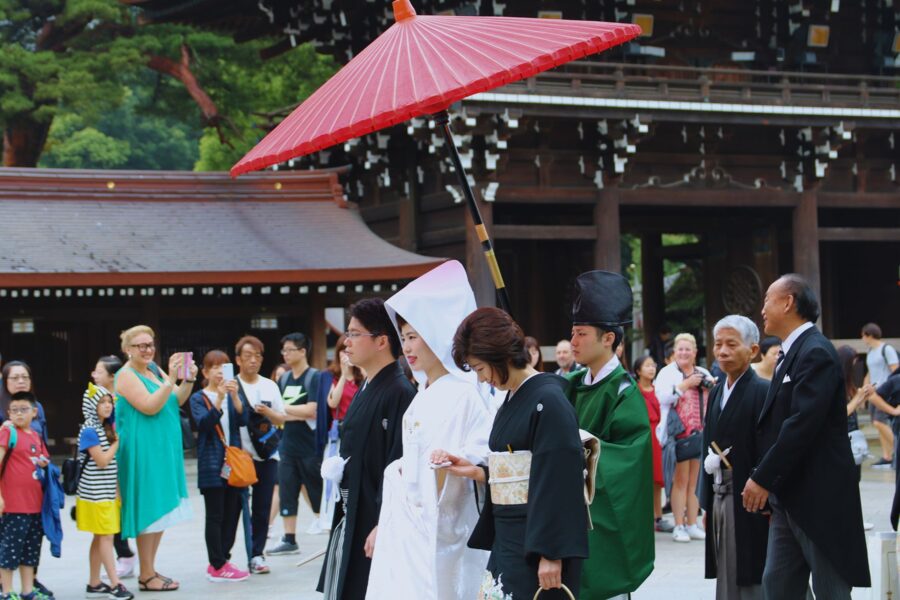
The Tokyo Convention & Visitors Bureau’s guide to the shrine points to Sunday mornings as the time to see one. The ceremonies are booked far ahead: Forest Terrace Meiji Jingu, the shrine’s wedding and dining complex, opened bookings on November 1, 2026 for weddings in the year starting April 2028.

Festivals through the year
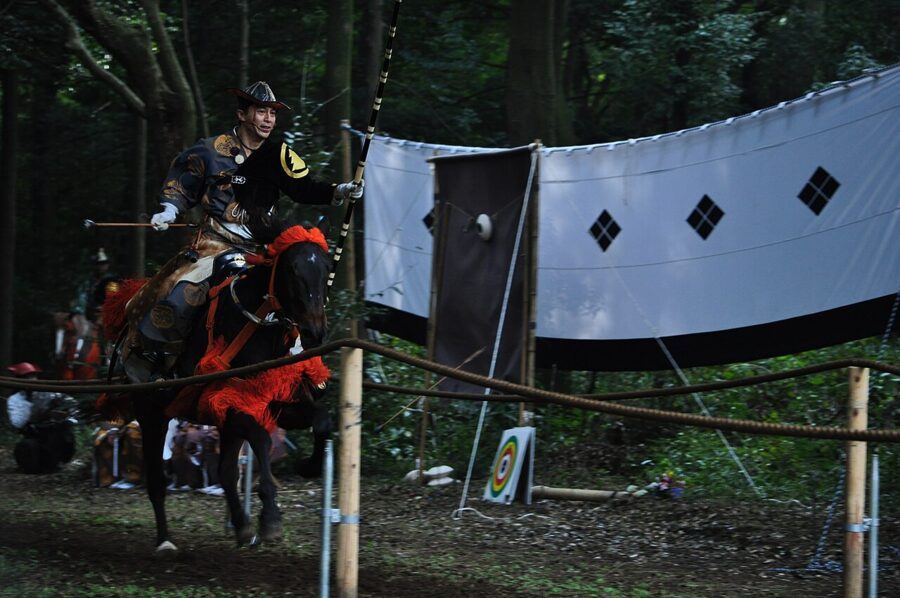
The autumn festival runs from November 1 to 3 every year. November 1 marks the day of the founding, and November 3, Culture Day, is Emperor Meiji’s birthday, when an envoy comes from the imperial palace for the shrine’s main annual rite. Around it the shrine stages court music and dance, noh and kyogen, archery and old martial arts, and on the afternoon of November 3 yabusame, mounted archery, on the lawn along the West Approach; the autumn festival page carries each year’s program.

Around the same weeks, from late October to November 23, chrysanthemum growers show their flowers along the main approach. November is also the month of shichi-go-san, when families bring girls of three and seven and boys of five for a blessing in the Kaguraden, so November weekends bring small children in kimono to the courtyard.
The spring festival centers on May 3 and spreads over the days before it, with more performances on the stage in front of the hall. The rest of the shrine’s year is quieter but fixed: National Foundation Day on February 11, the anniversary of the empress’s death on April 11, the purification rites on June 30 and December 31, the anniversary of the emperor’s death on July 30, and the harvest thanksgiving on November 23. Monthly rites fall on the 1st and the 15th.
The Outer Garden: the ginkgo avenue, the Picture Gallery and the rebuild
The shrine has a second half that most people never connect to it. The Meiji Jingu Outer Garden (明治神宮外苑) lies about two kilometers east, past Sendagaya, on the old Aoyama Parade Ground, where the emperor’s funeral rites were held on September 13, 1912. Where the Inner Garden is a Japanese shrine in a forest, the Outer Garden is a Western-style park of lawns, sports grounds and a domed memorial hall, built with public donations and dedicated to the shrine on October 22, 1926; its centenary fell in October 2026.
Its famous part is the ginkgo avenue. According to the Outer Garden’s own page on the trees, 146 ginkgos stand in four rows, 9 meters apart, along the 300 meters from Aoyama-dori to the circle in front of the Picture Gallery. Their seeds were gathered in 1908 from a ginkgo in Shinjuku Gyoen and sown in a nursery on the land that is now the shrine forest; the avenue was finished in 1923.
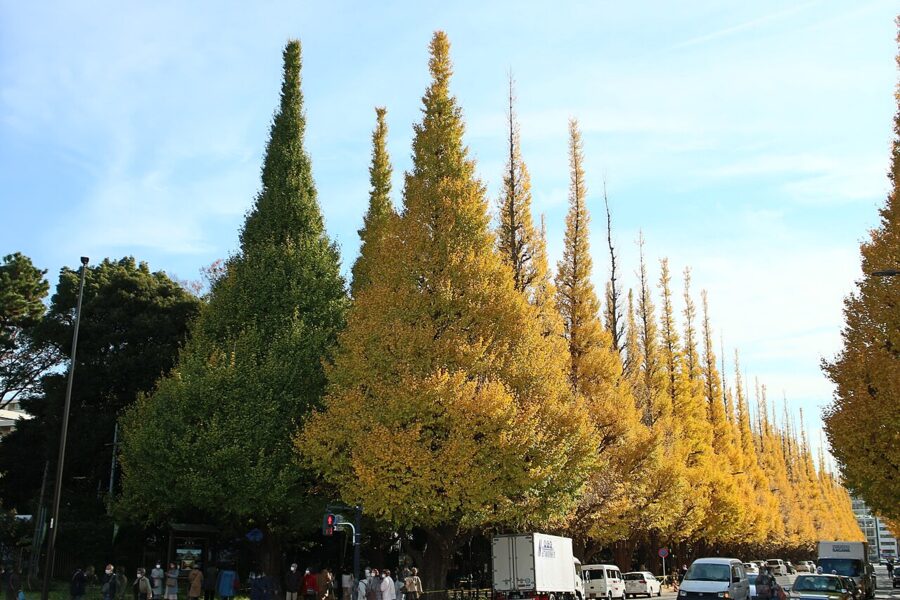

The garden designer Orishimo Yoshinobu, chief engineer on the Outer Garden works, designed the avenue as a perspective drawing in trees, and the trick still works: stand at the Aoyama-dori end and the gallery looks farther away than it is. The leaves start to turn in mid-November and are at their brightest from late November into early December most years.
Go on a weekday before 09:00. A Saturday in late November at midday is a slow shuffle shoulder to shoulder, and in recent years, 2023 included, a festival with food stalls has run alongside the avenue in the peak weeks. The nearest stations are Gaienmae on the Ginza Line and Aoyama-itchome on the Ginza, Hanzomon and Oedo lines; from the shrine, walk down Omotesando to Omotesando Station and take the Ginza Line one stop.
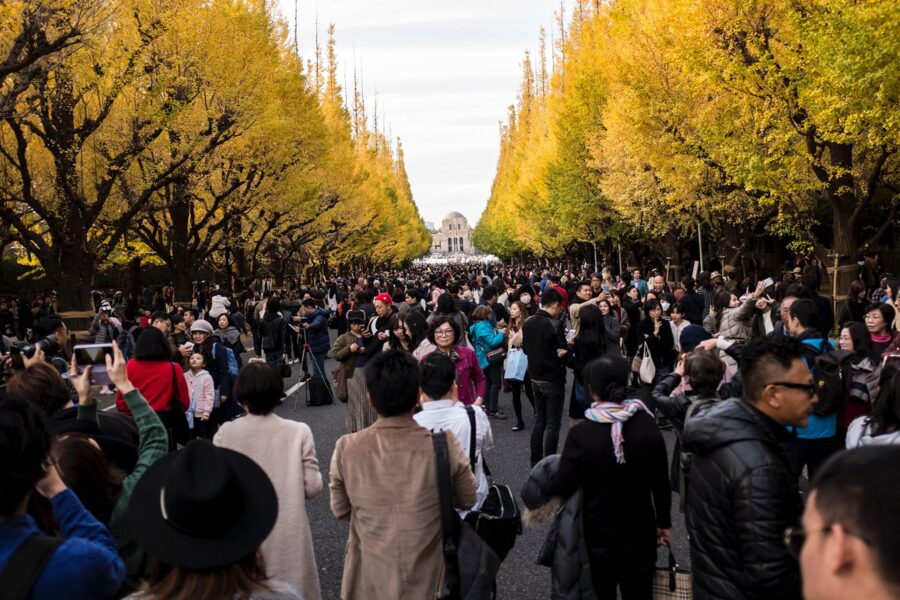
At the end of the avenue is the Seitoku Memorial Picture Gallery (聖徳記念絵画館), begun in March 1919 and finished in October 1926. It holds 80 large murals of the emperor’s life in order, 40 in the Japanese style and 40 in the Western style; only five were in place when it opened, and the set was completed in April 1936. The building, 112 meters across and 32.1 meters to the top of the dome, is itself an Important Cultural Property.
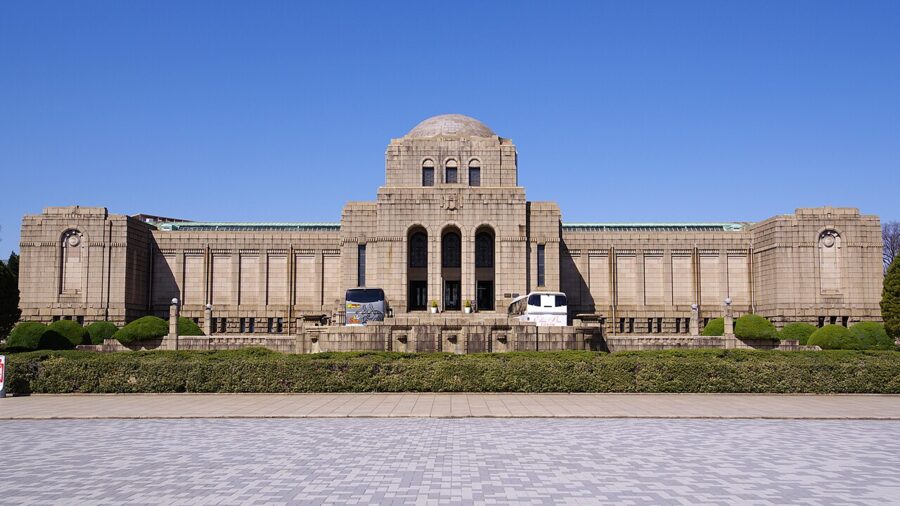

The gallery is closed. It shut on April 1, 2025 for seismic reinforcement and conservation, and on October 21, 2026 the Outer Garden moved the planned reopening from the end of May to the end of August 2027. Until then, the shrine has put all 80 murals and their painters online in a web gallery it opened on October 1, 2026.
The rest of the Outer Garden is being rebuilt. The redevelopment of the 28.4-hectare district is run by four parties, Mitsui Fudosan, Meiji Jingu, the Japan Sport Council and Itochu, and it began in March 2023 with the demolition of the Jingu No. 2 Stadium. The plan swaps the sites of Jingu Stadium and Chichibunomiya Rugby Stadium, rebuilding them in turn, adds two high-rises, and is due to be complete in 2038.
The developers’ project page says all four rows of the ginkgo avenue will be kept, and it reports soil and watering work on the trees each year since 2023. The shrine’s case for the scheme is money: the sports grounds’ income has paid for the shrine and the forest for a century, and the old stadiums need replacing. The felling of other trees in the district has been contested by petition since 2022 and in the courts.
After the shrine
The shrine’s own food is at the Harajuku end. Café Mori no Terrace, in front of the torii at the Harajuku Gate, opens from 09:00, and its posted hours run until the gates close, with last orders half an hour before. Forest Terrace Meiji Jingu, on the right of the South Approach next to the museum, has a noodle and rice-bowl counter from 10:00, a restaurant from 11:00, and the gift shop.
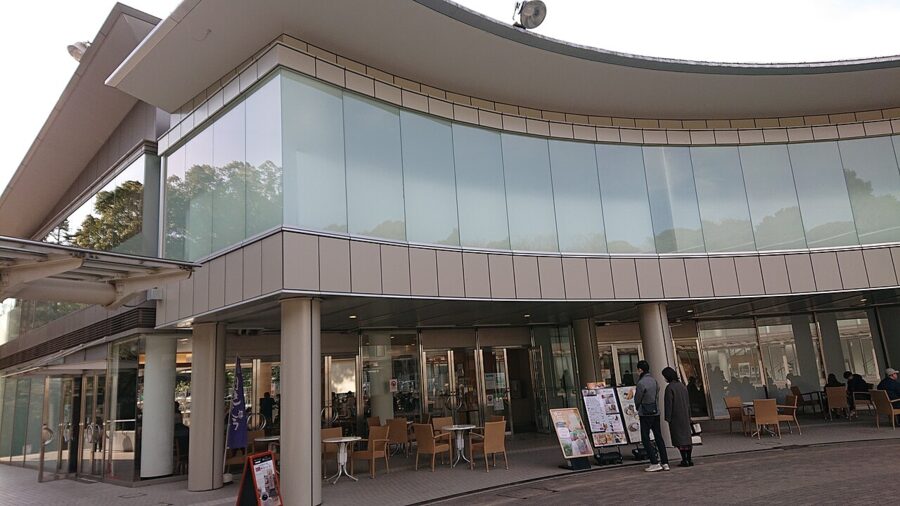

Outside the gates, the city takes over within a block. Yoyogi Park, Takeshita Street, Omotesando and Cat Street are all in the guide to Harajuku, and the shrine has a short section in the list of things to do in Tokyo alongside the rest of the west side.
In December the Harajuku Gate opens at 06:40 and closes at 16:00, and the priests do not wait; be under the first torii by 08:00, at the counters at 09:00, and out through the Yoyogi Gate or back to Harajuku long before the light goes.